
What is Claude for Small Business, and what changed on September 15, 2026?
Claude for Small Business is a plugin for Claude Cowork, included with every paid Claude plan, that connects Claude to the tools a company already runs on. On September 15, 2026, Anthropic took it from the 15 workflows of the May release up to 43, added 27 new integrations, and reported more than 900,000 installations to date. The library covers the work.
It does not cover who decides what correct means inside your company, and that becomes the binding constraint the moment more than one person has to agree.
Questions as you read? Ask, or take the first-agent screen with you.
Where should we send it?
Sent ✓ Download it now →
What Anthropic shipped on September 15
In May, Claude for Small Business was a set of connectors and 15 ready-to-run workflows. Anthropic’s launch post described 15 skills built on the tasks owners said slowed them down most.
Today it is 43 workflows and 27 new integrations. Anthropic’s announcement names Shopify, Xero, Gusto, Square, Stripe, Salesforce, Zoom, Atlassian, TikTok and Zapier among them. The company reports more than 900,000 installations since May.
The training side grew with it. Anthropic says the free workshop tour returns this fall in ten US cities, that more than 150 organizations it has certified under the Approved Claude SMB Trainer program are expected to run over 750 community workshops, and that 14 integration partners will each host a free webinar on their own connector between late September and November.
The tense in that sentence does real work, in our coverage and in anyone else’s this week. The 750 workshops are planned, not delivered. The 150 trainers are organizations, not people.
The distribution around the product is larger than the product. Anthropic also announced a learning series built with Goldman Sachs 10,000 Small Businesses, which it describes as having helped more than 19,000 entrepreneurs in the United States, a founding role in IncuVersity, a program aimed at 20,000 early-career entrepreneurs, and a partnership with Echoing Green for early-stage social entrepreneurs. Alongside that, it has started naming SMB-focused consulting partners and system integrators inside the Claude Partner Network.
None of that is a product announcement. Anthropic is building distribution for a work layer it intends to make ordinary.
Every figure in this article is Anthropic reporting on Anthropic. Installation counts, workshop counts, trainer counts, survey percentages. None of it is independently audited. That does not make any of it wrong, and it does not need to be discounted. It needs to be labeled, which is why the word Anthropic appears next to each number here and will keep appearing.
Now the part that matters more than the count.
Four months ago, a workflow library, a connector set and a training program were something a small consulting engagement sold. Somebody scoped your repeatable work, wrote the automations, wired them to QuickBooks and HubSpot, and trained your team. Plenty of good firms deliver that service, and deliver it well.
As of this week, the first-party version of that service is included with a paid plan, it ships with the vendor’s own connectors, and it comes with a local workshop and a webinar on your accounting tool. The work layer just became a commodity.
We think that is good. We also think it changes the buying decision in a way almost nobody will describe honestly this week, because the people describing it mostly sell the thing that just got commoditized.
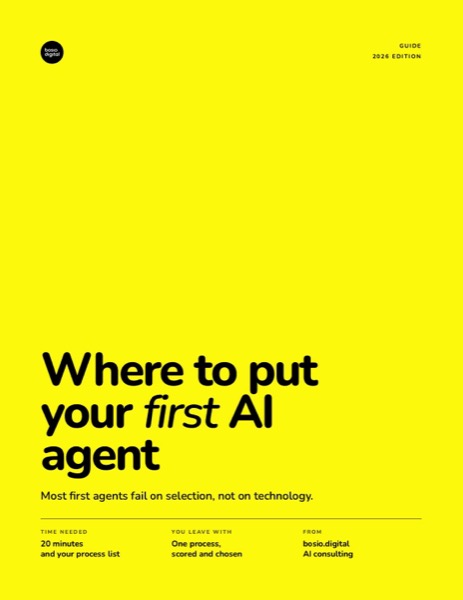
Where to put your first AI agent.
A four-trait screen and a veto, so the first one you build survives contact with the work.
On its way. Check your inbox, or download it now →
What the 43 Claude workflows actually cover
The library runs as a plugin inside Claude Cowork, the desktop application where Claude reaches your files and whichever tools you have connected. Install it, ask it to set you up, connect a tool or two, and pick a task.
The shape of the coverage tells you what Anthropic learned on the road. In May the workflows were back-office: close the books, reconcile the accounts, chase the invoice, prep the payroll. The September set extends into the front of the house. Answering inbound leads after hours. Building a priced, branded proposal from a voice memo. Drafting next week’s campaign and the replies to this week’s reviews. Putting cash, sales, pipeline and overdue invoices on one page before Monday starts.
Anthropic says about a third of the requests it collected on the spring tour were about growing the business, and that reporting was the single most common use case outside marketing work. The new workflows are that feedback, shipped.
The connector counts are per workflow, which is a detail most summaries will flatten. Anthropic lists 37 partner connectors as eligible for the weekly brief, 15 for the lead-response workflow, 17 for proposals, 16 for marketing and 14 for the month-end close. Every one of them also has an offline path: upload the statements, forward the inquiry, paste the reviews.
Two things in the design deserve more attention than the headline number.
The first is the default. Anthropic states that “Every workflow starts in approval mode,” that Claude stages the work and waits, and that you can let an individual workflow run on its own once you are comfortable, one workflow at a time, reversible. The default is genuinely good, and it matches the architectural position we have argued for on every client system we have built: the machine proposes, a person disposes, and autonomy is earned per task instead of granted per tool.
The second is permissions. Anthropic says existing software permissions carry over, so an employee who cannot see a folder or a ledger today cannot see it through Claude either. That closes a real hole, and the scope of it is exact: it inherits the permissions you already set. If your access model is loose today, the plugin will faithfully reproduce a loose access model with a much faster engine attached to it.
The commercial terms are worth stating plainly, because an included plugin still sits on a paid product. Anthropic says the library is available on every paid Claude plan, and points any company past a single user at the Team plan.
Its pricing page lists Team at 20 dollars per seat per month billed annually, 25 billed monthly, with a premium seat at 100 or 125, sold for groups of 2 to 150 people. On Anthropic’s annual seat price that puts a ten-person company at 2,400 dollars a year for the whole work layer.
What Anthropic has built here is a strong, well-defended work layer. Each of the 43 items is a packaged unit of work with a trigger, some tools and a stopping point, which is the argument we made about AI skills versus agents when Anthropic first formalized the pattern: the useful unit is not another autonomous agent, it is a piece of packaged competence that a general model can pick up when the situation calls for it.
Forty-three of them, at no extra charge, wired to your accounting system, is a serious piece of engineering and a serious piece of distribution.
The AI Briefing
Tuesdays. 500+ leaders. No hype, just what works.
Where the packaged library is the whole answer
Here is the part we would rather say before the part that sells anything.
For a large number of companies, the library is not the first step of a project. It is the project. Install it, connect QuickBooks and your CRM, run the Monday brief, hand the close to it, and do not hire anyone to help you think about it.
The shape of company that is true for has one property that has nothing to do with headcount: one person decides what correct looks like.
When the owner is the standard, the context the system needs already exists in one head and can be typed into one place. When the owner approves, the gate is a person, not a policy. When the owner decides the proposal reads wrong, the fix is one conversation with one instruction. Every layer that normally needs design collapses into a single human being who is present and who can just say so.
Most companies in the band Anthropic is aiming at look like that. Anthropic reports that 80 percent of its spring tour registrants ran companies of 5 to 50 employees, weighted toward the physical economy: trades, construction, logistics, manufacturing and the professional firms serving them. In our experience the packaged library carries a company with a single decision-maker comfortably up to somewhere around 25 people, and often past it.
If one person decides what correct means, a workflow library that comes with the plan is not the start of an engagement. It is the answer.
We are not being generous. We are being accurate about our own market, and accuracy is the only thing that makes the rest of this article worth reading.
A second group gets nearly the same answer: companies that have not made the platform decision yet. If you are still working out whether your work belongs in Claude, ChatGPT, Copilot or Gemini, a 43-workflow library that comes with the plan is a cheap way to find out what your own repeated work actually looks like. We wrote the full comparison for that decision, on choosing between ChatGPT, Claude, Copilot and Gemini, and none of it changes because the library got bigger.
Run the library for a quarter. Notice which workflows stuck. That beats any discovery workshop, including ours.
Anthropic’s own research post carries the clearest example of what the extraction band can do without a consultant anywhere near it.
A five-person trucking compliance shop in Tennessee lost most of its clients in a downturn and was then given thirty days’ notice by its core software vendor. According to Anthropic, the five of them rebuilt the system themselves using Claude, drove the error rate on their fuel tax filings from 7 percent down to zero, and can now run twice the peak volume they used to carry, at the same headcount.
Five people. One decision-maker. No engagement. That is the honest version of what the library plus a determined owner can produce, and it is a better outcome than most of what gets sold as a small AI project.
The mistake a firm like ours makes here is to argue that the trucking shop got lucky, or that it will hit a wall later. It might. It also might never need us, and treating every success story as a future client is how a consulting firm stops telling the truth about its own market.
Where the library stops: the moment two people have to agree
Now the limit, and it is not the one the market expects.
The limit is not company size, revenue, industry or technical sophistication. It is the number of people who have to agree on what correct means.
A workflow is a unit of work. Around every unit of work sit four other things, and a packaged library cannot ship any of them, because they are facts about your company rather than features of a product.
For the single-decision-maker company, all five layers live in one person and four of them stay invisible. Nothing breaks, because there is no disagreement to resolve.
Add a second person with real authority and every one of those layers becomes an argument.
Two managers define an acceptable proposal differently, so the workflow that drafts proposals produces output one of them silently rewrites. Finance and sales disagree about which number is the real pipeline number, so the Monday brief becomes a thing people correct in the meeting instead of a thing people trust. Nobody owns the instruction file behind a workflow, so the first bad output is fixed in a chat window, the fix helps one person for one afternoon, and the same error returns next month for somebody else.
A workflow library ships the work. Nobody can ship you the agreement.
We call the first mode extraction and the second arbitration. Extraction is pulling work out of people’s evenings, and a packaged library is genuinely excellent at it. Arbitration is deciding, on the record, whose definition of correct the system encodes, and it cannot be bought in a plugin because it is not a technical problem.
The transition usually begins somewhere between 25 and 100 people, though the real trigger is structural rather than numeric: the first time the answer to “is this right?” depends on who you ask. Some 30-person firms never cross it. Some 15-person firms crossed it the day the founder hired a second senior manager and stopped being in every conversation.
The work of crossing it is writing down what was previously carried in someone’s head: what we mean by correct, whose call it is, what we do when the machine is wrong, what we count as proof. We wrote the method out in the context engineering guide, and the five things a model cannot work out on its own, and none of the five is a feature request. Each one is a decision somebody in your company has to make and own.
Humans First stops being a slogan here and becomes a design constraint. A gate is not a checkbox. It is a named person who is accountable for what happens after they click yes, and who has enough context to say no. Approval mode gives you the pause. It cannot tell you who is standing in it.
Where to put your first AI agent.
A four-trait screen and a veto, so the first one you build survives contact with the work.
On its way. Check your inbox, or download it now →
Anthropic’s own research already says this
We would rather not be the consultants arguing that the bundled library is not enough. So the evidence here is Anthropic’s own field research, published five days before the expansion, and it is more honest about this than anything a vendor is required to publish.
The post, by Lina Ochman, who leads US small business at Anthropic, reports on more than 1,000 owners across ten cities on the spring tour. Three findings in it matter for this decision.
The first is demand for help after the tool. Of the 635 exit surveys collected, the item attendees named most often was the guided build session. Anthropic reports that nearly two thirds of those attendees went on to ask for hands-on help with implementation once the workshop ended. These are people who had just received free training on a library that came with their plan, from the company that built it, and the most common thing they wanted next was somebody in the room with them.
The second is what the owners furthest along had actually done. Anthropic describes a 40-person engineering firm where new hires review every Claude-generated summary as deliberate on-the-job training. A branding agency that automated its whole proposal-to-contract flow and kept a human send on every prospecting email. A 20-person back-office firm handling client payroll data that built redaction for personal information and a registry of every Claude workflow before letting staff use any of it.
Each of those three built something the product does not ship. A review rule. An approval boundary. An inventory and a data rule. None of it came in the box, and all of it is the gate and the proof layers of an AI chief of staff, constructed by hand, by the customers Anthropic names as furthest along.
The third finding is the barrier. Anthropic says its pre-launch survey of 503 small business decision-makers put data security at the top of the list, and that half the owners surveyed on the tour named it as their single biggest hesitation. It also notes that owners hear conflicting things from vendors, consultants and headlines, and want one plain-language source of truth about what happens to their data.
That confusion is not solved by a better feature. A written policy solves it: one that a specific person in your company owns, written in your words, that survives the next tool change.
A fourth finding maps most directly onto the loop layer. Anthropic reports that before launch, 81 percent of the small business owners in its survey described themselves as open to new AI tools, and that the pain point they named most was staff not knowing when or how to use them. On the tour, the apprehension owners kept describing was something important slipping through unnoticed, and what they were learning was how to validate an answer instead of accepting it.
The tactics Anthropic describes from owners are unglamorous and exactly right. One owner now asks Claude to flag when it is assuming something as opposed to knowing it. A painting contractor caught the model pricing a bid off a floor-area multiplier when it should have used the real wall measurements, and now asks it to show its work.
Both of those are loop behavior invented by a single user. Neither of them survives the person who invented it leaving, unless somebody writes it down and makes it the way this company works. A good habit and an operating standard part company exactly there, which is why the loop is a layer and not a tip.
One more number from that post. Anthropic reports that about one attendee in five already worked as a consultant or an educator to other small businesses. The tour was not only training owners. It was training the people who will train owners, which is exactly how you commoditize a service layer on purpose and at speed.
We think that is the right thing to do, and we are saying so as a firm whose work it partially replaces.
The platform now does the diagnosis. Someone still has to act on it.
A second release from the same week will get connected to this one by almost nobody, and it matters more to the mid-market reader than the workflow count.
On September 10, 2026, Anthropic’s release notes record smart reports entering beta. The feature reads how a team uses Claude and reports on the work getting done, what it costs, where sessions run into friction, and, in Anthropic’s words, “which repeated patterns are worth packaging as shared skills.”
That last clause describes a consultant’s job. Finding the repeated pattern that should become a standard piece of company competence has been a chunk of billable discovery work for as long as anyone has been selling AI projects. It is now telemetry, generated continuously, by the platform.
One limit is load-bearing and is stated plainly in the same release note: smart reports are in beta on Claude Enterprise plans. The plan Anthropic recommends to a small business with more than one person is Team, which does not have it. So for the reader of this article, the diagnosis layer is visible on the roadmap and not yet in their hands.
When it does arrive, it will hand a company a list, not a decision. The report will say that some pattern keeps repeating across several people. Somebody still has to decide whether that pattern is good practice worth standardizing or a bad habit worth eliminating, whose version of it becomes the standard, who maintains it, and what happens when it produces a wrong answer in front of a client.
The diagnosis is becoming telemetry. The decision about what becomes standard is still a person’s, and it is the same decision whether you have 43 workflows or four.
We described this pattern when Claude is becoming an operating system first became a reasonable thing to say out loud. The platform keeps absorbing layers upward. On September 17, 2026 it absorbed another, when the Claude Projects redesign put a coordinator over parallel threads with a shared memory between them. Every layer it absorbs is a layer you no longer build, and the remaining work concentrates into the decisions that are specific to your company and cannot be shipped by a vendor to anyone.
That concentration is good news. It also makes the remaining work harder to delegate.
What to do this month
Five steps, in order, whatever size you are.
Install the plugin and connect two tools. Not six. The Monday brief and the month-end close are the two workflows with the clearest before and after, and they will tell you quickly whether the connector coverage fits your stack.
Run everything in approval mode for a month and keep a list of what you corrected. That list is the most valuable artifact you will produce this quarter. Every correction is a place where the system did not know something about your company, and the list is the raw material for the context layer.
Name one person per workflow before you turn autonomy on for it. Not a committee, not a job title. A person, who gets to say what correct looks like for that workflow and is accountable for what goes out under it.
Write down the answer to five questions, in your own words, before you scale past the pilot: what we mean by correct, whose call it is, what we do when the output is wrong, what we never send without a human reading it, and what we count as proof that this worked. A page each. The page is not a document for us or for any other firm. It is the thing that makes your automation survive the next model, the next tool and the next hire.
Then decide whether you actually need help, using a test that does not depend on our opinion.
If you can get the five answers written by asking one person, you do not need outside help for this. Write them yourself, run the library, and spend your money on something else.
If the five answers require three people in a room who disagree, that is not a technology problem and it will not resolve itself in a workshop. Somebody has to run that argument to a decision, write the result down in a form a machine can act on, and get the people who lost the argument to live with it.
Doing that from the inside is hard for a reason that has nothing to do with skill: the people best placed to decide are also inside the political consequences of deciding. We do that work, and designing AI workflows around the way a company actually decides is what it means in practice.
Use this test on us and on anyone else you talk to. Ask what you own at the end. If the answer is a system you can run, change and explain without the firm that built it, the engagement is worth having. If the answer is a dependency, the library that comes with the plan is a better deal, and you should say so.
Your Correction Log, Turned Into a Context File
Run the workflows for two weeks and keep every correction you made. Then paste this prompt with that list. You get a first draft of the two layers a packaged library cannot ship for you: what your company knows, and who decides.
Context: You are helping me turn a list of corrections into a written context layer for my company. I run a business with [NUMBER] people in [INDUSTRY]. Below is a list of every time I corrected an AI-generated output over the last two weeks, in my own words, with no cleanup.
Step 1. Sort the corrections: Group them into three buckets. Bucket one, the model did not know a fact about my business. Bucket two, the model did not know my standard or my preference. Bucket three, the model did something I would never authorize. Show me the buckets with the corrections in them, and tell me which bucket is largest.
Step 2. Draft the context file: From buckets one and two, write a plain-language document called What This Company Knows. Use my words, not yours. Organize it by the decisions it affects, not by topic. Where a correction implies a rule I never stated, write the rule as a question back to me instead of guessing it.
Step 3. Draft the gate: From bucket three, list every action that must never happen without a named person approving it. For each one, propose who that person should be, what they need to see to decide, and what happens if they are unavailable. Mark any item where you are inferring authority rather than reading it from my corrections.
Output: Two documents I can edit, plus one list of the questions you could not answer from my corrections.
Stop there. The next two layers, how the system improves after a bad output and how you prove any of it worked, need a second person and an argument, and a prompt cannot hold that argument for you. If those two are where you are stuck, see where you stand first.
Sources
- Claude for Small Business launches new workflows, integrations, and training programs (Anthropic, 15 September 2026): the 43 workflows, 27 new integrations, 900,000 installations, the fall tour cities, the trainer and webinar counts, approval mode and the permission model
- What 1,000 small business owners taught us about AI (Lina Ochman, Anthropic, 10 September 2026): the spring tour findings, the 80 percent registrant band, the 635 exit surveys, the 503-person pre-launch survey, and the three customer governance examples
- Claude for Small Business (Anthropic, 13 May 2026): the original launch, 15 ready-to-run workflows and 15 skills, the first connector partners, and the spring tour stops
- Claude apps release notes (Anthropic): smart reports entering beta on 10 September 2026, and the Enterprise-plan limitation
- Claude pricing (Anthropic): Team plan seat pricing, the 2 to 150 size band, and what the plan includes
- Claude for Small Business solutions page (Anthropic): the current connector list and the offline paths for businesses without connections
- Anthropic Trust Center (Anthropic): the data handling and model-training defaults referenced in both posts
- Claude Partner Network (Anthropic): the consulting partners and system integrators named for small business work
Frequently Asked Questions
What is Claude for Small Business?
Claude for Small Business is a plugin for Claude Cowork, included with every paid Claude plan,, Anthropic’s desktop application, that connects Claude to the tools a business already uses and runs packaged workflows inside them. Anthropic launched it in May 2026 with 15 workflows and expanded it to 43 on September 15, 2026. The plugin is available on every paid Claude plan, and Anthropic’s recommendation for any company past a single user is the Team plan.
What changed in Claude for Small Business in September 2026?
Anthropic expanded the library from 15 workflows to 43 and added 27 new integrations, naming Shopify, Xero, Gusto, Square, Stripe, Salesforce, Zoom, Atlassian, TikTok and Zapier among them. It reported more than 900,000 installations since May. It also announced a fall workshop tour in ten US cities, more than 150 trainer organizations that will run over 750 community workshops, and 14 connector webinars hosted by integration partners. The new workflows extend the library from back-office work into lead response, proposals and marketing.
How much does Claude for Small Business cost?
The plugin itself costs nothing. It runs on a paid Claude plan, and Anthropic’s pricing page lists the Team plan at 20 dollars per seat per month billed annually, or 25 billed monthly, with a premium seat at 100 or 125 on the same terms. Team is sold for groups of 2 to 150 people and includes Claude Cowork, which is where the plugin runs. The real cost of the library is not the seat price. It is the time spent deciding what your company means by correct.
What workflows does Claude for Small Business include?
Anthropic groups the 43 workflows around running and growing a business. The examples it publishes include a weekly brief covering cash, sales, pipeline and overdue invoices, after-hours lead qualification and response, proposal building from a voice memo or call transcript, marketing campaign drafting with review replies, and a month-end close that reconciles accounts and produces a packet for an accountant. Connector coverage differs per workflow, and each one also has an offline path using uploaded files.
Are these AI agents for small business, or something else?
They are packaged workflows that a general model runs, which is a more useful unit than an autonomous agent for most small businesses. Each one has a trigger, a set of connected tools, an output and a stopping point, and by default it stages its work and waits for a person to approve. That design choice is why the library is safe to hand to a non-technical team, and it is also why the interesting question is not how autonomous it can get, but who is accountable for approving what.
Is Claude for Small Business enough on its own?
For a company where one person decides what correct means, usually yes. The library covers the work, the approval default covers the safety basics, and the free workshops and partner webinars cover the training. It stops being enough when two people with real authority disagree about what a good output looks like, because at that point somebody has to decide whose definition the system encodes, and no plugin can make that decision for you.
When does a company still need outside help?
When the answers to five questions need more than one person to agree: what correct means, whose call it is, what happens when the output is wrong, what never goes out unread, and what counts as proof. Writing those down is hard from the inside, because the people best placed to decide sit inside the consequences. A useful test for any firm, including ours: ask what you own at the end, and whether you could run the system without them.