

How should a mid-market company choose between ChatGPT, Claude, Copilot, and Gemini?
Split them into two groups, not four rivals. Copilot and Gemini are embedded assistants — the AI built into the productivity suite you already run (Microsoft or Google). ChatGPT and Claude are standalone platforms you adopt on their own and can build on. So the decision is really two questions: which embedded assistant comes with your suite, and do you also want a standalone platform — and if so, ChatGPT or Claude?
Match each platform to the job — a productivity assistant versus a system you build on — rather than crowning one winner.

Questions as you read? Ask, or take the first-agent screen with you.
Where should we send it?
Sent ✓ Download it now →
The question every mid-market leader is asking right now
A leader at a company we’ve been talking to said something last week that I’ve now heard, in some form, a dozen times: “We just implemented Microsoft Copilot, and now leadership is asking for Claude. So which is it?”
It’s the most common AI question in the mid-market right now, and it’s almost always framed as a fork in the road — Copilot or Claude, pick one, defend the budget. (And that’s usually before someone points out that half the team already lives in ChatGPT.) That framing feels responsible. It’s also, as of early 2026, mostly wrong. Not because the answer is “use everything and spend more,” but because the question treats four very different products as one race — and skips the distinction that actually determines whether you get value or just another line item.
Let me give you the distinction first, then the evidence: the real question isn’t which AI model you license. It’s what you’re building on versus what you’re using as a tool. Those are different layers of the stack, and conflating them is how companies end up paying for two platforms and getting the value of neither.
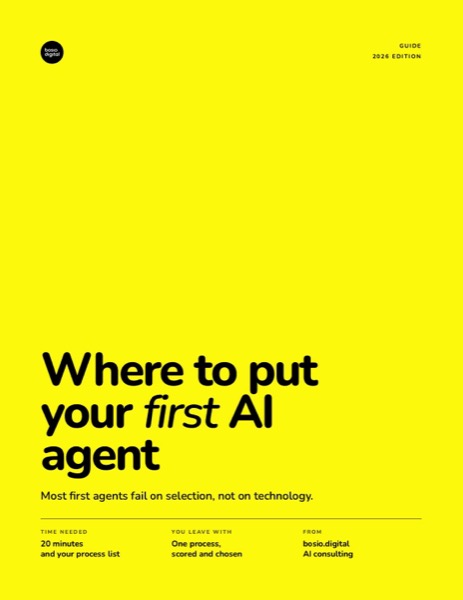
Where to put your first AI agent.
A four-trait screen and a veto, so the first one you build survives contact with the work.
On its way. Check your inbox, or download it now →
Microsoft already blurred “Copilot or Claude” — but it’s an admin setting, not a default you can assume
Here’s the development that reframes the debate, and most leaders haven’t caught up to it. Microsoft now offers Anthropic’s Claude as a built-in model option inside Microsoft 365 Copilot. For most US commercial tenants, Microsoft switched the Anthropic “subprocessor” on by default — it became enabled on January 7, 2026 (Microsoft Learn). So the wall everyone’s arguing about has a door in it. But before you assume you’re already walking through it, three things matter.
It’s on by default at the tenant level — not for every employee automatically. “On by default” means Microsoft flipped the org-level switch that allows Claude; it does not mean your people can use it yet. Your Microsoft 365 administrator manages Anthropic in the admin center and chooses which users or security groups actually get access. Microsoft’s own documentation is explicit: “Your admin must first allow access to Anthropic AI models in the Microsoft 365 admin center before you can use Claude in Researcher.” So whether you “already have Claude in Copilot” is a question for your admin, not an assumption.
Which Copilot surface you get it in varies. Claude is generally available in specific places — the Researcher agent, Agent Mode in Excel, Copilot Studio, and the Word/Excel/PowerPoint document agents. But Claude in Copilot’s main chat, and Copilot Cowork, rolled out first through Microsoft’s Frontier early-access program — the channel Microsoft uses to ship next-generation Copilot features before general availability. So a company can have Claude enabled and still not see it in the chat box, because that surface came through Frontier.
Region and cloud change the answer entirely. Tenants in the EU, EFTA, and the UK have Anthropic off by default and must opt in. Government clouds (GCC, GCC High, DoD) don’t get a toggle at all — Claude isn’t available there. So “you already have both” is partly true for a US commercial tenant whose admin has enabled and assigned it, and flatly false in Europe or government. (Separately, for developers: as of February 2026 Claude is included in GitHub Copilot Business and Pro at no extra cost.)
So if leadership is asking for Claude and you’re on Copilot in the US, your first move isn’t a procurement cycle — it’s a conversation with whoever runs your Microsoft admin center, to find out what’s already switched on. But here’s the part that justifies the rest of this article: even fully enabled, Claude inside Copilot is not the same product as Claude on its own. Understanding that gap is the whole decision.
The AI Briefing
Tuesdays. 500+ leaders. No hype, just what works.
What each platform is actually for
Strip away the benchmark wars and the marketing, and the four platforms occupy genuinely different positions — and they fall into two camps, not one ranking. Here’s the honest version.
Microsoft Copilot is an AI layer over the work you already do. Its real advantage isn’t model quality — it’s that it lives inside Word, Excel, PowerPoint, Outlook, and Teams, and reads your existing email, calendar, and documents through Microsoft Graph. If your company runs on Microsoft 365, Copilot earns its keep by making the data you already have searchable and actionable without anyone learning a new interface. No other platform can replicate that integration without years of work. For an M365 shop, that’s a structural edge you’ve already paid the setup cost for. Pricing: the SMB Business tier runs about $21 per user per month standard (currently discounted to $18 on a promotion through September 2026), and the Enterprise add-on is roughly $30 per user per month on top of your existing M365 licensing.
Claude, used directly, is an environment you build on. This is what your leadership is probably actually reaching for, even if they can’t name it. Used on its own — through Claude’s own apps (including the packaged Claude for Small Business workflows inside Cowork), its agentic tools, and its ability to connect to your other systems through the Model Context Protocol — Claude is built for sustained reasoning, multi-step work, and being shaped around how your business actually operates. The capabilities you lose when Claude runs inside Copilot are real and worth naming: the extended thinking, the persistent memory, the connections to your own tools (your CRM, your project system, your database). As one practitioner put it, it’s “the same engine, different car” — the model is similar, but the controls, the range, and what you can carry are not. Pricing: $20 per user per month for the Team plan (5–150 seats); Enterprise is $20 a seat plus usage, sales-assisted.
Gemini is the Copilot story for Google’s world. If your company runs on Google Workspace instead of Microsoft, Gemini is your embedded layer — built into Gmail, Docs, Sheets, and Meet, now bundled into Workspace plans starting at $14 per user per month on Business Standard rather than sold as a separate add-on. It also leads on raw context length (handling very large documents) and tends to be the cost-efficient option at scale. Everything I just said about “Copilot or Claude” applies symmetrically here: plenty of companies are asking “we have Gemini, should we add Claude?” — and the logic is identical.
ChatGPT is the standalone platform most of your team already knows. Like Claude, ChatGPT isn’t tied to a productivity suite — you adopt it on its own and can build on it through OpenAI’s API, enterprise connectors, and its own agent tooling. Its edge is familiarity and maturity: it’s the tool most of your employees have already used personally, which lowers the adoption hurdle, and ChatGPT Enterprise is a capable, well-supported product. Crucially, it sits on the same axis as Claude — the standalone, build-on-it platform — not the embedded-assistant axis where Copilot and Gemini live. That’s why, for most companies, the real standalone decision is ChatGPT or Claude, not ChatGPT versus the suite assistants. Pricing: ChatGPT Business runs about $20–25 per user per month; Enterprise is custom-quoted, commonly negotiated in the $50–60 range at scale (150-seat minimum).
Notice what that comparison reveals: these four aren’t one race, they’re two. Copilot and Gemini answer the same question — how do we put AI inside the productivity suite our people already live in? ChatGPT and Claude answer a different one — what standalone platform do we want to build on? That’s not a feature gap between four rivals. It’s two distinct jobs, with two strong contenders each — and the most expensive mistake is shopping for one when you actually need the other.
Where to put your first AI agent.
A four-trait screen and a veto, so the first one you build survives contact with the work.
On its way. Check your inbox, or download it now →
The distinction that actually decides it: platform vs. tool
This is the heart of it, and it’s the thing the “Copilot vs Claude” framing hides.
A tool makes an existing task faster. Copilot drafting your email, summarizing your meeting, querying your spreadsheet — that’s tool work, and it’s genuinely valuable. The interface doesn’t change, the workflow doesn’t change, the work just gets faster. For most knowledge workers, most of the time, that’s exactly what they need, and Copilot (or Gemini, on Google) delivers it with near-zero adoption friction because it shows up inside the apps they already use.
A platform is something you build on — where you encode how your business works, connect your own systems, and create capabilities that didn’t exist before and that compound the more you use them. This is the territory where direct Claude access stops being a luxury and becomes a different category of thing. When you want AI that knows your business — your processes, your context, your domain expertise — and can act across your systems rather than just inside Office, you’re no longer shopping for a productivity assistant. You’re building on a platform.
This is the distinction we’ve made before in writing about Claude becoming an operating system: the difference between using AI and building on it. And it maps directly onto the ROI evidence. The companies actually seeing returns from AI aren’t the ones who bought the most seats of the most tools — they’re the ones who made deliberate architectural decisions about which layer of the stack each platform serves. The ones who treated platform and tool as the same purchase are the ones with two invoices and a vague sense that neither is paying off.
ChatGPT or Claude: choosing your standalone platform
Once the embedded question is settled — Copilot if you’re on Microsoft, Gemini if you’re on Google — the live decision is the standalone one: ChatGPT or Claude. This is where most of the “which AI platform” energy should actually go, because the standalone platform is the one you build on, and the choice compounds over time.
Both are strong, and the honest case for each is different. ChatGPT’s case is familiarity and reach: it’s the tool most of your people already know, OpenAI still commands roughly 27% of enterprise model spend (Menlo Ventures, December 2025), and ChatGPT Enterprise is mature and well-supported. Claude’s case is build-depth: the Model Context Protocol for wiring it into your own systems (CRM, project tools, databases), its agentic tooling for multi-step work, and the sustained reasoning that matters when you’re encoding how your business operates rather than just drafting faster.
We lean toward Claude for the build-on-it work — a preference with a rationale, not a knock on ChatGPT. If your standalone need is mostly stronger drafting, analysis, and a familiar chat experience your team adopts instantly, ChatGPT is a defensible, low-friction choice. If it’s connecting AI to your systems and building capability that compounds, Claude’s architecture is built for that. On cost the two land in similar territory (ChatGPT Business ~$20–25/user/month; Claude Team $20; both with custom enterprise tiers), so price isn’t the deciding factor — the deciding factor is which one you’d rather build on.
The deciding factor is which one you’d rather build on.
So what should you actually do?
Here’s the practical decision path for the “we have Copilot, leadership wants Claude” situation — which, again, is the most common one we’re seeing.
First, find out what you already have. Don’t assume — ask whoever runs your Microsoft 365 admin center. If you’re a US commercial tenant, the Anthropic switch is likely on by default, but someone still has to have enabled it and assigned your users, and the surface you care about (main Copilot chat) may have come through the Frontier early-access program. Confirm what’s actually live, for whom, before you buy anything new — you may find “leadership wants Claude” is already partly satisfied at no additional cost. (In the EU, UK, or government cloud, this step differs — Claude is off by default or unavailable, so you’d opt in or go direct.)
Then ask what the Claude request is really about. If leadership wants Claude for better drafting and analysis inside their existing Office work, Claude-through-Copilot probably covers it. But if what they actually want is AI that connects to your CRM, runs multi-step work on its own, holds context about your business across sessions, or becomes something you build proprietary capability on — that’s the platform job, and it needs Claude directly. The losses in the embedded version (no persistent memory, no external connections, no extended reasoning) are exactly the capabilities that platform work depends on.
Then deploy by role, not by mandate. You don’t need every employee on every platform. The realistic mid-market pattern is Copilot (or Gemini) for the broad base of people doing productivity work inside the suite they already use, and direct Claude for the smaller set of roles doing reasoning-heavy, agentic, or build-it work — strategy, analysis, operations design, anyone creating leverage rather than just moving faster. At roughly $30 for a Copilot seat plus $20 for a Claude seat, the combined cost for the people who genuinely need both is a rounding error against what those people cost per hour. The waste isn’t running two platforms. The waste is putting everyone on both without deciding who needs what.
Then watch for sprawl. The failure mode to avoid is bolting Claude onto Copilot — or a third and fourth tool onto those — without any design decision behind it. That’s not a strategy; it’s AI agent sprawl, and it produces redundant spend, governance gaps, and no compounding value. The point of the platform-vs-tool distinction is precisely to make the additions deliberate.
One more thing worth flagging, because it’s a live governance question: when Copilot routes work to Claude, your data flows across cloud boundaries under a specific set of terms. For most companies that’s fine and well-documented. For regulated industries it’s a question your governance owner should answer on purpose, not discover later. It belongs in the same conversation as the rest of your AI governance.
All four vendors now sell or preview an agent that keeps working while you are away. They differ most in whose name it acts under, which we cover in always-on AI agents compared.
The market is voting — but don’t mistake that for your answer
For context, since leaders always ask “what’s everyone else doing”: the enterprise center of gravity has shifted hard toward Anthropic. Menlo Ventures’ 2025 enterprise survey put Anthropic at 40% of enterprise large-language-model spend, ahead of OpenAI at 27% — a reversal from two years prior. Ramp’s spending data, drawn from tens of thousands of US businesses, showed Anthropic overtaking OpenAI in business adoption for the first time in May 2026.
That’s a real signal about where serious money is going. But it is not your decision. A market-share statistic doesn’t know whether your company runs on Microsoft or Google, whether your team needs a faster Office assistant or a system to build on, or whether you’re in a region where Claude-in-Copilot is even switched on. The companies getting this right aren’t the ones who picked the most popular model. They’re the ones who asked what each layer of their work actually needs — and bought accordingly.
So when leadership asks “Copilot or Claude,” the most useful answer isn’t a name. It’s a better question: what are we trying to build, and what are we just trying to do faster? Answer that, and the platform decision mostly makes itself.
Sources
- Microsoft Learn — Anthropic as a subprocessor for Microsoft Online Services — subprocessor toggle on by default for most US commercial tenants (enabled Jan 7, 2026); EU/EFTA/UK off by default; GCC/sovereign excluded; admin enables and assigns users/groups
- Microsoft Support — Use Claude with Researcher in Microsoft 365 Copilot — “Your admin must first allow access to Anthropic AI models… before you can use Claude in Researcher”
- Microsoft 365 Blog — Copilot Cowork: Now available in Frontier (March 30, 2026) and Frontier program early-access for Claude in main Copilot chat
- GitHub Changelog — Claude and Codex now available for Copilot Business & Pro users (February 26, 2026)
- Anthropic — Claude pricing — Team and Enterprise tiers
- Microsoft — Microsoft 365 Copilot pricing pages (Business ~$21 standard / $18 promo through Sept 2026; verify at publish)
- Google — Google Workspace pricing — bundled Gemini from $14/user/month (Business Standard)
- OpenAI — ChatGPT pricing — Business ~$20–25/user/mo; Enterprise custom (commonly $50–60 at scale)
- Menlo Ventures — 2025: The State of Generative AI in the Enterprise (December 9, 2025) — Anthropic 40%, OpenAI 27%
- Ramp — AI Index, May 2026 — Anthropic 34.4% vs OpenAI 32.3% of businesses; April 2026 adoption crossed 50%
- Amit Kothari — Claude inside Copilot: what your company is actually buying — “same engine, different car”
Frequently Asked Questions
Is it Copilot or Claude — do I have to choose?
Often not — but don’t assume you already have both. Microsoft enabled Anthropic’s Claude as a built-in option in Microsoft 365 Copilot, on by default at the tenant level for most US commercial customers as of January 7, 2026. Even so, your admin has to turn it on and assign users, and access in Copilot’s main chat rolled out through Microsoft’s Frontier early-access program. Once it’s enabled, the real decision is when to use Claude through Copilot (in-Office tasks) versus when you need Claude directly (reasoning, agentic work, connecting your own systems). EU, UK, and government tenants are off by default or unavailable.
What's the difference between using Claude inside Copilot and using Claude directly?
Claude inside Copilot gives you the model for tasks within Microsoft apps. Using Claude directly unlocks capabilities the embedded version lacks: extended reasoning, persistent memory across sessions, and connections to your own tools (CRM, databases, project systems) via the Model Context Protocol. For productivity tasks, the embedded version is fine. For building capability that compounds, you need it directly.
How much do Claude, Copilot, Gemini, and ChatGPT cost for business?
As of mid-2026: Microsoft Copilot’s SMB Business tier is about $21/user/month standard ($18 on a promotion through September 2026), or roughly $30/user/month as the Enterprise add-on on top of M365 licensing. Claude Team is $20/user/month (5–150 seats); Claude Enterprise is $20/seat plus usage. Google Gemini is bundled into Google Workspace from $14/user/month (Business Standard). ChatGPT Business is about $20–25/user/month; ChatGPT Enterprise is custom-quoted (commonly $50–60 at scale, 150-seat minimum). Verify current pricing directly with each vendor before budgeting.
Which AI platform is best for a company on Microsoft 365?
Copilot has the structural advantage on Microsoft 365 because it’s embedded across Word, Excel, PowerPoint, Outlook, and Teams and reads your existing data through Microsoft Graph — with near-zero adoption friction. Add direct Claude for the roles doing reasoning-heavy or build-it work that needs to connect beyond Office. Match the platform to the job rather than forcing one tool to do everything.
We use Google Workspace, not Microsoft — does this change the answer?
The logic is the same. Gemini is your embedded productivity layer on Google Workspace (bundled from $14/user/month), the way Copilot is on Microsoft 365. The “we have Gemini, should we add Claude?” question has the identical answer: keep Gemini for in-suite productivity, add direct Claude for the reasoning and build-it work that benefits from a platform you can shape and connect.
What about ChatGPT — where does it fit?
ChatGPT isn’t embedded in your productivity suite the way Copilot (Microsoft) and Gemini (Google) are, so it doesn’t compete in that slot — it competes with Claude on the standalone “platform you build on” axis. ChatGPT Enterprise is a strong, mature option; we lean toward Claude for build-on-it work because of its Model Context Protocol for connecting your own systems, its agentic tooling, and its depth on long, complex reasoning. Put simply: if you want an embedded assistant, the question is Copilot vs. Gemini; if you want a standalone platform, it’s ChatGPT vs. Claude.
Is it wasteful to run two AI platforms at once?
Not if it’s deliberate. The waste isn’t running Copilot and Claude — it’s putting everyone on both without deciding who needs what. Deploy the embedded assistant (Copilot or Gemini) to the broad base of productivity users, and direct Claude to the smaller set of reasoning- and build-heavy roles. Adding tools without a design decision behind them is agent sprawl, and that’s the real cost.
Should I just pick the platform with the biggest market share?
No. Market share tells you where enterprise money is flowing (currently toward Anthropic, per Menlo Ventures and Ramp data), but it doesn’t know whether you run on Microsoft or Google, what your teams actually do, or your region’s availability rules. The right platform is the one matched to your stack and your jobs-to-be-done — not the most popular name. Matching the platform to your stack and real jobs-to-be-done — then building on it — is the AI automation work we do.