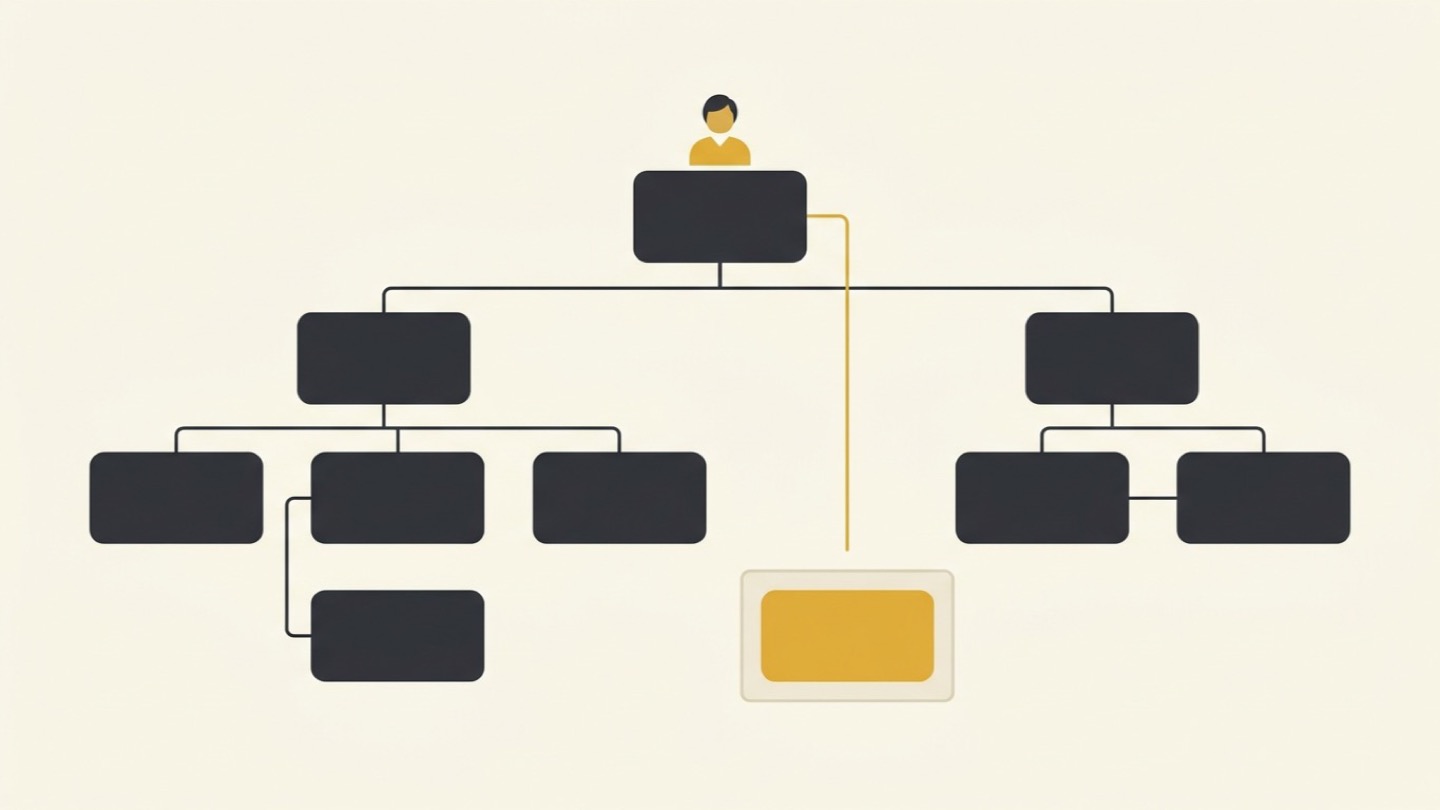

Who should own AI adoption in a company?
Not IT alone — and not by default.
AI ownership usually lands on the CIO for an administrative reason (IT holds the licenses and permissions), not a strategic one, and the data shows that’s exactly where adoption stalls: Deloitte’s 2026 enterprise survey found organizations where senior leadership actively shapes AI achieve significantly greater value than those delegating it to technical teams, and McKinsey’s AI high performers are three times more likely to have senior leaders who personally demonstrate ownership.
The working answer is a one-page ownership charter with one accountable executive and four named lanes: the CEO owns the why, function leaders own adoption inside their own workflows, IT owns the rails (identity, data boundaries, security — elevated, not demoted), and AI Enablers own the daily loop where usage becomes habit.

Questions as you read? Ask, or take the assessment with you.
Where should we send it?
Sent ✓ Download it now →
Ask the question in your next leadership meeting
There’s a one-question diagnostic for how an AI program is really going, and it costs nothing to run. In the next leadership meeting, ask: who owns AI here?
In most of the rooms we’ve been in lately, the same thing happens. A short pause. Then heads turn toward the CIO — or the IT director, or whoever signed the ChatGPT Enterprise agreement. Someone says the sentence that sounds like an answer: “IT owns it. They manage the licenses and the permissions.”
That turn of the head is the finding. The org chart didn’t answer the question. It confessed.
Because listen to the justification. They manage the licenses and the permissions. Nobody says IT owns AI because IT is closest to how underwriting decisions get made, or how proposals get written, or why the ops team still re-keys data between two systems. The ownership claim rests entirely on administrative custody — who provisions the accounts, who passed the security review, who holds the admin console. And administrative custody is a perfectly good reason to own a system. It is no reason at all to own a behavior change — which is what adoption actually is.
This article makes one argument: the near-universal default of handing AI to IT is a structural error, it produces a predictable failure loop you can watch happening in your usage data, and the fix is not a better department or a new hire. It’s a page. One page that names who owns what — and it starts with the person reading this.
The Human Domain.
The assessment, five scored dimensions, and the interval controls that keep judgment yours.
On its way. Check your inbox, or download it now →
Why every head turns toward the CIO
The reflex deserves respect before it gets corrected, because it isn’t stupid. It’s habit — and the habit worked for twenty-five years.
Every major technology wave of the last quarter century entered the company through the same door. ERP went to IT. CRM went to IT. Cloud migration, collaboration suites, cybersecurity — all IT. The pattern held because those systems shared a shape: they were infrastructure. Deploy them correctly, integrate them, keep them secure and running, and the value showed up. The department that owned the deployment could own the outcome, because the outcome was the deployment.
AI arrived through that same door — a software subscription with a procurement cycle, a security review, an SSO integration. So it got filed under the same ownership. Understandable. And wrong, because AI is not shaped like the systems that came before it.
An ERP system enforces a process: the workflow lives inside the software, and using it is a condition of doing the job. A general-purpose AI tool enforces nothing. It sits there, capable of almost anything and required for nothing, and it creates value only when a person changes how they work — when the account manager drafts the renewal proposal differently, when the analyst builds the model differently, when the scheduler stops re-keying the data. The value doesn’t live in the system. It lives in a thousand small behavior changes inside functions that IT does not run and cannot see into.
Which is why the license logic fails. A license grants access. Adoption changes behavior. Permission is not adoption, and a license is not a workflow. The distance between those two — between what you bought and what changed — is precisely the adoption gap, and it’s where most AI programs quietly die.
You can already see this gap in your own billing data, before anyone fills out a survey. We wrote about the seat-utilization gap in our AI cost guide: companies buying AI seats ahead of adoption, paying for licenses that get activated once and never reached for again. Finance reads that as a cost problem. It isn’t. It’s an ownership problem wearing a cost costume — nobody owns the distance between the license and the behavior, so the distance just sits there, invoiced monthly.
The AI Briefing
Tuesdays. 500+ leaders. No hype, just what works.
The doom loop: what IT-default ownership does next
Here’s what makes this failure mode worth naming precisely: it unfolds with no villains. Every actor in the loop does their job well, and the loop tightens anyway.
Turn one: IT owns AI, so IT’s metrics apply. Every department manages toward what it’s measured on, and IT is measured on exactly what it should be measured on — uptime, security incidents, deployment milestones, license compliance. So an IT-owned AI program reports what those metrics can see: tools deployed, seats provisioned, zero incidents. Notice what’s absent. Nobody in that reporting chain is measured on whether the sales team writes better proposals now. That number belongs to a different department — the one that doesn’t own the program.
Turn two: policy optimizes for control. Held accountable for risk but not for usage, IT does the rational thing: locked-down model choices, conservative data policies, approval workflows for new use cases, blocked integrations pending review. Each control defensible. The sum: a system that is easier to secure than to use.
Turn three: friction lands on your best people first. The employees most eager to work with AI — the ones any adoption effort should treasure — hit the friction earliest and hardest, because they’re the ones actually trying. They ask for a use case and wait three weeks. They hit the blocked integration. And then they do what capable, motivated people always do with an obstacle: they go around it.
Turn four: the lockdown manufactures the shadow. This is the turn with the receipts, and they’re remarkable. PagerDuty’s 2026 survey of 1,250 professionals at large companies found that 66% have used AI tools at work despite believing it violated company policy — and 39% would rather keep using AI quietly than disclose it. Okta’s 2026 research found 52% of knowledge workers using unsanctioned AI tools, while 95% of executives assumed their employees were using AI responsibly under the official policy. And the sharpest number of all, from the same PagerDuty study: 72% of employees believe they understand AI better than the team managing it internally. Sit with that one. The governed have concluded they’re ahead of the governors — and at many companies, on the question of what AI can do for their specific daily work, they’re right. The control-first posture didn’t prevent ungoverned AI use. It produced ungoverned AI use, at majority scale, on personal accounts you can’t see, secure, or improve.
Turn five: the dashboard lies, and the budget believes it. Official usage looks flat — because the real usage went underground. Leadership reads flat usage as “AI isn’t ready” or “our people aren’t ready,” and the initiative gets deprioritized, right at the moment when more than half the workforce is using AI daily in the dark. The program dies of a measurement error.
Read the loop end to end and the point sharpens: IT did nothing wrong in it. IT was handed accountability without the authority that matters — authority over how work gets done inside functions it doesn’t run — and it managed what it could actually control. A hero miscast is not a villain. The error belongs to whoever made the casting decision. Which, at most companies, was nobody: the ownership question was never decided at all. It was defaulted.
What the evidence says about who owns AI — and what it costs
For years “who owns AI” was a governance question nobody measured. That changed. The 2025–2026 research wave measured it from several directions at once, and the findings agree with each other to an uncomfortable degree.
Where ownership sits today: Foundry’s State of the CIO 2026 — a survey of more than 900 IT and business leaders — found that 83% of organizations either have or are building a cross-functional AI steering committee, but IT is the dominant player on it. So the market has already conceded, structurally, that AI is cross-functional — while staffing the structure so that the software-door reflex survives inside it. A committee is progress. A committee dominated by the department with the least visibility into how the work changes is the old default with more meetings.
What the CEOs think of the arrangement: Gartner’s survey of CEOs found that only 44% consider their own CIO “AI-savvy” — while 77% of the same CEOs say AI is ushering in a new business era (fieldwork 2024, published 2025 — an aging number, but the freshest of its kind). Whatever that gap measures — capability or perception — it’s a fragile foundation for a default ownership assignment.
What ownership placement does to outcomes: this is where the evidence stops being descriptive and starts being expensive. Deloitte’s 2026 State of AI in the Enterprise — 3,235 senior leaders across 24 countries — found that enterprises where senior leadership actively shapes AI governance achieve significantly greater business value than those delegating the work to technical teams alone. McKinsey’s State of AI research found its high performers are three times more likely to report that senior leaders demonstrate ownership of and active engagement with AI — not budget approval; personal, visible engagement. And BCG’s research on the widening AI value gap found the small group of “future-built” companies — about 5% — pulling roughly twice the revenue growth of the laggard majority, with leadership-anchored ownership among their defining traits.
Set those findings against the corpus numbers we keep returning to — McKinsey’s finding that 92% of companies are increasing AI investment while only 21% have redesigned even a single workflow, and Deloitte’s finding that only 25% of organizations have moved even 40% of their pilots into production — and the picture assembles itself. The money flows through one door. The value comes through another. And the department standing at the first door has been assigned to deliver what only the people behind the second door can: changed work.
The leadership lane matters for a reason that has nothing to do with technology, and we’ve written about why AI projects fail at the human level: people calibrate to what leaders do, not what they announce. When AI belongs to IT, every employee hears the real message underneath the all-hands enthusiasm — this is a systems thing, not a how-we-work thing. They’ll treat it accordingly.
The market’s answer: appoint someone. It’s half right.
The market has noticed the ownership vacuum, and its response has been dramatic. IBM’s 2026 CEO Study — two thousand CEOs across 33 markets — found that 76% of organizations now report having a Chief AI Officer, up from 26% a year earlier.
Authority in an organization does not triple in twelve months. Titles do.
Be honest about what a number like that can and can’t mean. Authority in an organization does not triple in twelve months; titles do. A jump that steep is mostly title velocity — a senior person gaining “AI” in their signature block, often without new budget, new reports, or new say over how the sales team works. (The adjacent data says as much: Gartner finds 70% of chief data and analytics officers — a different, older role — already holding primary responsibility for AI strategy, which means many companies now have two executives with a plausible claim to the same mandate and no page that says whose it is.) A title can even make things worse, by letting everyone else exhale — someone owns it now — while nothing about the work changes.
And yet the instinct behind the number is correct, and it’s the same instinct this article is arguing for: the fix for accidental ownership is named ownership. BCG’s AI Radar found 72% of CEOs now describing themselves as their company’s chief decision-maker on AI — double the share a year earlier. The market is converging, fast, on the idea that AI is a leadership mandate rather than an infrastructure assignment. Where it hasn’t converged is on the follow-through: a mandate without defined lanes is just a busier inbox.
So the CAIO question — should we have one? — has a cleaner answer than the discourse suggests. If AI is strategically central to your company and the coordination load is real, a dedicated AI executive can be exactly right — provided the title comes with the charter we’re about to draw, not instead of it. If you’re mid-market, the full-time version is usually premature: a $400K executive hire to coordinate a program that doesn’t have its lanes drawn yet solves the org chart, not the adoption. That’s the situation the fractional Chief AI Officer model exists for — senior AI leadership, a defined slice of the week, tasked first with drawing exactly the lanes this article describes. But fractional or full-time or neither: the charter is the fix. The hire is one way to staff it.
The Human Domain.
The assessment, five scored dimensions, and the interval controls that keep judgment yours.
On its way. Check your inbox, or download it now →
Who should own it: one page, one name, four lanes
Everything above converges on a boring-sounding artifact with unreasonable returns: an AI ownership charter. One page. It answers, in writing, the question your org chart has been answering by reflex.
First, the part that disarms the strongest objection up front. The objection: “collaborative ownership is no ownership — when four groups own something, nobody does.” Correct. Diffusion is exactly how 83% of companies end up with a steering committee and a stalled program at the same time. So the charter’s first line is a single name: one accountable executive — the CEO in most mid-market companies, a designated AI lead where scale demands it — who answers for adoption the way the CFO answers for the numbers. Committees advise. Lanes execute. One person answers. What follows is not shared ownership; it’s distributed execution under named accountability — four lanes, each with a different job, none of them optional.
Lane one — the CEO owns the why. Not the vendor selection, not the rollout plan: the story and the standard. Why AI, why now, what it means for how this company competes, and what it means for people’s jobs — said plainly, repeated often, and demonstrated. That last word is the McKinsey finding made operational: high performers’ leaders are three times more likely to visibly engage with AI themselves. A CEO who works with AI in the open — and talks about what worked and what didn’t — does more for adoption than any AI training budget. A CEO who delegates the subject entirely has answered the “is this real?” question every employee is silently asking. The answer they heard is no.
Lane two — function leaders own the how. Here’s the principle the whole charter turns on: whoever owns the work owns the adoption of AI into it. The VP of Sales owns what AI-assisted selling looks like — which parts of the pipeline change, what good looks like now, which behaviors get recognized. Operations owns AI in operations. Finance owns AI in finance. This is non-delegable, and the reason is structural, not motivational: redesigning a workflow requires knowing where the friction actually lives, and that knowledge exists only inside the function. McKinsey’s data names workflow redesign the single biggest driver of AI’s bottom-line impact — and the reason only 21% of companies have done it is that the companies assigned it to a department that structurally can’t.
Lane three — IT owns the rails. Elevated, not demoted. Read carefully, because this is the opposite of “take AI away from IT.” The charter takes away the one job IT was never positioned to do — changing behavior in other people’s functions — and formalizes the job that becomes more critical as adoption accelerates: the architecture everything runs on. Identity and access. Data boundaries — what the AI may see, touch, and retain. Model and vendor strategy. Security posture. The governance framework that makes speed safe — which, with agentic AI arriving, is about to be the most consequential rails-work of the decade: Deloitte finds about 75% of enterprises planning agentic deployments within two years, and only 21% with a mature governance model for it. Rails-IT is a bigger mandate than gatekeeper-IT, not a smaller one. The measure changes from “nothing bad happened” to “how fast can a function safely ship a new AI workflow on our rails” — and IT finally gets scoped to be great at exactly what it’s great at.
Lane four — AI Enablers own the daily loop. Between the leaders’ lanes and Monday morning sits the layer where adoption actually compounds: a named person in each major function — not a fan with a hobby, but a role with protected time, a monthly deliverable, and a mandate co-signed by their function leader and the accountable executive. They surface what’s working, spread it sideways, flag where the rails chafe, and close the loop between the people doing the work and the people designing it. AI change management that turns early adopters into an engine instead of an accident is most of what separates companies where usage compounds from companies where it plateaus at the enthusiasts.
Whoever owns the work owns the adoption of AI into it. Every lane on the charter is scaffolding for that one sentence.
One honest carve-out before anyone signs the page. There are companies where the technical org should lead adoption — companies whose product is software, where “the work” and “the engineering” are the same thing. Uber’s much-cited surge — agentic coding tool adoption from 32% to 84% of engineers in a single month — was driven by its internal developer-tools team, and rightly so. But notice that the exception obeys the rule: at Uber, the tool team owns the work being transformed. Engineering-led adoption of engineering tools is lane two, not a counterexample to it. If your company moves freight or sells apparel or runs clinics, your IT department is not where the work lives — and the rule points away from the door the software came through.
The Monday move
The whole diagnosis compresses into one meeting you can run this week.
Put the leadership team in a room and ask the question from the top of this article: who owns AI here? Let the pause happen. Watch where the heads turn. Then put a single page on the table and draw the four lanes — the accountable name at the top, then the why, the how, the rails, the daily loop, with a name in every lane. Expect the second lane to be the uncomfortable one: some function leaders will reach for the old reflex — “isn’t that an IT thing?” — and that reflex, spoken aloud, is the most useful data the meeting will produce. It’s the doom loop announcing itself in advance, while it’s still cheap to fix.
The page won’t be right the first time. Lanes will need redrawing; a name will change. Fine. A charter that’s 80% right and signed beats a perfect structure that exists in nobody’s calendar — because the alternative isn’t a better structure. The alternative is the default. And you’ve already seen where the default leads: control mistaken for progress, your most motivated people routing around the program, dashboards reporting the flatline of an initiative that’s actually alive and hiding.
A note on outside help, because this meeting is where a partner like us earns its keep — or doesn’t. You don’t need a consultant to write four names on a page. What an outside senior advisor is actually for is the part that’s hard to run from the inside: refereeing the lane between the CIO and the function leaders without anyone losing face — the person redrawing the org’s power map can’t also be standing on it. Add to that the pattern-library from other companies’ charters (which lane fights are normal, which are warning signs), and someone with standing to hold the accountable executive to the review rhythm after the launch energy fades. That’s the shape of our own CEO AI Program, and it’s also your test for any firm you’d bring in: if the engagement doesn’t end with your names in the lanes and the charter running without the consultant, it wasn’t ownership work. It was dependency with a deliverable.
Your AI adoption is currently owned by whoever happened to sign the license agreement. Change that on purpose, on one page, this quarter — or the org chart will keep answering the question for you. It’s gotten it wrong once already.
Draft Your AI Ownership Charter
Run this prompt with your AI to produce a first draft of the one-page ownership charter from this article — accountable executive, four lanes, named owners — sized to your company.
Context: I’m drafting an AI ownership charter for my company. We have [NUMBER] employees in [INDUSTRY]. Our main functions are [LIST — e.g., sales, operations, finance, marketing]. Today, AI is de facto owned by [WHO — e.g., “IT”, “nobody”, “the CEO informally”]. Ask me clarifying questions before each step if you need them.
Step 1 — Diagnose the current default: Help me map where AI ownership sits today. Who bought the licenses? Who sets AI policy? Who is measured on AI usage or outcomes (if anyone)? Where has friction or shadow AI use appeared? Summarize the gap between who holds control and who owns the work AI is supposed to change.
Step 2 — Name the accountable executive: Based on our size and structure, recommend the single accountable owner for AI adoption (CEO, COO, or a designated AI lead), and write their one-sentence mandate: what they answer for, and to whom.
Step 3 — Draw the four lanes: Draft the charter’s lanes with a named role in each. (1) CEO: the why — the narrative, the standard, and the visible personal use. (2) Function leaders: the how — each leader owns AI adoption inside their own workflows; list our functions and what “owns the how” means for each. (3) IT: the rails — identity, data boundaries, model strategy, security, governance; write the rails mandate as an enablement metric, not just a control metric. (4) AI Enablers: the daily loop — one named person per major function with protected time and a monthly deliverable.
Step 4 — Set the review rhythm: Propose a lightweight cadence: what the accountable executive reviews monthly, what function leaders report, what the Enablers surface, and the one adoption-depth metric each function tracks (a real task done the AI way, unprompted — not seats activated).
Output: A one-page AI Ownership Charter: accountable executive and mandate at the top, four lanes with named owners and one-line responsibilities, the review cadence, and the first 30-day action for each lane.
This gets you the page. What it can’t see from the outside is whether the lanes hold once real workflows, real data, and real politics hit them — that’s the readiness question. See where you stand →
If You’re Redrawing the Lanes
The charter names who owns the change. Two companion pieces cover what the owners actually do next:
If your rollout already stalled — flat usage, quiet dashboards, training that didn’t stick — the guide to closing the adoption gap diagnoses why deployment never became adoption and what closes the distance: workflow redesign first, support second.
If the shadow-AI numbers in this article made you check your own policy — the shadow AI guide covers what unsanctioned AI use actually exposes you to, and how to bring it into the open without punishing the people who were right about the tools.
Sources
- Foundry — State of the CIO 2026 (via CIO.com, 2026) — 83% have/are building cross-functional AI steering committees with IT dominant; 46% see the CIO as a proactive business leader
- Deloitte — State of AI in the Enterprise 2026 (January 2026) — senior-leadership-shaped AI governance outperforms delegation to technical teams; N=3,235 across 24 countries
- Deloitte — State of AI press release (January 2026) — only 21% of agentic-AI deployers have mature governance; ~75% plan agentic deployment within two years
- IBM Institute for Business Value — 2026 CEO Study (May 2026) — 76% of organizations report a Chief AI Officer, up from 26% in 2025; N=2,000 CEOs
- PagerDuty — Shadow AI Workplace Survey (June 2026) — 66% used AI despite believing it violated policy; 39% prefer quiet use over disclosure; 72% believe they understand AI better than the team managing it
- Okta — AI Agents at Work 2026 (March 2026) — 52% of knowledge workers use unsanctioned AI tools; 95% of executives assume responsible use
- McKinsey — The State of AI (November 2025) — high performers 3x more likely to report senior leaders demonstrating ownership of AI
- McKinsey — The State of AI: How Organizations Are Rewiring to Capture Value (March 2025) — 92% increasing AI investment; only 21% have redesigned any workflow
- BCG — The Widening AI Value Gap, press release (September 2025) — “future-built” 5% see ~2x revenue growth and 40% greater cost reduction than laggards
- BCG — AI Radar 2026: As AI Investments Surge, CEOs Take the Lead (January 2026) — 72% of CEOs identify as their company’s chief AI decision-maker, roughly double the prior year
- Gartner — CDAO Agenda Survey (May 2025) — 70% of CDAOs hold primary responsibility for AI strategy and operating model
- Gartner — CEO and Senior Business Executive Survey (May 2025) — 44% of CEOs consider their CIO AI-savvy; 77% say AI ushers in a new business era (fieldwork June–November 2024)
- Forbes — Uber burns its 2026 AI budget in four months on Claude Code (May 2026) — engineering adoption 32%→84% in one month, driven by the internal developer-tools team
Frequently Asked Questions
Who should own AI adoption in a company?
One accountable executive — the CEO in most mid-market companies — backed by a one-page charter with four lanes: the CEO owns the why (narrative, standards, visible personal use), function leaders own the how (AI adoption inside their own workflows), IT owns the rails (identity, data boundaries, security, governance), and AI Enablers own the daily loop in each function. The evidence favors this arrangement: Deloitte found organizations where senior leadership actively shapes AI achieve significantly greater value than those delegating it to technical teams alone.
Should the CIO or IT department own AI adoption?
IT should own the AI platform — the rails: access, data boundaries, model strategy, security, and governance — but not adoption itself. Adoption is behavior change inside functions IT doesn’t run, measured by outcomes IT isn’t accountable for. When IT owns adoption by default, policy optimizes for control, friction hits the most motivated users first, and usage goes underground: PagerDuty found 66% of professionals have used AI at work despite believing it violated policy. The rails mandate is bigger under a proper charter, not smaller — it’s the job that makes every function’s speed safe.
Do we need a Chief AI Officer?
Sometimes — but the charter matters more than the title. IBM’s 2026 CEO Study reports 76% of organizations now have a Chief AI Officer, up from 26% a year earlier; a jump that steep is mostly title velocity, not reallocated authority. A CAIO works when the role arrives with defined lanes, budget, and accountability for adoption outcomes. If it arrives instead of those things, it just gives the old confusion a new inbox. Large enterprises with heavy coordination loads justify a full-time CAIO; most mid-market companies don’t yet.
What is a fractional Chief AI Officer?
A senior AI executive who leads your AI strategy and adoption part-time on a retainer, rather than as a full-time hire. For mid-market companies, it solves the gap between “we need named senior AI ownership” and “a full-time AI executive is premature”: you get the accountable leadership lane of the ownership charter — strategy, governance, adoption oversight — at a fraction of the cost, typically with the explicit mandate to build the charter and the internal capability so the role can eventually transfer in-house.
Is an AI steering committee enough to govern AI adoption?
No — a committee coordinates; it doesn’t own. Foundry’s State of the CIO 2026 found 83% of organizations have or are building a cross-functional AI steering committee, yet adoption keeps stalling, partly because IT dominates most of those committees and partly because committees diffuse accountability rather than assign it. A committee works as the forum where the four lanes coordinate — under one named accountable executive. Without that name and those lanes, it’s the old default with more meetings.
Why did our IT-led AI rollout stall?
Most likely the doom loop: IT-owned programs are measured on deployment and risk (seats, uptime, incidents), so policy optimizes for control; friction lands on your most motivated users first; they route around the official tools; official usage flatlines while real usage goes underground. Okta found 52% of knowledge workers using unsanctioned AI tools while 95% of executives assumed employees were using AI responsibly. Flat dashboards then get read as “AI isn’t ready,” and investment gets cut — a measurement error, not an adoption failure.
What role should the CEO personally play in AI adoption?
Own the why, and demonstrate it. McKinsey’s AI high performers are three times more likely to have senior leaders who personally demonstrate ownership of and engagement with AI — meaning leaders who visibly use it and talk about what worked, not leaders who endorse it in a memo. BCG found 72% of CEOs now call themselves their company’s chief AI decision-maker, double the prior year. Employees calibrate to what leaders do: a CEO who works with AI in the open answers the “is this real?” question better than any training program.
How do we write an AI ownership charter?
Keep it to one page. Top: the single accountable executive and their one-sentence mandate. Then four lanes, each with a named owner: CEO — the why; each function leader — the how, inside their own workflows; IT — the rails (identity, data, models, security, governance), measured on enablement as well as control; AI Enablers — one per major function, with protected time and a monthly deliverable. Add a monthly review rhythm and one adoption-depth metric per function (a real task done the AI-enabled way, unprompted). Sign it, expect to redraw it once, and run it.
Do we need an AI consultant to fix AI ownership?
Not to write the page — you can draft a charter in one meeting. Outside help earns its place on the parts that are structurally hard from inside: refereeing lanes between the CIO and function leaders without anyone losing face, bringing the pattern from other companies’ charters so you don’t relearn common failure modes, and holding the accountable executive to the review rhythm after launch energy fades. The test for any firm: the engagement must end with your names in the lanes and the charter running without the consultant — ownership transferred, not rented.