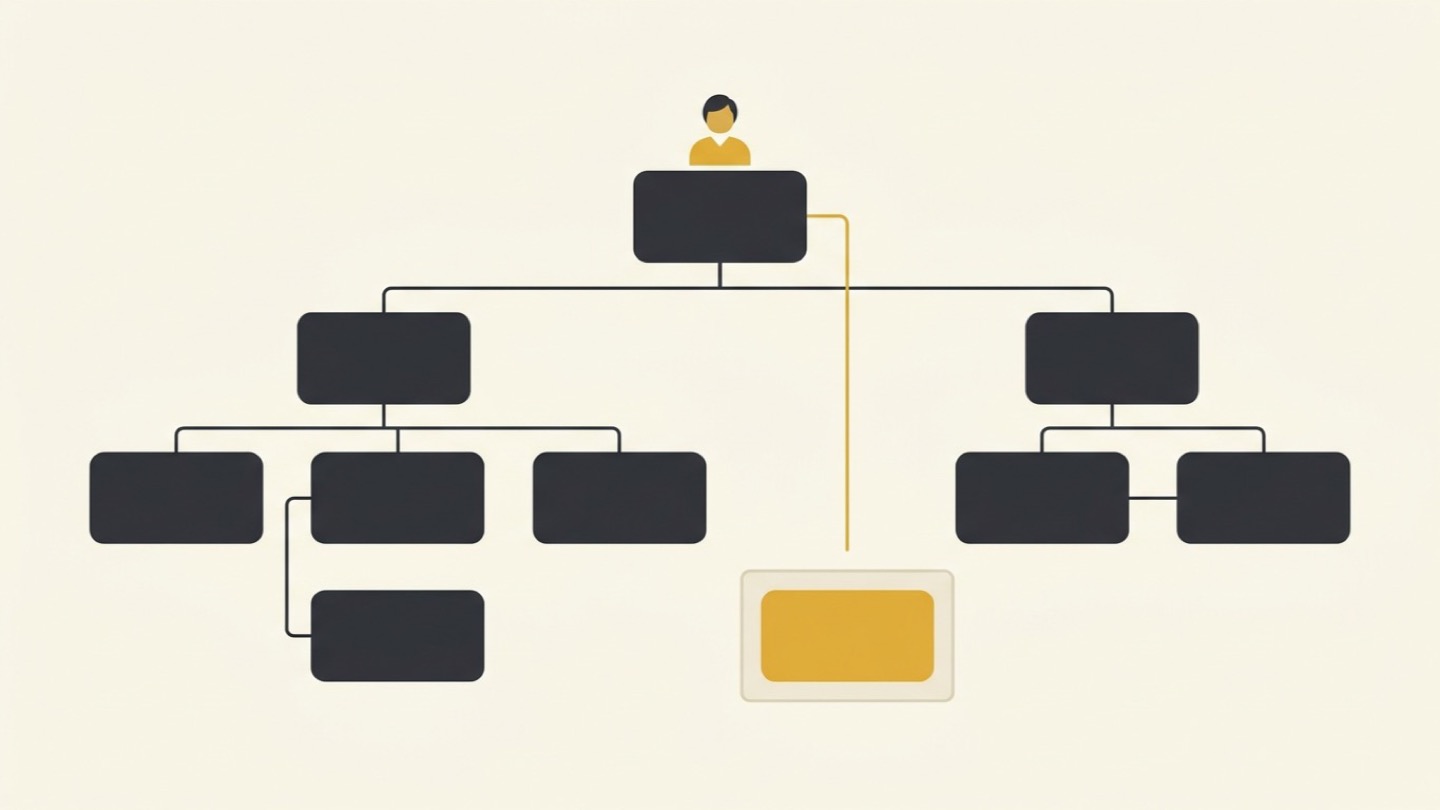

Why isn't my team using AI after we bought the tools and ran the training?
Because buying licenses and running training is deployment, not adoption — and they predict almost nothing about whether behavior actually changes. McKinsey found 92% of companies are increasing AI investment but only 21% have fundamentally redesigned a single workflow (2025), and that workflow redesign is the biggest driver of value.
Meanwhile your people are often already using AI — just quietly: a 2025 KPMG global study of more than 48,000 employees found 57% hide their AI use from their managers. The fix isn’t more training. It’s redesigning how the work flows so the AI lives inside it.

Questions as you read? Ask, or take the assessment with you.
Where should we send it?
Sent ✓ Download it now →
The gap between what you bought and what changed
You did everything the playbook told you to do. You bought the licenses. You ran the training sessions. You may have named a few champions and sent the all-hands email about the future of work. And now, weeks or months later, you’re looking at usage numbers that don’t move, and asking the question every mid-market leader is asking right now: why isn’t anyone actually using this?
Start with the uncomfortable scale of the problem, because it tells you this isn’t your company being uniquely bad at it. McKinsey put a number on the disconnect that should reframe how you think about your own rollout: 92% of companies plan to increase their AI investment, but only 21% have fundamentally redesigned even a single workflow to use it (2025). Deloitte’s 2026 enterprise survey found that only 25% of organizations have moved even 40% of their AI pilots into production — the rest are stuck in the gap between “we tried it” and “we run on it.” And MIT’s NANDA initiative found that only about 5% of generative-AI pilots achieve rapid revenue acceleration (2025); the rest stall before they ever change how the business runs.
Read those three numbers together and a pattern emerges. The money is flowing. The tools are bought. The pilots are running. And the work itself — how a task actually gets done on a Tuesday afternoon — has not changed. That gap is the whole story, and almost everyone is misdiagnosing it.
The instinct is to conclude that your people are resistant, or that you need more training, or a better tool. We’re going to make the case that all three of those conclusions are wrong — and that the real reason is something you can actually fix, but only if you stop measuring the wrong thing.
The Human Domain.
The assessment, five scored dimensions, and the interval controls that keep judgment yours.
On its way. Check your inbox, or download it now →
Deployment is not adoption. You’ve been grading the wrong test.
Here is the distinction that almost every stalled AI program gets wrong, and it’s worth stating plainly: deployment is what you do to the organization. Adoption is what the organization does with what you deployed. They are not the same event, and one does not cause the other.
Deployment is licenses activated, accounts provisioned, training sessions delivered, champions appointed. It’s measurable, it’s satisfying, and it shows up in a board deck as progress. Adoption is something else entirely: it’s when a person reaches for the AI by default to do a real task, because it’s genuinely the better way to do that task, and keeps reaching for it next week without being reminded. Deployment is a number you can hit by spending money. Adoption is a behavior, and behaviors don’t change because you bought something.
This is why “seats activated” is one of the most misleading metrics in the entire AI conversation. A seat activated tells you someone logged in once. It says nothing about whether the tool changed how they work. The same is true of “employees trained.” Completing a training session is an event; using the skill three weeks later is a behavior — and the distance between those two is where almost every AI program quietly dies. When a leader tells us “we’ve deployed AI across the company,” our first question is always the same: deployed, or adopted? The answer is usually a long pause.
The reason this matters isn’t semantic. It’s that the two problems have completely different solutions. If the problem were deployment — people don’t have access, don’t know the tool exists — then training and licenses would fix it. But the data says deployment is largely done. The problem is adoption, and adoption does not respond to more deployment. You can run the training again. You can buy more seats. You can send another email. None of it moves a behavior, because none of it changes the conditions under which the behavior would happen.
The AI Briefing
Tuesdays. 500+ leaders. No hype, just what works.
Your people are already using AI. They’re just hiding it from you.
Before you spend another dollar trying to convince your team to try AI, sit with the single most clarifying statistic in this entire field.
A 2025 KPMG and University of Melbourne global study — more than 48,000 employees across 47 countries — found that 57% admit to hiding their AI use from their managers (May 2025). More than half. Not uncomfortable using it — unwilling to be seen using it.
This detonates the standard diagnosis. The question almost every leadership team is asking — “how do we get our people to adopt AI?” — is built on a false premise. Your people have already adopted it. They’re drafting emails with it, summarizing documents with it, working through problems with it. They’re just doing it on personal accounts, in private, and not telling you.
Once you absorb that, the real question changes shape entirely. It’s not “how do we get them to try this?” It’s “why don’t they feel safe doing it in the open, on our tools, in a way we can support and improve?” And that question has a very different answer than “run more training.” People hide their AI use for reasons that are entirely rational from where they sit: fear that using AI makes them look less competent, or replaceable; uncertainty about whether it’s even allowed; a sense that the official tools are worse than what they already use at home; and an absence of any signal from leadership that this is encouraged rather than tolerated. None of those are capability gaps. Every one of them is a condition you set, or failed to set.
This is the human factor in AI project failure that the technology conversation keeps skipping past. The barrier was never that the work was too hard to learn. Harvard Business School researchers put it cleanly in late 2025: organizations struggle with AI not because the technology fails, but because “their people, processes, and politics do.” The tool works. The training happened. The behavior still hides — because the conditions around it punish visibility instead of rewarding it.
Why your training didn’t become behavior
Let’s talk about the training itself, because it’s where the most money and the most false confidence get spent.
There’s a well-replicated finding in the science of memory, first described by Hermann Ebbinghaus and confirmed in peer-reviewed work as recently as 2015: without reinforcement, we forget most new information within about a day. The forgetting curve is steep and it is universal. This is not a knock on your people’s discipline; it’s how human memory works. A two-hour AI training session on a Thursday, however well delivered, is fighting biology — and biology wins by Friday afternoon unless something reinforces the new behavior in the actual flow of work.
That’s the mechanism. Here’s the part that should genuinely concern you. Deloitte’s 2026 survey found that the number-one way companies are adjusting their talent strategy in response to AI is education and training — ahead of redesigning roles or workflows. Sit with that. The dominant corporate response to the AI adoption gap is to run more training. And training, delivered as a standalone event with no change to the surrounding work, is precisely the intervention the forgetting curve guarantees will fail. The industry is, at scale, applying the one fix least likely to produce durable behavior change, and then concluding that adoption is hard.
This is what we’ve come to call training theater: the activity that looks like solving the problem, generates a completion certificate and a satisfied line in a status report, and changes nothing about how work actually gets done on Monday. It isn’t that training is useless. Employee AI training that is embedded in the workflow, repeated, tied to a real task someone needs to do that week, and reinforced by a manager who actually uses the tool — that training works. But the one-off “AI 101” session, disconnected from the daily work, is not a smaller version of that. It’s a different thing that happens to share a name, and it produces a certificate instead of a behavior.
The test for whether your training was real is simple, and you can run it right now: pick any task your team was trained to do with AI six weeks ago, and check whether they’re doing it that way today, unprompted. If the honest answer is no, you didn’t have a training problem. You had a conditions problem — and training was the wrong tool reached for out of habit.
The Human Domain.
The assessment, five scored dimensions, and the interval controls that keep judgment yours.
On its way. Check your inbox, or download it now →
The trap nobody warns you about: more change management can make it worse
Here’s where we have to be honest about something, because it cuts against the easy advice — including advice we and every other firm in this space have given.
The standard prescription, once a leader accepts that adoption is a human problem, is “do more change management.” More workshops. More communication. More champions. More readiness programming. And there is real evidence that change management, done well, works: Prosci’s long-running research found that 88% of projects with excellent change management met or exceeded their objectives, versus just 13% of projects with poor change management (2023). That gap is enormous and it’s real.
But “do more change management” and “do change management well” are not the same instruction, and confusing them can actively backfire. Consider what your people are walking in with. Gartner found that by 2025, only 32% of leaders reported achieving “healthy change adoption,” and 79% of employees reported low trust in change — after years of absorbing a relentless stream of corporate change initiatives, most of which faded. Your workforce is not a blank slate waiting to be inspired. It is a population that has lived through wave after wave of initiatives, most of which were announced with the same conviction and then quietly faded. They are not poorly informed about change. They are correctly calibrated by experience.
This is connected to the broader pattern of AI brain fry and change fatigue — when you layer another AI “readiness program” onto a workforce already saturated with initiatives, the cynicism isn’t a failure of communication. It’s a rational response to a pattern they’ve seen fail before.
So when you respond to flat AI usage by piling on more programming — another workshop, another champion cohort, another change-management initiative — you are often not adding momentum. You are adding to the pile of initiatives a team has learned to wait out. The “people work” becomes its own form of theater: visible, well-intentioned, and read by your most experienced employees as exactly the signal that this, too, will pass. Change fatigue is not solved by more change activity. It’s deepened by it.
This is the uncomfortable nuance underneath the Humans First idea, and it’s worth getting right precisely because we believe in the human side so strongly: the answer to a stalled AI rollout is rarely more human-side activity. It’s better-targeted human-side work — fewer, more credible interventions that change real conditions, backed by leaders who visibly do the thing themselves. The difference between change management that works and change management that breeds cynicism isn’t volume. It’s whether anything in the actual work changes as a result.
What actually closes the gap: change the work, then support the people
If training doesn’t durably change behavior on its own, and more programming can backfire, what’s left? The evidence points, consistently and from multiple directions, to the same answer — and it’s an answer that inverts the usual order of operations.
McKinsey’s 2025 research tested 25 different attributes against whether organizations actually saw bottom-line impact from generative AI. The single attribute with the biggest effect on EBIT impact was workflow redesign — fundamentally changing how the work gets done to put the AI inside it. And yet, as we noted at the top, only 21% of companies have done it. The highest-leverage move is also the least-taken one, because it’s the hardest and the least glamorous. Buying a tool is a purchase. Running a training is an event. Redesigning a workflow is work — it means looking at how a task actually flows today and rebuilding it so the AI is a native step, not a thing you’re supposed to remember to go use.
BCG arrived at the same place from a different angle, and turned it into a rule worth taping to the wall: their guidance is that successful AI transformation is 70% people and process, 20% technology and data, and 10% algorithms (2025). Notice what that allocation says. The model — the thing the entire market obsesses over — is 10% of the work. Seventy percent is the people and the process: how work flows, who does what, what gets reinforced, what leadership models. The companies still stuck in pilot purgatory are, almost without exception, spending their energy on the 10% and wondering why the 70% didn’t take care of itself.
Two more conditions matter, and both are about signal rather than instruction. First, leadership behavior. McKinsey found that AI high performers are three times more likely to strongly agree that their senior leaders demonstrate ownership of and commitment to AI — and demonstration means using it visibly, not endorsing it in a memo. Your team reads what you do, not what you announce. If the executive team isn’t visibly working with AI, no amount of mandated training will convince anyone it’s genuinely the new way of working. Second, psychological safety. Remember the 57% who hide their AI use. The single cheapest adoption intervention available to you is making it unambiguously safe — celebrated, even — to say “I used AI for this, and here’s how.” That one shift converts a population of secret users into an open, improvable, supportable practice. It costs nothing and it changes everything, and it’s exactly the kind of AI change management that turns skeptics into champions when it’s done in the open.
There’s a reason this whole pattern shows up in the ROI conversation too. The companies that aren’t seeing returns from AI aren’t failing because they bought the wrong model. They’re failing because they treated AI as a tool to install rather than a way of working to design — and installation, no matter how complete, was never going to produce a behavior.
For leaders who want a roadmap rather than a diagnosis, the blueprint for AI-ready organizations walks through what it looks like to build the conditions — workflow, culture, leadership behavior — that make adoption the natural outcome rather than the thing you keep chasing.
The sequence, inverted
Put the evidence together and it prescribes an order of operations that is almost the exact reverse of how most companies run an AI rollout.
The standard sequence is: buy the tool, train the people, appoint champions, send the announcement, then wait for adoption and act surprised when it doesn’t come. Each step is deployment. Adoption is left to chance at the end, as if it were a natural consequence of the steps before it. It isn’t.
The sequence that actually works runs the other way. Start with a real workflow — one specific, high-friction task your team does constantly — and redesign it so AI is a built-in step, not an optional detour. Then put the tool inside that redesigned flow, where using it is the path of least resistance rather than an extra thing to remember. Then support the humans through the transition with training that’s tied to that exact task, reinforced over weeks, and modeled by their manager. And measure adoption depth — is the task actually being done the new way? — not seat activations or training completions. In this order, the human-side work has something concrete to attach to, the training reinforces a behavior the workflow already encourages, and the tool earns its place because it genuinely made a real task easier.
This is why the firms getting AI adoption right look different from the inside. They didn’t run a bigger training program. They picked a workflow that mattered, rebuilt it around the AI, made it safe and obvious to use, and let adoption follow from changed conditions rather than chasing it with changed messaging. It’s slower at the start and far faster after — the opposite of the buy-and-train approach, which is fast to launch and then stalls indefinitely.
What to do this quarter
You don’t need to relaunch your entire AI program. You need to stop running the play that isn’t working and run a different one, on a small enough scope to prove it. Three moves:
Re-measure honestly. Drop “seats activated” and “people trained” as your headline metrics — they’ve been telling you a flattering story that isn’t true. Replace them with one question about one task: is this specific job being done the AI-enabled way today, by people who weren’t reminded to do it? That number is your real adoption rate, and it’s the only one that predicts value.
Pick one workflow and rebuild it. Choose a single high-frequency, high-friction task — not a flashy one, a frequent one. Redesign how it flows so the AI is a native step, then deploy the tool into that flow. One workflow done to the point of genuine behavior change teaches you more, and converts more, than a company-wide rollout that changes nothing.
Make visibility safe, and model it from the top. Say plainly that using AI on company work, on company tools, is encouraged — and then have your leaders show their own AI use in the open. Turning the more than half of your team who are hiding their AI use into people who share it openly is the highest-return, lowest-cost adoption move available to you, and no training program comes close.
The reason your team isn’t using AI is not that they’re resistant, under-trained, or waiting for a better tool. It’s that you’ve been measuring deployment and hoping it would turn into adoption — and pouring more deployment on the gap when it didn’t. Adoption was never going to come from what you bought or what you announced. It comes from changing the conditions of the work itself, and then standing in front of your team and doing the thing you’re asking them to do. That’s not a software project. It’s a leadership one — which is exactly why it’s been the hardest part all along, and exactly why the companies that get it right pull away from the ones that don’t.
Sources
- McKinsey — The State of AI: How Organizations Are Rewiring to Capture Value (March 12, 2025) — 92% increasing investment / 21% redesigned workflows; workflow redesign = biggest EBIT driver
- McKinsey — Superagency in the Workplace (January 28, 2025) — maturity and training-gap data
- McKinsey — The State of AI (November 2025) — AI high performers 3x more likely to have leaders demonstrating ownership
- KPMG & University of Melbourne — Trust, Attitudes and Use of AI: Global Study 2025 (May 2025) — 57% of 48,000+ employees across 47 countries hide their AI use from their managers
- BCG — The Leader’s Guide to Transforming with AI (July 14, 2025) — the 10-20-70 rule
- Deloitte — State of AI in the Enterprise 2026 (January 2026) — 25% moved 40%+ of pilots to production; education = #1 talent response
- MIT NANDA — The GenAI Divide: State of AI in Business 2025 (August 18, 2025) — ~5% of pilots achieve rapid revenue acceleration
- Gartner HR — Just 32% of Leaders Report Healthy Change Adoption (July 8, 2025) — 32% healthy adoption; 79% low trust in change
- Prosci — Best Practices in Change Management, 12th Edition (2023) — 88% (excellent CM) vs 13% (poor CM) met objectives
- Harvard Business Review — Overcoming the Organizational Barriers to AI Adoption (November 11, 2025) — “people, processes, and politics”; Moderna CEO quote
- PMC4492928 — Ebbinghaus forgetting curve peer-reviewed replication (2015) — memory decay without reinforcement
- S&P Global Market Intelligence via Fortune (June 11, 2025) — AI initiative abandonment rose 17% to 42%
Frequently Asked Questions
Why isn't my team using the AI tools we paid for?
Almost always because you’ve solved a deployment problem (access, licenses, training) when you actually have an adoption problem (behavior). Buying seats and running training predicts very little about whether people change how they work. McKinsey found 92% of companies are increasing AI investment but only 21% have redesigned any workflow — and workflow redesign is the biggest driver of value. Usage follows changed conditions, not changed access.
What's the difference between AI deployment and AI adoption?
Deployment is what you do to the organization: provision accounts, run training, appoint champions. Adoption is what the organization does with it: people reach for the AI by default on real tasks and keep doing it. Deployment is a purchase; adoption is a behavior. Most programs measure deployment (“seats activated,” “people trained”) and assume adoption follows — it doesn’t.
Is more AI training the answer to low adoption?
Rarely, at least not standalone training. Memory research (the Ebbinghaus forgetting curve) shows most new information fades within about a day without reinforcement, so a one-off session changes little. Deloitte found education is companies’ number-one response to AI — which means the industry is over-relying on the intervention least likely to change behavior. Training works when it’s embedded in a redesigned workflow, tied to a real task, repeated, and modeled by managers.
Could doing more change management actually hurt adoption?
Yes, if it’s volume without substance. Gartner found that by 2025 only 32% of leaders achieve healthy change adoption and 79% of employees have low trust in change. Layering another AI “readiness program” onto a change-fatigued workforce often deepens cynicism. Change management done well works (Prosci: 88% of projects with excellent change management met objectives vs 13% with poor) — but “well” means fewer, credible interventions that change real conditions, not more programming.
Why are employees hiding their AI use?
A 2025 KPMG global study of more than 48,000 employees found 57% hide their AI use from their managers — usually from fear of looking less competent or replaceable, uncertainty about whether it’s allowed, or a sense the official tools are worse than what they use privately. It reframes the problem: your people aren’t refusing to adopt AI, they’ve adopted it in secret. The fix is psychological safety and clear permission, not more training.
What actually drives AI adoption?
Changed conditions, not changed awareness. The strongest evidence points to workflow redesign (McKinsey found it’s the biggest driver of bottom-line impact), visible leadership use (AI high performers are 3x more likely to have leaders who demonstrate ownership), and psychological safety so people use AI in the open. BCG’s rule captures it: AI success is 70% people and process, 20% technology and data, 10% algorithms.
How should we measure AI adoption instead of seat licenses?
Measure adoption depth, not access. Pick a specific high-frequency task and ask whether it’s actually being done the AI-enabled way today, by people who weren’t reminded to. That behavior-level metric predicts value; “seats activated” and “training completed” predict almost nothing. If usage only happens when prompted, you have deployment, not adoption.
Where do we even start if our AI rollout has stalled?
Don’t relaunch everything. Pick one high-frequency, high-friction workflow, redesign it so AI is a built-in step, deploy the tool into that flow, support the people through the transition with task-specific reinforcement, and make it safe to use AI openly. One workflow taken all the way to behavior change teaches and converts more than a company-wide rollout that changes nothing.