What is an AI readiness assessment, and how do you know if your company is ready for AI?
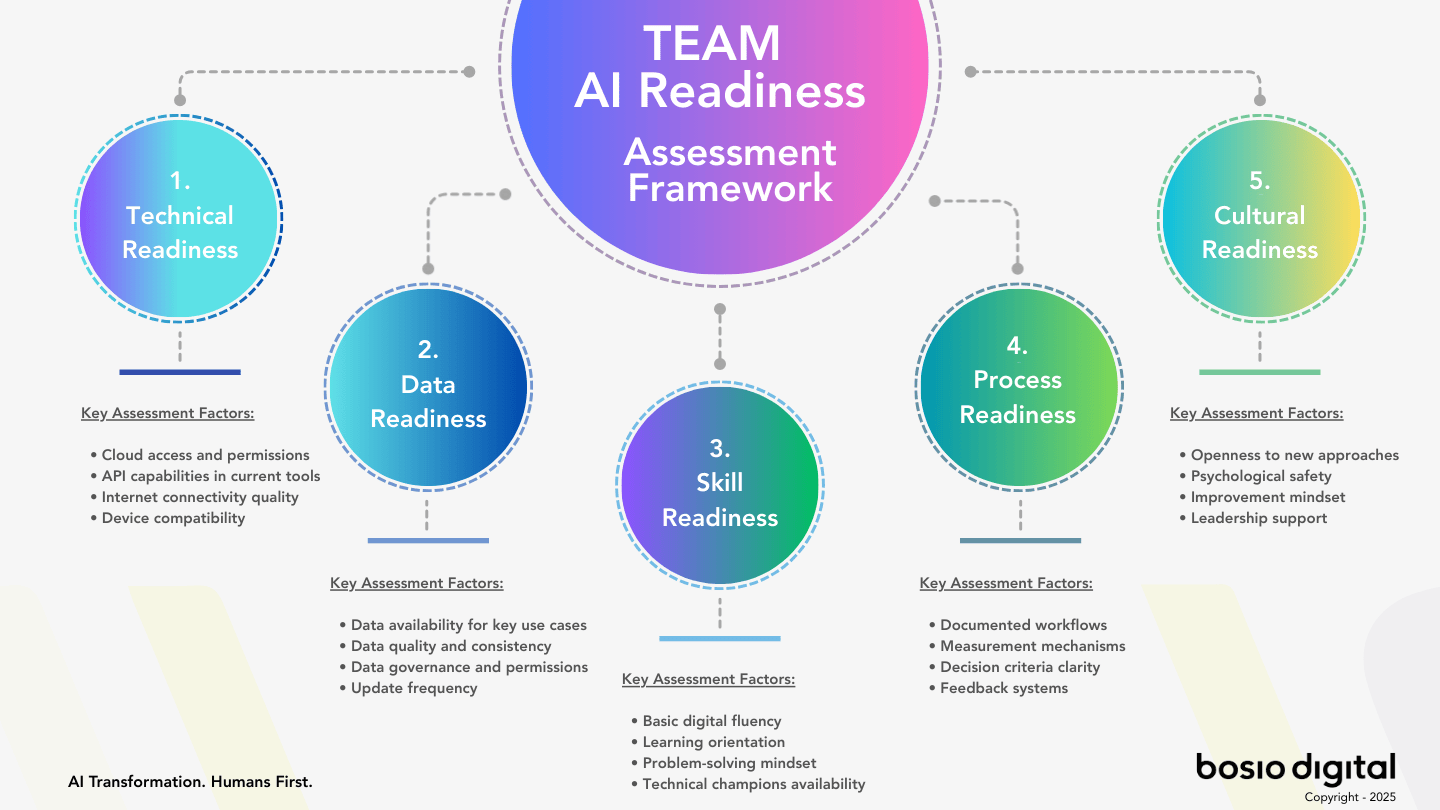
An AI readiness assessment evaluates whether your organization can actually adopt AI — not whether the technology works, but whether your company is set up to use it. A complete assessment scores five foundations: technical setup, data, team capability, process clarity, and culture.
Most AI initiatives stall on the last three, not the first two — which is why S&P Global found 42% of companies abandoned most of their AI initiatives before they reached production in 2025, up from 17% the year before. Readiness, not technology, is the difference.

Questions as you read? Ask, or take the assessment with you.
Where should we send it?
Sent ✓ Download it now →
The problem isn’t the tools. It’s whether you’re ready to use them.
The tools work. That question is settled. The one that isn’t — the one that decides whether your AI investment returns anything — is whether your organization is ready to put them to work.
The evidence is blunt. S&P Global Market Intelligence found that 42% of companies abandoned most of their AI initiatives before they reached production in 2025 — up from 17% a year earlier.
The technology improved and the outcomes got worse. That only makes sense if the constraint was never the technology.
The rest of the research points at the same culprit from every direction. BCG’s long-standing rule of thumb for AI transformation puts the weights plainly: success is 70% people and process, 20% technology and data, and only 10% the algorithms themselves — yet almost every readiness conversation starts and ends with the 30%. McKinsey found 92% of companies increasing AI investment while only 21% had redesigned even a single workflow to absorb it. And BCG’s AI Radar found the gap between AI leaders and everyone else tracks organizational adoption, not spend — roughly 60% of the laggard cohort reports no material gains at all.
For mid-market companies — call it 50 to 5,000 employees — this matters more than it does for either end of the market. You don’t have the enterprise luxury of a failed $2M program you can quietly write off, and you don’t have the small-shop simplicity of one person changing one workflow. You have real organizational complexity and real budget discipline at the same time.
That’s what an AI readiness assessment measures. The rest of this guide is the assessment itself: the five foundations, the diagnostic questions for each, what ready and not-ready actually look like at mid-market scale, and what your score tells you to do first.
The Human Domain.
The assessment, five scored dimensions, and the interval controls that keep judgment yours.
On its way. Check your inbox, or download it now →
The five foundations of AI readiness
AI readiness rests on five foundations. The first two are about your systems. The last three are about your people and how they work — and that’s where readiness is actually won or lost.
Score your company on each before reading the deep dives — first instincts are usually more honest than considered answers. Then use the sections below to pressure-test the scores.
Technical foundation: can your systems support AI?
The baseline question: will AI tools connect to what you already run?
The diagnostic questions. Do your core systems have APIs — can they share data with AI tools rather than trapping it? Is your data accessible from a browser, or locked in desktop-only software that only one machine can touch? Is your infrastructure stable enough to support tools your team will come to rely on daily? And is someone accountable for access — who can grant an AI tool a connection to your CRM, and how long does that take?
Ready looks like: your core systems (CRM, ERP, project management, file storage) are cloud-based or API-accessible; granting a new tool access is a decision, not a project; and nobody has to export CSVs by hand to move data between systems.
Not ready looks like: the business runs on desktop software with local files, system access flows through one overloaded IT person, and every integration story you’ve attempted has died in the connector stage.
The mid-market specifics. Here’s the good news most enterprise-grade readiness frameworks miss: you rarely need enterprise infrastructure to start. Most effective mid-market AI runs on standard cloud software and normal connectivity. Scoring this foundation isn’t about raising the bar — it’s about knowing honestly what you have before you build on it. A 3-out-of-5 technical score with a strong team foundation beats the reverse every time, because tools can be upgraded in weeks; people can’t.
Data foundation: do you have the raw material?
AI runs on your information — but the standard here is usable, not perfect.
The diagnostic questions. What do you actually collect — customer records, sales history, quotes, project files, operational logs? Can your team find and use it, or is it scattered across systems and spreadsheets nobody fully trusts? Is there one version of the truth for your most important numbers, or three? And do you know what you’re allowed to use — where the privacy, contractual, and regulatory lines sit for customer and employee data?
Ready looks like: your important information lives in known places; the team can answer “where would I find X?” without a scavenger hunt; and someone can articulate, even roughly, what data is off-limits for AI tools and why.
Not ready looks like: every department keeps its own spreadsheet empire, the numbers in the Monday meeting depend on who pulled them, and nobody has thought about which data can legally touch a third-party AI service.
The mid-market specifics. Most mid-market companies have far more usable data than they realize — years of quotes, tickets, emails, and project history that never became “data” because nobody treated it that way. The work isn’t acquiring data; it’s organizing what exists so AI can reach it. That’s weeks of effort, not the multi-year “data transformation” that enterprise frameworks prescribe — another place where the enterprise yardstick misleads more than it measures.
Team foundation: are your people ready to learn?
This is where most implementations are decided — and the foundation most technology-led assessments barely score.
The diagnostic questions. How does your team meet new tools — with curiosity or quiet resistance? Who are the people others already turn to for help, the informal go-to’s who learn first and teach the rest? Have you addressed the question sitting under every rollout, spoken or not — “does this replace me?” And here’s the one most leaders can’t answer: do you actually know how your people use AI today — or is it already happening on personal accounts, invisibly?
That last question matters more than it looks. A global KPMG study of over 48,000 employees found 57% hide their AI use from their managers. If that’s true in your company — and statistically, it is — your team foundation is both stronger and more fragile than you think: stronger because people are already learning, more fragile because they’ve concluded it isn’t safe to do so openly. We’ve written a full diagnosis of why teams hide their AI use and what it takes to reverse it.
Ready looks like: a few credible people visibly experimenting, leadership talking about AI as capability-building rather than cost-cutting, and honest answers available for the replacement question.
Not ready looks like: training sessions nobody applies, tools nobody opens twice, and a workforce that’s concluded the safest posture is polite non-participation.
The mid-market specifics. You don’t need everyone to be an expert. You need a handful of credible early adopters — name them deliberately, we call them AI Enablers — and honest time budgeted for real adoption.
Process foundation: how does work actually get done?
The diagnostic questions. Are your key workflows documented, or do they live in a few people’s heads? If your best operations person left tomorrow, what would stop working? Can you measure whether something is improving — do baselines exist for the work you’d point AI at? And who decides whether a new tool stays or goes — a named owner, or whoever shouts loudest?
Ready looks like: your five most important workflows could be sketched on a whiteboard by more than one person; “how long does a quote take today?” has an answer; and tool decisions have an owner.
Not ready looks like: tribal knowledge everywhere, no baselines anywhere, and a graveyard of tools nobody remembers deciding to buy.
The mid-market specifics. You don’t need perfect processes — you need enough structure that AI has something to amplify. Point AI at a broken process and you get a faster broken process. The practical move: before any AI purchase, document just the one workflow you intend to point it at. One page. Who does what, in what order, and how you’d know it improved. That single page converts an AI experiment from a hope into a test.
Culture foundation: is the organization open to change?
Score a 2 here and strong scores elsewhere won’t save you — a team that doesn’t trust change won’t use tools it technically has access to.
The diagnostic questions. Does “that’s how we’ve always done it” win most arguments? Can people admit what they don’t know without paying for it? When the last change initiative rolled through, did it stick — and what did your team learn from watching it? Are leaders genuinely behind trying new ways of working, or endorsing from a distance?
That third question carries more weight than it appears to. Gartner found that 79% of employees report low trust in organizational change — your workforce isn’t a blank slate waiting to be inspired; it’s a population correctly calibrated by every initiative that faded before this one.
Ready looks like: leadership visibly using the tools themselves (McKinsey’s research on AI high performers found they’re three times more likely to have senior leaders who demonstrate ownership of AI, not just endorse it); a track record of at least one change that stuck; and safety to say “I don’t know how this works yet.”
Not ready looks like: initiative fatigue, executive sponsorship that never survives contact with the calendar, and a rollout history your employees would describe — accurately — as waves that passed.
The mid-market specifics. Culture change is slow and it starts at the top — if leadership isn’t authentically invested in AI making the work better (not merely cheaper), the organization reads that immediately, and adoption dies polite. The counterweight is cheap and rare: leaders who show their own AI use in the open, including the parts that didn’t work.
The AI Briefing
Tuesdays. 500+ leaders. No hype, just what works.
The Human Domain.
The assessment, five scored dimensions, and the interval controls that keep judgment yours.
On its way. Check your inbox, or download it now →
The pattern that predicts abandonment
Score the five foundations, and the abandonment statistic stops being mysterious.
S&P didn’t score those companies on these five foundations — nobody did; the framework is ours. But the surrounding research says where they broke: strong on tools and data, weak everywhere people-shaped. They bought capable tools, connected them to decent data, and then discovered nobody had made it safe to change how work gets done.
McKinsey’s numbers show the same shape at scale: 92% of companies are spending more; only 21% have changed a single workflow. That gap between spending and changing is the readiness gap. It’s also why the most common corporate response to a stalled rollout (more training, more tools, more licenses) fails: it invests in the foundations that were already strong.
Readiness is not a gate you pass before touching AI — and it’s not a prerequisite you finish. Readiness is built by adopting, deliberately, in the right order: one workflow, one team, one measurable outcome at a time. The assessment doesn’t tell you whether to start. It tells you where.
Why enterprise readiness indexes mislead mid-market companies
Search for “AI readiness assessment” and most of what ranks are readiness indexes from the large technology vendors — thorough, well-built instruments designed for organizations with thousands of employees, dedicated data teams, and procurement cycles measured in quarters.
They’re good tools for the companies they were built for. The problem is scale-fit, not quality. Those frameworks weight what enterprises struggle with: infrastructure standardization, data governance at petabyte scale, security review across hundreds of applications. Run a 200-person company through an enterprise index and you’ll conclude you need a data lake, a center of excellence, and a year of foundation work before your first use case — advice that would burn your budget precisely backwards.
The mid-market reality inverts the weights. Your technical gap is usually weeks of integration work, not years of platform migration. Your data gap is organization, not volume. What you genuinely share with the enterprise — and what the indexes underweight — is the people side: the team that has to change how it works, the processes that have to absorb a new step, the culture that decides whether any of it sticks. BCG’s 70/20/10 rule isn’t a slogan; it’s the correct weighting for an assessment. If your readiness instrument spends 70% of its questions on technology, it’s measuring the 30% that rarely kills mid-market AI programs.
That’s the design principle behind the five-foundation model: two foundations for systems, three for people and process, weighted the way the failures actually distribute.
Interpreting your score
Four patterns cover most mid-market companies:
Strong across all five. You’re past assessment — move to a scoped first implementation. Pick one high-value, well-understood workflow, set a baseline, and build there. Your risk isn’t failure; it’s diffusion — trying six things at once and mastering none. The adoption roadmap maps what the climb looks like from here.
Strong on systems, weak on people. The most common mid-market pattern, and the S&P 42% in the making. Don’t buy more tools — the work is change management: named AI Enablers, honest communication about roles, leadership using the tools visibly, and one win public enough to convert skeptics. This is where the right kind of AI consulting engagement for a mid-market company earns its cost: it closes the people-and-process gap that tools can’t.
Strong on people, weak on systems. Rarer and better than it feels. An eager team blocked by inaccessible data or locked-down systems is a solvable problem with a clear scope — integration work has a price and a timeline. Fix the one system blocking your best use case first; don’t boil the infrastructure ocean.
Weak across the board. Not a reason to wait for “someday” — a reason to start smaller. One team, one workflow, one measurable outcome, with the explicit goal of building organizational muscle rather than ROI. The first project’s job is to teach your company how to adopt; the second one gets to be about returns.
What to do next: the first 90 days
Whatever your pattern, the sequence that works runs the same way.
Weeks 1–2: make the score honest. Run the assessment with more than one scorer — leadership self-assessments run reliably optimistic. Where scores diverge between leadership and the people doing the work, believe the people doing the work; the divergence itself is data about your culture foundation.
Weeks 3–4: pick the one workflow. High-frequency, high-friction, measurable, owned by a team with at least one willing early adopter. Document it on a page. Set the baseline number you’ll compare against. If you already run on Claude, the packaged workflows in Claude for Small Business are a cheap way to see which of your repeated work a tool can take as it comes.
Weeks 5–12: build the smallest real thing. Deploy into that one workflow, support the humans through the change (task-specific training beats generic AI literacy sessions every time), and measure against the baseline. Name your AI Enablers and give them real time, not a title on top of a full calendar.
Then reassess. Readiness scores move fast when adoption is real — a culture foundation that scored 2 looks different after one visible win. The assessment is a cycle, not a certificate.
The honest caveat about doing this alone: the assessment itself is free and self-serve, and for many companies it’s enough to get moving. Where an outside partner genuinely fits is the part that’s hard from inside — scoring your own culture honestly (nobody grades their own leadership credibility well), sequencing across competing departmental priorities, and pattern-recognition from having watched many companies attempt the same climb. Whoever you’d bring in, ours or anyone’s, apply the ownership-transfer test: when the engagement ends, do your people own the assessment, the roadmap, and the ability to rerun both without help? If the answer is a retainer, keep looking.
Sources
- S&P Global Market Intelligence — 2025 AI Experiences survey — 42% of businesses abandoned most of their AI initiatives before reaching production in 2025, up from 17% the prior year.
- BCG — The Leader’s Guide to Transforming with AI — the 70/20/10 rule: AI success is 70% people and process, 20% technology and data, 10% algorithms.
- BCG — AI Radar 2026 — AI leaders generate materially higher returns than laggards; roughly 60% of the laggard cohort reports no material gains; the gap tracks organizational adoption, not spend.
- McKinsey — The State of AI: How Organizations Are Rewiring to Capture Value (2025) — 92% of companies increasing AI investment while only 21% have fundamentally redesigned a workflow; workflow redesign is the biggest driver of value.
- McKinsey — The State of AI (November 2025) — AI high performers are 3x more likely to have senior leaders demonstrating ownership of and commitment to AI.
- KPMG & University of Melbourne — Trust, Attitudes and Use of AI: Global Study 2025 — 57% of 48,000+ employees across 47 countries hide their AI use from their managers.
- Gartner HR — Just 32% of Leaders Report Healthy Change Adoption (July 2025) — 79% of employees report low trust in organizational change.
- Deloitte — State of AI in the Enterprise 2026 — only 25% of organizations have moved even 40% of their AI pilots into production.
Frequently Asked Questions
What is an AI readiness assessment?
An AI readiness assessment evaluates whether your business can actually adopt AI — not whether the technology works, but whether your organization is set up to use it. A real assessment scores five foundations: technical setup, data, team capability, process clarity, and culture. Most AI initiatives stall on the last three, not the first two — readiness is mostly a people-and-process question, not a tooling one.
How do you assess whether a business is ready for AI?
Score the five foundations honestly: technical (can your setup support AI tools), data (is your information organized enough to use), team (are your people ready and willing to learn), process (is it clear how work actually gets done), and culture (is the organization open to changing how it works). Use multiple scorers — leadership self-assessments run optimistic — and treat any large gap between leadership’s scores and the team’s scores as a culture finding in itself. Teams that would rather not score it alone can run a facilitated version as the first step of our AI strategy engagements.
What questions should an AI readiness assessment ask?
The load-bearing ones per foundation: Do our systems share data through APIs? Can our team find and trust our most important information? Do we know how our people already use AI — including unofficially? Could more than one person sketch our five key workflows? And did our last change initiative stick? A good assessment also asks the uncomfortable one: is leadership prepared to use these tools visibly, or only to sponsor them?
How much does an AI readiness assessment cost, and how long does it take?
A self-assessment like our free diagnostic takes about 15 minutes and costs nothing. A formal, facilitated readiness assessment from a consulting firm typically runs $25,000–$40,000 over two to four weeks and produces a prioritized roadmap and executive alignment, not just a score. Our AI consulting cost guide breaks down what each tier includes and where the price differences come from.
Who provides AI readiness assessments for mid-market companies?
Enterprise vendors offer readiness indexes built for large-scale IT environments; most weight technology far more heavily than the people-and-process factors where mid-market adoption actually breaks. Mid-market companies (roughly 50–5,000 employees) are better served by an assessment that weighs culture, team, and workflow as heavily as infrastructure. That people-first approach is the core of how we work — our AI consulting services begin most engagements with exactly this readiness diagnostic before any build.
What's the difference between AI readiness and AI maturity?
Readiness measures whether you can adopt — the five foundations before and during early adoption. Maturity measures how far you’ve gotten — the stages from first chat tools to AI running inside your operations. Readiness is the entry diagnostic; maturity is the progress map. If you score ready, the natural next question is where you sit on the five steps of AI adoption — and what the next step asks of your organization.
How often should you reassess AI readiness?
Quarterly during active adoption, and after any significant change — a new leadership hire, a reorganization, a failed or successful pilot. Readiness scores move faster than most leaders expect: one visible win can move a culture score in a month, and one badly-handled rollout can move it back. The assessment is most useful as a recurring instrument, not a one-time gate.
What's the difference between AI readiness for a small business and a mid-market company?
A small business is usually one decision-maker and a handful of workflows — readiness is mostly choosing the right tools and building the habit. A mid-market company has multiple teams, more data, and genuine change-management complexity — readiness there is about alignment across departments and whether the organization can absorb the change, not just whether the tools work. The five foundations apply to both; the weight shifts toward culture and process as you scale.