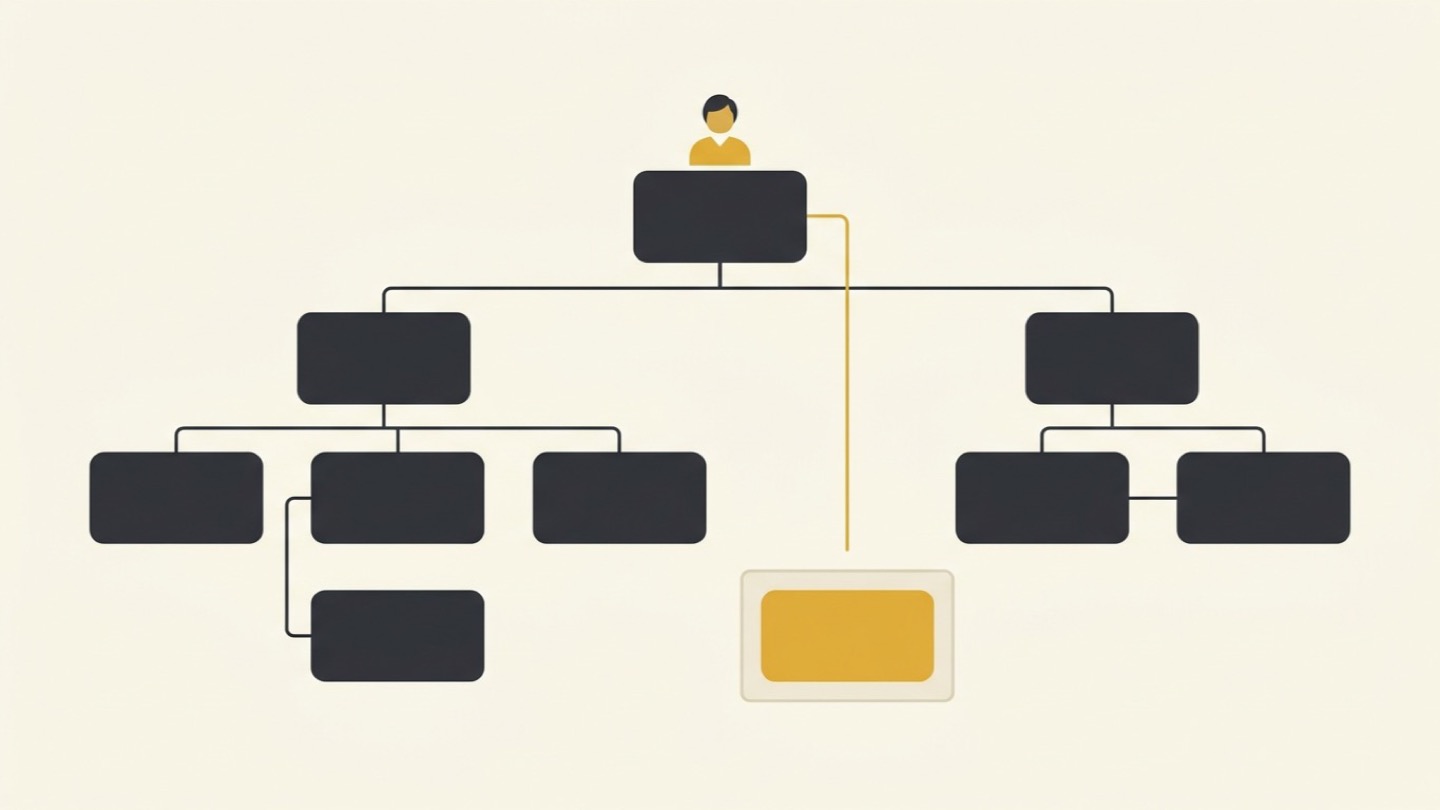

If AI makes work so much faster, why aren't business outcomes arriving any sooner?
Because AI compresses work — the active cognitive effort inside a process — but does almost nothing to cycle time, the calendar time from “we want this” to “we have it.” In most business processes, active work is only a small fraction of the calendar; the rest is wait-states, approvals, handoffs, and rework. Amdahl’s Law shows that speeding up a 20% slice yields at most a 1.25x improvement overall.
It’s why, even in 2026, only about a quarter of companies report meaningful ROI from generative AI (Writer/Workplace Intelligence and Gartner, April 2026) — even as AI activity soars.

Questions as you read? Ask, or take the worksheet with you.
Where should we send it?
Sent ✓ Download it now →
The Work Got Faster. The Calendar Didn’t.
Here is the uncomfortable thing almost no one in the AI conversation will say out loud: most organizations have gotten dramatically faster at the work, and not one day faster at the outcome.
The data is blunt, and it’s current. In a survey of 2,400 executives and employees published in April 2026, the AI firm Writer and its research partner Workplace Intelligence found that only 29 percent of enterprise leaders report seeing significant ROI from generative AI. The same month, Gartner reported that just 28 percent of AI use cases fully succeed and return on their investment — and that figure came from infrastructure and operations, one of the most heavily AI-invested functions in the business. Narrow the lens to formal pilots and it gets starker still: MIT’s NANDA initiative found only about 5 percent of AI pilot programs achieve rapid revenue acceleration, while the vast majority deliver little to no measurable impact on profit and loss (2025). Adoption is climbing. Returns are not. The two facts are usually presented as a paradox.
It isn’t a paradox. It’s a measurement error — and once you see it, it becomes the sharpest diagnostic you can bring into a business. The error is this: we have been measuring how fast people work and assuming that tells us how fast the business moves. Those are two different clocks. AI has been winding the first one furiously. It has barely touched the second.
I run an AI consulting firm. By any honest account, AI should be accelerating everything around me. And yet everywhere I actually look — vendors, contractors, approvals, legal review, my own projects — the calendar has not shortened. For a long time I treated that as a failure of adoption, something more or better AI would eventually fix. It isn’t. It’s structural. And the structure has a name in two older disciplines that figured this out decades before anyone typed a prompt.
The one-page AI budget worksheet.
What each tier of engagement buys, what the AI costs to run, and what to ask before you sign.
On its way. Check your inbox, or download it now →
Two Clocks Are Running. AI Only Sped Up One of Them.
Two clocks: task time vs calendar time
Every process you care about runs on two clocks at once.
The first is work — someone actively doing a thing. Researching. Drafting. Analyzing. Modeling a decision. This is the clock AI is devastatingly good at compressing. The second is cycle time — the calendar time from the moment you decide you want an outcome to the moment you actually have it. This is the clock the business feels, pays for, and reports to the board. It is the only one that shows up in EBIT.
The reason the second clock barely moves is that work is only a sliver of it. The rest of the calendar is made of five things AI does not touch:
- Wait-states — the hours and days a thing sits in a queue, an inbox, an approval, a reviewer’s backlog.
- Rework loops — the third revision after a gatekeeper kicks it back, the cycle nobody measures because it hides inside “the work.”
- Handoffs — the friction every time the baton passes between people, teams, or organizations.
- Institutional latency — liability, sign-offs, trust-building, “that’s not my department,” the statutory thirty-day window that exists no matter how good your draft is.
- Physical reality — concrete cures in twenty-eight days regardless of how smart your model is.
How big is the sliver? Smaller than almost anyone guesses. In Lean operations, the discipline of value-stream mapping measures something called process cycle efficiency: the share of total lead time that is actual value-adding work. In most organizations it lands somewhere between 5 and 15 percent. In office and knowledge work, where things spend most of their life waiting in someone’s queue, it is often lower (Mike Rother and John Shook, “Learning to See,” Lean Enterprise Institute, the canonical text on this). The other 85 to 95 percent is the list above.
So when AI makes the work radically faster, it is making the small part of the calendar faster. The part that was never the problem.
This is also why so many AI initiatives are quietly judged disappointing. The organization watches a genuine surge of activity — more drafts, faster analysis, more output per person — and reasonably expects the business to move faster as a result. When it doesn’t, the conclusion is that AI was overhyped. The more accurate conclusion is that the AI was aimed at the wrong clock. This is the same structural story behind why most companies aren’t seeing AI ROI — the investment landed on activity, not on the thing that actually gates the outcome.
The AI Briefing
Tuesdays. 500+ leaders. No hype, just what works.
Amdahl’s Law Comes for the Enterprise
In 1967, the computer architect Gene Amdahl presented a short paper at the AFIPS Spring Joint Computer Conference with a forgettable title and an unforgettable idea. He was arguing about parallel computing, but he had really discovered a law about optimization itself: the speedup you get from improving one part of a system is capped by the fraction of the system you didn’t improve.
The formula is simple — overall speedup equals 1 divided by ((1 − p) + p/s), where p is the proportion you can accelerate and s is how much you accelerate it. The implication is brutal and worth sitting with. Take a process where 20 percent of the time is work you can speed up. Make that 20 percent infinitely fast — reduce it to zero — and your total process gets a 1.25x speedup. Twenty-five percent. That’s the ceiling. Not because your AI is weak, but because the serial 80 percent you didn’t touch still has to happen, in order, at its own metabolic rate.
Now put the real number in. If active cognitive work is 5 to 15 percent of lead time, as value-stream mapping routinely finds, then even perfect, instantaneous AI execution of that fraction produces — at most — a 5 to 17 percent improvement in the calendar. The approvals, handoffs, scheduling, procurement, and human deliberation that make up the rest are completely untouched. This is Amdahl’s Law applied to civilization: AI is eating the cognitive sliver, and the serialized human and institutional remainder does not care how advanced the model is.
A fair objection: Amdahl was describing processors, and Goldratt, whom we’ll get to, was describing factories. Neither was talking about your procurement cycle. True. These are conceptual lenses, not literal theorems about your org chart. But the structure transfers exactly, because the thing they describe — a system whose speed is governed by its slowest serial component — is not a property of silicon or steel. It’s a property of any process where steps must happen in sequence and only some of them can be accelerated. That describes nearly every business process ever built.
Optimizing Anything That Isn’t the Bottleneck Is Theater
Amdahl tells you the ceiling. Eliyahu Goldratt tells you where to aim. In his 1984 business novel “The Goal,” Goldratt laid out the Theory of Constraints, and its central claim is as close to a law as operations gets: the throughput of any system is set entirely by its single biggest constraint — its bottleneck. Improve anything that is not the bottleneck, and you produce the appearance of progress — busier people, more output, fuller dashboards — while actual throughput stays exactly where it was.
Read that twice, because it is the most expensive sentence in enterprise AI. Improvement off the constraint is not a smaller win. It is not a win at all. It is motion that looks like progress.
Put Amdahl and Goldratt together and you get the line we now use in nearly every executive conversation: AI applied off the constraint is theater. It looks like acceleration. The calendar doesn’t move.
This is not hypothetical. Hamilton Mann of IMD documented a case in January 2026 in which an organization used AI to triple its email volume and dramatically accelerate draft creation — and watched its win rate and its cycle time to qualified pipeline stay flat or decline. The activity graph looked heroic. The outcome graph was a flat line. The AI worked perfectly. It was simply pointed at a part of the system that was never setting the pace.
Most executives are buying AI to speed up work. What they actually care about is cycle time to outcome. Conflating the two is the single most common and most expensive mistake in AI strategy today — and it’s why so much AI spend produces dashboards instead of measurable return.
The Contrast Illusion
The clock disagreed with the feeling, and the feeling won.
Here is the twist that makes the frustration so acute, and it’s the part the operations textbooks miss because it isn’t about systems — it’s about perception.
AI makes your side instant. And the moment your side is instant, every wait on everyone else snaps into sharp relief. You used to spend two weeks preparing a deliverable while the client took two weeks to review it; it felt parallel, tolerable, even productive. Now you finish in an afternoon and spend the next thirteen days waiting on their sign-off. The client didn’t get slower. The external slowness didn’t increase. Your contrast did. The waiting was always there. AI just removed the work that used to hide it.
I call this the contrast illusion, and there is now hard data that it is real — and that it fools even the people experiencing it. In July 2025, METR ran a rigorous randomized controlled trial with sixteen experienced open-source developers, working on 246 real tasks drawn from repositories they had maintained for years. Before starting, the developers predicted AI would make them 24 percent faster. In fact, using AI tools made them 19 percent slower. And here is the part that should stop you: even after living through the slowdown, the same developers still believed AI had made them about 20 percent faster. The gap between what was felt and what was measured was nearly 40 percentage points.
That is not stupidity. These are expert engineers working on code they know intimately. It is what the contrast illusion does to the mind. The active work felt faster — because it was faster, in the moment, in the part you can feel. The waiting, the reviewing, the reconciling that followed didn’t register as “the work,” so it didn’t get counted. The clock disagreed with the feeling, and the feeling won.
I’ll say something here that sits a little outside the usual register of a business article, because it’s the truest thing I know about this. Thirty years of contemplative practice teach you exactly one transferable skill: noticing the gap between what you feel is happening and what is actually happening. That gap is where almost every bad decision lives. The contrast illusion is that gap, dressed in a quarterly AI budget. The discipline that closes it isn’t a better model. It’s the willingness to measure the calendar instead of trusting the sensation of speed. The same attentional drift that makes AI quietly exhausting to work alongside is what makes it so easy to mistake motion for progress.
The one-page AI budget worksheet.
What each tier of engagement buys, what the AI costs to run, and what to ask before you sign.
On its way. Check your inbox, or download it now →
Watch the Bottleneck Move
There’s a second-order effect that makes this worse before it gets better. When you accelerate one stage of a constrained system, you don’t eliminate the bottleneck — you relocate it. The work piles up faster at whatever comes next.
The clearest evidence comes from software, because software instruments everything. In April 2026, Faros analyzed two years of telemetry from 22,000 developers across more than 4,000 teams. AI adoption raised the pull-request merge rate per developer by 16.2 percent — real, measurable throughput at the task level. But average time spent in code review rose 199.6 percent. The ratio of production incidents to merged changes rose 242.7 percent. Code churn rose 861 percent. The constraint hadn’t disappeared. It had moved downstream, from writing code to reviewing, verifying, and cleaning up after it — and the new bottleneck was more expensive than the old one. Faros named the pattern aptly: acceleration whiplash.
This is the general shape of what happens when AI lands off the constraint. Work enters the system faster than the system can absorb it, and the result is not faster delivery — it’s congestion with a higher error rate. The expensive work doesn’t go away; it migrates to wherever the human judgment still lives. As one engineer put it, the cost simply moves to verification: does this actually do what we meant, does it fit, does it fail safely. AI is very good at generating. It cannot yet take responsibility. And responsibility is almost always the real bottleneck.
The deeper point: the gains AI delivers at the task level are completely real. A 2023 randomized trial in Science found 453 professionals using AI on writing tasks finished 40 percent faster with 18 percent higher quality (Noy and Zhang). A Harvard–BCG field experiment the same year found consultants using GPT-4 on suitable tasks were 25.1 percent faster and produced 40 percent higher-rated work — though, tellingly, on tasks outside the AI’s capability zone, the AI users did worse than those who used none. The task-level wins are genuine. They are simply wins in the work, not in the calendar. The meeting still gets scheduled for next Thursday. The sign-off still takes two weeks.
Two Worked Examples: The Deal and the Hire
Let me make this concrete, because it has the exact shape of nearly every enterprise AI engagement.
Take a deal you’re trying to close. The work of winning it — researching the account, tailoring the proposal, modeling the pricing, drafting every follow-up and answering every objection in writing — used to be days of effort spread across a week. With AI, it collapses into a morning. That compression is real and dramatic. You are more prepared, and prepared sooner, than you could have been a year ago.
And then the actual clock takes over. It’s set by the prospect’s procurement process. By three rounds of legal redlines. By a budget that only unlocks next quarter. By a buying committee that meets every other Thursday. None of it moves — not by a day. AI made the prepared party radically more prepared: first in line, the right answer on the first ask, every follow-up instant. It could not speed up the buyer’s institution by a single day.
Now take hiring a key role — the same story in a different function. AI compresses the work to almost nothing: it drafts the job description, screens hundreds of résumés in minutes, builds the interview guides, even summarizes the debriefs. The part that used to consume a recruiter’s week is done before lunch. And then the calendar reasserts itself — coordinating five people’s schedules for a panel, the candidate’s own response time, the second-round loop, references, a background check, and a notice period at their current employer that no model on earth can shorten. The seat gets filled on the institution’s schedule, not yours.
That asymmetry is the entire lesson, in both cases. The work went from days to a morning. The outcome — a signed contract, a filled seat — arrived on exactly the schedule that procurement, legal, calendars, and notice periods dictated. If you measured “AI productivity,” the numbers would look spectacular. If you measured the calendar — the only thing that shows up in revenue or in a team’s actual capacity — AI’s contribution was to make sure you were never the reason for a delay. That is genuinely valuable. It is also a completely different promise than “AI made this faster,” and confusing the two is how a deal, a hire, or a transformation program ends up with a heroic activity chart and an unchanged delivery date.
Where This Breaks — and Where AI Genuinely Moves the Calendar
An honest argument names its own limits, so here is the boundary of this one. The cycle-time illusion is strongest in the world most mid-market companies actually live in: business processes built on institutional approval chains, human sign-off, liability, and cross-functional handoffs. That is where the wait-states dominate and AI’s task speedups disappear into the calendar.
It is weakest — and in places simply wrong — where the constraint genuinely was the cognitive work itself. AI is really compressing cycle time in pharmaceutical discovery, where the bottleneck was the search through chemical space. In legal due diligence, where weeks of document review collapse to hours. In AI-native software pipelines where the constraint was the volume of code a team could produce and ship. In those domains, AI hit the bottleneck dead-on, and the calendar moved.
That contrast is the whole strategic point, not a hole in it. AI didn’t fail in the 80 percent of cases where outcomes stayed flat. It was aimed off the constraint. In the cases where it worked, it was aimed at the constraint. The variable that separates the two isn’t model quality, budget, or ambition. It’s whether the AI was pointed at the thing that actually sets the clock. The villain in this story is never AI. It’s AI applied to the wrong 20 percent.
Which means the most valuable work happens before a single model is deployed.
Where AI Actually Compresses Cycle Time
If you take this seriously, your AI roadmap reorganizes itself around throughput instead of activity. Three moves actually shorten the calendar — and notice that none of them is “automate the work.”
1. Right-first-time. Most latency in a process isn’t the work — it’s the revision loop after a reviewer or gatekeeper kicks the work back. That loop is invisible on most dashboards and enormous on the calendar. AI that pre-empts the gatekeeper’s objections — drafting to the standard that survives review the first time, anticipating the compliance question before it’s asked — compresses the one loop nobody measures. Killing a single rework cycle often saves more calendar than making the original work instant.
2. Parallelize what was serial. The most underused property of AI is that it lets one person prepare five workstreams at once that a human would have run one at a time. The individual steps don’t get faster; they stop waiting in line behind each other. The calendar shrinks even though no single task sped up. This is throughput thinking, and it’s where AI quietly earns its keep.
3. Be the lowest-friction party in every external interaction. You cannot speed up the client, the vendor, or the regulator. You can guarantee that you are never the one holding things up — first into the queue, the exact right ask on the first contact, every form complete, never the reason anything waits. You can’t speed up the counterparty. You can guarantee you never wait on yourself. In a world where everyone’s internal work is getting instant, the durable edge isn’t system speed — it’s being the most prepared actor in every interaction.
And before any of that: the diagnostic. Map the value stream for one process the business genuinely cares about. Tag every step as work (someone actively doing) or wait (sitting in a queue, inbox, approval, or rework). Overlay where AI is being applied today. Then find the gap between where you’ve automated and what actually gates the outcome. Nine times out of ten, the AI is sitting on steps that were never the bottleneck. That gap is the deliverable — and it reframes the entire roadmap around the calendar instead of the activity feed. It pairs naturally with knowing what each stage of AI maturity actually returns, so you invest where the clock actually is.
Find your real bottleneck in 15 minutes
Pick one process your business genuinely cares about — quote-to-cash, hire-to-start, brief-to-published, anything with a clear “we want it / we have it.” Paste this into your AI tool of choice and answer its questions honestly.
I want to map the cycle time of one business process, not the work inside it.
The process: [name it — e.g. “from signed contract to first invoice paid”]
Step 1 — List every step from the trigger (“we want this”) to the outcome (“we have it”). Include the boring ones: waiting for approval, sitting in an inbox, scheduling a meeting, a review cycle.
Step 2 — Tag each step as either WORK (someone actively doing) or WAIT (sitting in a queue, approval, handoff, or rework loop). Estimate the typical elapsed time for each.
Step 3 — Add up total WORK time vs total WAIT time as a share of the whole calendar.
Step 4 — Tell me which single step, if removed or halved, would shorten the total calendar the most — and whether AI is currently being applied to that step or to a step that was never the constraint.
This will show you where your clock is actually set. Where to point AI after that — and how to compress the wait-states a prompt can’t reach — is the architecture work. See where you stand →
The Promise Worth Making
Executives are exhausted by AI hype, and they have learned to distrust anyone selling speed. So the most credible thing you can do — the thing that actually earns the budget — is to lead with the limit. Not “AI will make your organization fast.” Something truer and more useful:
I’m not going to promise AI makes your organization fast. I’m going to make sure you’re never the reason anything is slow — and then point the speed exactly where your bottleneck actually is.
That is a CEO-grade promise. It’s honest where hype is hollow, it’s humble about what AI can and can’t move, and unlike “10x your productivity,” it’s measurable. Honesty about AI’s limits is the differentiator in a market drowning in claims — and it happens to be the only posture that produces results, because it forces the work onto the constraint instead of the activity feed.
The companies that win the next phase of AI won’t be the ones with the most models or the busiest dashboards. They’ll be the ones who did the unglamorous thing first: found what actually sets their clock, and aimed everything there. The work has never been faster. The question — the only one that shows up in EBIT — is whether any of that speed is landing where the calendar is decided.
So before you deploy another model, ask the question most AI strategies skip: what actually sets your clock? Everything worth doing follows from the answer.
Sources
- AI Adoption in the Enterprise 2026 — Writer / Workplace Intelligence, April 7, 2026 (only 29% of leaders report significant gen-AI ROI; survey of 2,400, fielded Dec 2025–Jan 2026)
- AI Projects Stall Ahead of Meaningful ROI Returns — Gartner, reported via The Register, April 7, 2026 (only 28% of AI use cases fully succeed and return on investment; 782 I&O managers)
- MIT Report: 95% of Generative AI Pilots Are Failing — Fortune, August 18, 2025, covering MIT NANDA “The GenAI Divide: State of AI in Business 2025,” July 2025 (~5% achieve rapid revenue acceleration)
- Experimental Evidence on the Productivity Effects of Generative AI — Noy & Zhang, Science, July 14, 2023 (40% faster, 18% higher quality on writing tasks)
- Navigating the Jagged Technological Frontier — Dell’Acqua et al., Harvard Business School / BCG, 2023 (25.1% faster, 40% higher quality; worse outside the capability frontier)
- Measuring the Impact of Early-2025 AI on Experienced Open-Source Developer Productivity — METR, July 10, 2025 (19% slower; perceived 20% faster)
- The AI Engineering Report 2026: The AI Acceleration Whiplash — Faros, April 12, 2026 (merge rate +16.2%, review time +199.6%, incidents-to-change +242.7%, churn +861%)
- The AI Productivity Illusion — Hamilton Mann, I by IMD, January 26, 2026 (activity heroic, outcomes flat)
- How Amdahl’s Law Still Applies to Modern-Day AI Inefficiencies — Fernando Bordallo, Atlassian, April 3, 2026
- Amdahl’s Law for AI Agents — Kyle Mathews, Electric, February 19, 2026 (maximum speedup = 1/H)
- The Amdahl’s Law Problem in AI-Assisted Development — Brian Conn, Connsulting, May 26, 2026 (the expensive work moves to verification)
- Theory of Constraints — TOC Institute (Eliyahu Goldratt, “The Goal,” 1984)
- Amdahl’s Law — Gene Amdahl, “Validity of the Single Processor Approach to Achieving Large Scale Computing Capabilities,” AFIPS Spring Joint Computer Conference, 1967
- Value-Stream Mapping & Process Cycle Efficiency — Lean Enterprise Institute (Rother & Shook, “Learning to See,” 1999)
Frequently Asked Questions
If AI makes me 40% faster on tasks, why aren't my projects finishing 40% sooner?
Because task speed and project speed are different clocks. Controlled studies confirm large task-level gains — 40% faster on writing tasks (Noy and Zhang, Science, 2023), 25% faster for consultants on suitable work (Harvard–BCG, 2023). But active work is typically only 5–15% of a project’s total calendar time; the rest is approvals, handoffs, scheduling, and rework. Amdahl’s Law caps your overall speedup at that fraction, so compressing the work moves the project only slightly.
What is Amdahl's Law and why does it matter for AI at work?
Amdahl’s Law, formulated by Gene Amdahl in 1967, states that the speedup from optimizing part of a system is limited by the fraction you didn’t optimize. If you can accelerate 20% of a process, the maximum overall improvement is about 1.25x — even if that 20% becomes instant. For AI, it means accelerating the cognitive slice of a process can’t outrun the serial human and institutional steps that make up most of the calendar.
Does AI actually improve business outcomes, or just individual productivity?
So far, mostly individual productivity. In 2026, only about a quarter of companies report meaningful returns from generative AI — 29% of enterprise leaders see significant ROI (Writer/Workplace Intelligence, April 2026) and just 28% of AI use cases deliver ROI (Gartner, April 2026) — while MIT found only about 5% of AI pilots achieve rapid revenue acceleration (2025). Individuals genuinely work faster; the business outcome depends on whether AI was applied to the actual bottleneck, which usually it wasn’t.
Why do employees feel more productive with AI but the numbers show no ROI?
It’s a perception effect we call the contrast illusion. AI makes your part of a process instant, which throws the surrounding wait-time into sharp relief and makes the whole thing feel faster. In a 2025 METR trial, experienced developers were actually 19% slower with AI but believed they were 20% faster — a near-40-point gap between felt and measured speed. The work feels faster; the calendar disagrees.
What is the bottleneck in AI-assisted work, and how do I move it?
The bottleneck is whatever step actually governs throughput — usually a wait-state, an approval, or a review/verification loop where human judgment and responsibility live. Speeding up a non-bottleneck step (the Theory of Constraints calls this optimizing off the constraint) produces activity, not throughput. To move it, map your process, tag each step as work or wait, find the step that gates the outcome, and apply AI there.
Is there evidence that AI is genuinely slowing some teams down?
Yes. Faros analyzed two years of data from 22,000 developers (April 2026): AI raised the code-merge rate 16.2% but increased review time 199.6%, the incident-to-change ratio 242.7%, and code churn 861% — the constraint moved downstream and got more expensive. The METR study found a 19% slowdown for experienced developers. The pattern, “acceleration whiplash,” appears whenever work enters a system faster than the system can absorb it.
How do I know if AI is helping actual results versus just activity metrics?
Stop measuring output per person and start measuring cycle time to outcome — the calendar days from “we want this” to “we have it.” If activity metrics are climbing while cycle time stays flat, AI is landing off the constraint. A value-stream map that separates work time from wait time will show you exactly where the clock is set and whether your AI is pointed at it.