How To Develop A Strong Brand

Image of art supplies courtesy of Balazs Ketyi, unsplash.com.

What is a brand strategy?

A brand strategy defines who your company is and what it is all about to potential clients or customers. The process may seem intimidating, but breaking it down into steps – and working with experts helps to demystify the process. Some people need branding as much as businesses. Those wondering how to develop a personal brand can follow this guide as well.

Getting started with your brand strategy

Start the branding development process by determining the target audience. Research your chosen demographics. Find out their needs and wants. You may have several different target markets, which will require a unified branding strategy with different campaigns to reach each one. Additionally, research the market for your industry in general. Learn what brands similar to yours are doing, and make sure your branding sets you apart from the crowd.

Next, create your positioning and messaging. Construct a positioning statement that illustrates the true spirit of your brand. You might need to use different messaging tactics to address different target demographics and client funnels. For example, the language you use to connect with millennials should be different from what you would use to speak to baby boomers, but both can come from the same overall brand.

At this point, you will create some of the most important assets for your brand – your logo, and tagline. If your rebrand includes a company name change, that should also occur at this point. Choose your color schemes, make a style guide, and create any other brand-defining assets that will guide your teams on how to proceed with the new brand. Don’t forget that internal company culture and corporate policy is also part of your brand. Employees can be your greatest asset as brand ambassadors with a positive company culture that keeps them happy.

Finally, using all the information from the above steps, create your marketing strategy. This includes everything from your website, social media accounts, ad-buys, content strategy, e-mail marketing plan, SEO, and any other marketing tactics. Your new strategy should be present in anything that gets in front of the eyes of potential clients and customers.  Don’t forget, your internal communications and company culture are also part of the brand.

The process doesn’t end there. A great branding agency will work with you to constantly review analytics and find areas for improvement, tweaking the brand along the way. Branding is more like a cycle than a process with a beginning and an end.

Great branding strategies turn your company into a thought leader for your industry and does more than just build awareness about your business. It actually creates the possibility for authentic relationships with clients and real partnerships with companies whose brands are aligned with yours.

A step-by-step breakdown

  1. Define – Figure out your target audience, your company’s purpose, and the values that will guide you along the way.
  2. Develop – Create a brand statement and marketing strategy based on your brand’s definition from Step 1.
  3. Implement – Design marketing and content plan, that express the ideas you developed in Step 2.
  4. Evaluate – Branding doesn’t stop. After implementing your marketing plan with your brand’s values, evaluate everything and identify areas for improvement. Make sure your marketing materials are achieving your goals.
  5. Renew – Once you’ve identified areas for improvement in your  strategy, develop new ideas to make each aspect of your brand plan amazing!

Need some help with your brand? Contact us to help!

A brand strategy example

XYZ Enterprises has been around for 50 years but they have never changed their brand strategy. The new CEO decides it is time for a change. She wants the company to connect with a younger audience, but doesn’t want to alienate its current clients, who are generally in the baby boomer category. The company hires a branding agency to help them with this new change.

Together, the company executives and the branding team perform discovery sessions to learn about the new brand vision. They perform research on the target demographics and other competitors to come up with ideas for what might work. The agency helps XYZ Enterprises create a new brand statement that aligns with its new goals.

From there, the agency creates a new website and digital marketing plan that encompasses the new brand idea. Once it is implemented, the agency will monitor key performance indicators to find areas of improvement for optimum sales and conversions.

Conclusion

Following the above steps is a great start, but if you really want to give your business a clear and concise brand, hire the brand experts at Bosio Digital.

Related Articles

Abstract visualization of a golden portal opening to reveal distribution opportunity networks, symbolizing the ChatGPT apps business moment
The New App Store Moment: Why ChatGPT Apps Are 2026's Biggest Distribution Opportunity

OpenAI launched apps inside ChatGPT in October 2025, putting third-party applications directly into conversations with 800+ million weekly users. This distribution opportunity mirrors the 2008 App Store moment that created billion-dollar companies.

read more

Marketing professional working at modern desk with laptop, reviewing data with focused expression, warm natural lighting
5 AI Workflows Your Marketing Team Can Implement This Month

Most marketing teams use AI like a fancy search engine—one-off questions, mediocre answers, back to the old way. Here's how to build AI into your actual workflows instead.

read more

Business team collaborating in a warm, modern office environment discussing strategy
The Data Readiness Myth: Why You're More Prepared for AI Than You Think

Most companies delay AI adoption waiting for "perfect data." Research shows only 14% have full data readiness—yet 91% have adopted AI anyway. The real barriers aren't technical.

read more

Diverse professionals collaborating in modern office - representing human factors in AI adoption
The 63% Problem: Why AI Fails at the Human Level (And What to Do About It)

There's a statistic making the rounds in change management circles that should fundamentally alter how every organization approaches AI adoption: 63% of AI implementation challenges stem from human factors, not technical limitations.

read more

Shielded dome of AI workers
AI Governance: The Unsexy Topic That's About to Become Your Problem

I don't blame you. The word itself sounds like something that belongs in a compliance binder—the kind of document that gets written once, filed somewhere, and never touched again. Governance conjures images of legal reviews, committee meetings, and policies that exist primarily to cover someone's backside.

read more

3 Pillars with Humans
The Blueprint for AI-Ready Organizations

What separates the 5% of AI initiatives that succeed from the 95% that stall?It's not better algorithms. It's not bigger budgets. It's not earlier adoption.It's what they build before they deploy.

read more

A team of professional in a business huddle.
AI Transformation. Humans First. The Manifesto.

The real issue was stated plainly in a recent Harvard Business Review article: "Most firms struggle to capture real value from AI not because the technology fails—but because their people, processes, and politics do."

read more

Lock AI Account
The Hidden Liability of Personal AI Accounts in Business: Why Your Team's ChatGPT Habit Could Cost You More Than Productivity

You've been using ChatGPT to draft that important email, haven't you? Your personal account—the one you signed up for 6-month ago. Maybe you pasted in confidential project details to get the tone right. Or uploaded meeting notes to create better summaries. Perhaps you fed it customer conversations to craft more persuasive responses. It felt productive. It felt harmless. After all, you're just trying to do your job better.

read more

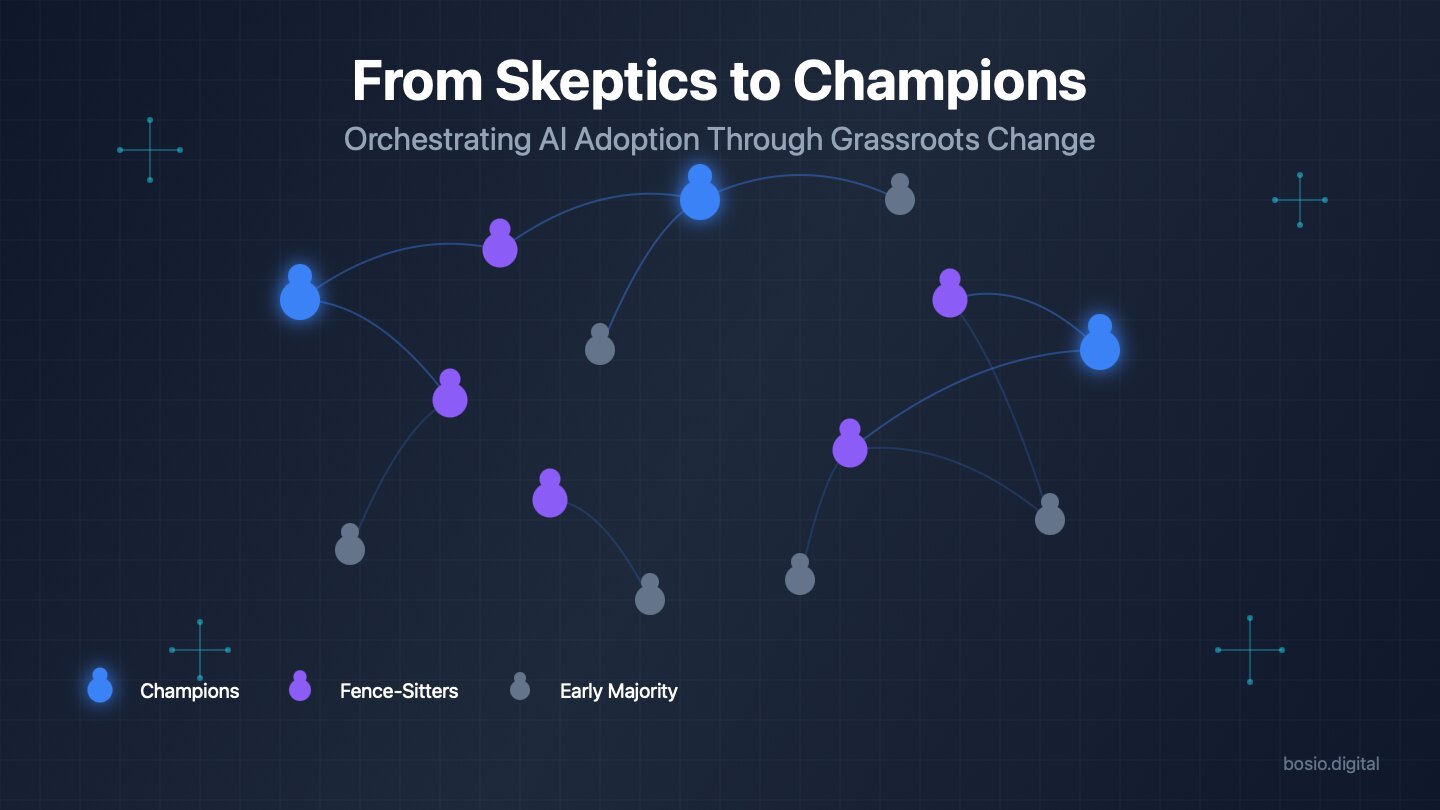
From Skeptics to Champions: Orchestrating Organizational Change in AI Adoption Without Top-Down Mandates

Sarah had done everything by the book. As VP of Operations at a 75-person manufacturing software company, she'd gotten executive buy-in, allocated budget, selected the right tools, and sent a company-wide email announcing their AI transformation initiative. She'd even organized mandatory training sessions. Three months later, adoption sat at 11%.

read more

Two fingers touching
High-Impact, Low-Complexity: The 15 Most Valuable AI Use Cases for Mid-Market Companies

The business world finds itself at a curious inflection point. While conversations about AI's transformative potential echo through every boardroom and business publication, a stark implementation gap persists, particularly among mid-market companies. We've collectively reached a stage of AI awareness, but the journey toward meaningful implementation remains elusive for many.

read more

Is Your Business and Team Ready for AI? The Real-World Assessment

77% of small businesses use AI, but most don't know if they're ready for it. Take our 15-minute assessment to discover your AI readiness across 5 key foundation blocks and get a practical action plan for your business and team.

read more

From Rankings to Citations: The New Search Playbook

Google's AI Overviews now appear in 47% of all searches, and when they do, 60% of users never click through to any website. This isn't the death of search visibility—it's a transformation from a rankings economy to a citation economy. The question is no longer "How do we rank higher?" but "How do we become the source that AI systems cite?"

read more

Female CEO speaking to the Board
Beyond the ROI Question: A More Intelligent Approach to Measuring AI's Human-Centered Value

"Discover a more comprehensive framework for measuring AI's true business value beyond traditional ROI. Learn how to assess AI's impact across operational efficiency, capability development, human capital, and strategic positioning to make better investment decisions and create sustainable competitive advantage through human-centered AI implementation.

read more

AI Adoption: A Business Guide

Your guide to strategic AI adoption. Learn why to adopt AI, navigate risks like cost & skills gaps, and implement it effectively.

read more

People using AI
AI Transformation. Humans First: The Mindful Prompting Approach

In a world racing to automate thinking, we believe that true AI transformation isn't about surrendering human expertise to algorithms—it's about amplifying our uniquely human capabilities while preserving our sovereignty of thought. This philosophy—AI Transformation. Humans First.—forms the foundation of our approach at bosio.digital. It emerged from a profound recognition: as AI capabilities accelerate, we stand at a pivotal moment in human history. The tools we're creating have unprecedented potential to either diminish or enhance what makes us distinctly human.

read more

Making AI Work for Your Teams: A Practical AI Adoption Guide

The business world reached a turning point in early 2025. While large enterprises have been investing in AI for years, a new trend has emerged that's particularly relevant for organizations with 25-100 employees: team-level AI adoption.

read more

webflow tempalte
Why Leading Companies are Leaving WordPress Behind for Webflow

Leave the limitations of WordPress behind. Webflow empowers you to create cutting-edge websites that reflect your brand's innovation and ambition.

read more

Image of Google Search screen courtesy of Christian Wiediger, unsplash.com.
How To Build An SEO Strategy

SEO stands for search engine optimization – and everyone needs it. Working with an SEO agency can raise your website’s ranking on search engine results pages, making it easier for people to find.

read more

Image of art supplies courtesy of Balazs Ketyi, unsplash.com.
How To Develop A Strong Brand

A brand strategy defines who your company is and what it is all about to potential clients or customers. The process may seem intimidating, but breaking it down into steps – and working with experts helps to demystify the process.

read more

Image of a desk and accessories courtesy of Jess Bailey, unsplash.com.
How To Develop Converting Content

A content strategy is a plan for how your business will create any type of content including pieces of writing, videos, audio files, downloadable assets and more. Businesses need content.

read more

Image of post-it notes on a wall courtesy of Patrick Perkins, unsplash.com.
How To Develop A Digital Marketing Strategy

A digital marketing strategy is your plan for everything online about your brand including your business’s website, social media, SEO, content strategy, and more. It helps you to achieve business goals like increasing sales or lead generation.

read more