

What is an AI operating system?
An AI operating system is the layer that holds what your company knows and how it works, so that every team’s AI runs on the same intelligence instead of scattered chatbots with no memory. The term is used four different ways: a computer operating system with a model built in, a data infrastructure platform, an agent orchestration framework for developers, and a business operating layer.
Only the last one is something a company runs on, and it is built in five stages: context (what the AI knows), the work (what it actually runs), the gate (where humans decide), the loop (how corrections make it better), and the proof (how you know it is working). What changes as a company grows is not the five stages. It is how many people have to agree on them.

Questions as you read? Ask, or take the context files with you.
Where should we send it?
Sent ✓ Download it now →
Start here
Type “ai operating system” into Google and you get four different products.
One result is a literal computer operating system with a model built into it, the Windows question, whether the desktop as we know it survives. Another is a data infrastructure platform, the plumbing that moves training data around. Another is an orchestration framework for developers who are building agents and need somewhere to run them. And somewhere down the page, usually below the fold, sits the only result that describes something a company runs on. On the search we ran in August 2026, that one was in position twenty, and it was 667 words of vendor copy.
Thirteen hundred people a month search that phrase. Most of them are asking one of the first three questions. But a growing number of them are executives asking the fourth, and the fourth question has almost no honest answer on the open web.
So here is ours, and here is the argument in one line: there is a fourth category that nobody names, and it is the only one your company will ever actually operate.
The confusion is not accidental. It is what happens when a term gets useful before it gets defined, and four industries reach for it at once. One of the better results on that page, from a developer tools company, does try to sort the mess out. It splits AI operating systems into three categories: infrastructure layer, agent orchestration, and specialized systems. That is a genuinely useful taxonomy, and it is missing the entire business meaning. All three of its categories are things engineers install. None of them is a thing a company runs on.
That gap is worth taking seriously, because the business version is the one with money attached to it, and it is the one nobody is describing.
That middle number is the whole problem in one line. RSM surveyed 1,030 middle-market executives in July 2026. Eighty-six percent said AI is integrated into operations. Thirty-six percent said it is embedded across core processes. The gap between those two figures is the gap between owning tools and running a system, and closing it is what the rest of this article is about.
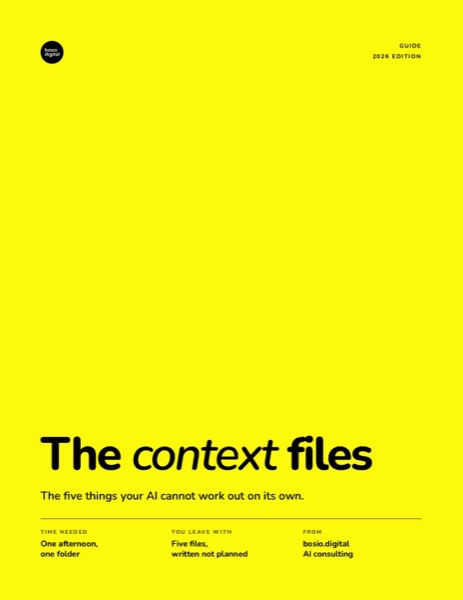
The five context files.
Fill-in templates for what your AI should know, and the page that says where each one loads.
On its way. Check your inbox, or download it now →
The four things people mean
Before the useful definition, the four meanings, because you cannot buy the right thing while the word is doing four jobs.
A computer operating system with AI inside it. This is the consumer and developer question: does the desktop get rebuilt around a model, and does the operating system start doing the work instead of launching the applications that do the work? Research projects and several large platform efforts live here. It is a real and interesting question. It has nothing to do with how your firm runs.
An infrastructure or data platform. Storage, pipelines, the movement of very large amounts of data to and from very large amounts of compute. Vendors in this category use “operating system” the way a data center uses it. If you are not training models, this is not your layer.
An agent orchestration framework. This is the developer meaning, and it is the fastest growing of the four. The most complete example we found lists nine components: agent identity, memory architecture, a tool and skill registry, an orchestration engine, a knowledge base, communication interfaces, security and access, monitoring, and workflow automation. That list is accurate and it is well made. It is also a build specification for engineers. It describes what a platform needs, not what a company needs, and the difference matters more than it sounds.
A business operating layer. The system that holds what your company knows and how it works, so that everyone’s AI is working from the same understanding of the business. This is the one almost nobody writes about, and it is the only one where the buyer is an executive rather than an engineer.
The tell is who the components are for. Nine technical components describe a platform a developer assembles. What a company needs is different in kind: not a list of parts, but an order of operations. Not “what does this system contain” but “what do we build first, and how do we know it worked.”
That is the gap. Nobody on that results page describes what a company builds, in what order, with a named owner at each step. So that is what the rest of this is.
The AI Briefing
Tuesdays. 500+ leaders. No hype, just what works.
The one that matters: what a company actually runs on
Here is the definition we use, and it is deliberately plain.
An AI operating system is the layer that sits between your business and whatever models you happen to be using, holding three things: what the company knows, how the company works, and who decides what. Every team’s AI reads from it. When someone corrects it, the correction lands in the layer rather than in a chat window. It outlives the model you are on, the vendor you buy from, and the people who wrote it.
The word “operating system” earns its place for one reason. An operating system is the thing that other things run on. It is not an application. Nobody uses an operating system directly, and the test of a good one is that the software running on top of it behaves consistently without each program having to reinvent the basics. That is exactly the relationship between this layer and the AI your teams touch every day.
Which means the opposite of an AI operating system is not “no AI.” The opposite is what most companies have right now: eleven subscriptions, four teams, and no shared memory. Every conversation starts from zero. Every good result is a personal achievement that leaves when the person leaves. Every correction gets made again next week by somebody else.
There is a related question that is not the same question, and it is worth separating cleanly. When a vendor’s platform starts absorbing more of the workflow, the reasonable thing to ask is whether Claude is becoming an operating system you build on rather than one you merely use. That is a platform question, and it is about dependency and leverage. This is an architecture question, and it is about what belongs to you regardless of the platform. You can answer the platform question wrong and recover. Answer this one wrong and you have nothing to move.
The five stages below are a build sequence, not a maturity model that describes you. The order is load bearing: each stage assumes the one before it. Skipping ahead is the single most common way this goes wrong, and it is why so many agent projects stall at the demo.
Stage 1: Context (what the AI knows)
Everything else is built on this, and it is the stage companies most want to skip, because it looks like documentation and documentation feels like the opposite of progress.
What you build. Five things the model cannot work out on its own: how you sound, what things cost and who can approve an exception, what never leaves the room, what “done” looks like for the work you produce most often, and a short orientation file on what you actually do. We have written the full context engineering method for the five files separately, including what goes in each one and how to write them by counter-example, which is the part that makes them usable.
The reason this stage is non-negotiable is that these five are not derivable. A model can infer a great deal from context, but it cannot infer your discount floor, and it cannot infer which client’s facts must never appear in another client’s document. It will guess, confidently, and the guess will be wrong in a way that produces no error message.
Who owns it. One person, by name. Under twenty-five people that is usually the founder, which is inconvenient because the founder is busy, and it is still correct, because the context is in their head.
How you know it worked. Open a fresh session with no setup and ask for something typical: a client email, a scope note, a proposal section. If the output could have come from any company in your industry, the layer is not loaded or not specific enough. If it sounds like you on a good day, stage one is done enough to build on.
The deeper version of this stage, where the context layer stops being files and starts compounding, is what makes the difference between a folder that ages and a layer that gets more valuable each quarter. But it starts as five files, and it should exist before it is good.
Stage 2: The work (what it actually runs)
Once the system knows the business, it can start doing the business. This is where most companies go wrong, and they go wrong in a specific and expensive way: they buy agents.
The instinct is understandable. An agent is a thing you can point at. But an agent without stage one is a very fast employee with amnesia, and twenty-five of them is not an operating system. It is AI agent sprawl, and it makes a business measurably less intelligent, because knowledge fragments across tools that cannot see each other and each one has to be updated by hand.
What you build. Encoded procedures rather than accumulated agents. The distinction that matters here is AI skills versus agents: a skill is a written-down way of doing one job that any capable model can pick up and run. A generic model with a library of your procedures beats a zoo of specialists, because the procedures are portable, readable, and fixable by the people who own the work.
Start with the work that is repeatable, high volume, and currently inconsistent. Not the most impressive job. The most repeated one. The first thing you encode should be something your team does weekly and argues about occasionally, because the argument is the sign that the standard was never written down.
The shift the team has to make. This is the part that is organizational rather than technical, and it is the reason capable teams stall. The skill your people need is not prompting. It is defining what “good” looks like and then checking against it. Prompting is a personal trick that leaves with the person. A defined standard is an asset that stays, and it is the thing that turns a demo into a process.
How you know it worked. Two different people run the same job through the system on different days and get results that a reviewer would grade the same. If the output quality depends on who started it, you have a talented user, not a system.
Stage 3: The gate (where the human stays)
Stage two makes the system capable. Stage three is what makes it safe to let it be capable, and it is the stage that gets built last, usually the week after something goes wrong.
What you build. A written answer to one question, per category of work: who decides. Three tiers is usually enough. The system may act alone. A named person must approve. Nobody may commit without an executive. Most of the value here comes from having written it down before the situation arrives, because the alternative is that the answer gets invented under pressure by whoever is in the room.
The common failure is treating this as a policy document. A policy that lives in a PDF is advice. What you need is a gate: a point in the actual workflow where the thing stops until a person acts. If the constraint is a sentence in a document rather than a step in the process, it is decoration.
Who owns it. This is the question the org chart answers badly. In most companies AI ownership defaults to IT, which owns the rails and cannot own the judgment. We have covered who should actually own AI adoption in full, and the short version is that ownership splits: the executive owns the why, IT owns the rails, and a named person per domain owns the standard. Nobody owns all three, and pretending one person does is how it stalls.
The design principles are not ours and do not need to be reinvented. Anthropic’s own framework for trustworthy AI agents sets out human control, value alignment, security, transparency, and privacy as the load-bearing five, and the useful pattern inside it is progressive trust: start with approval on everything, and widen autonomy as the system earns it, per category, with evidence.
A constraint written in a policy document is advice. A constraint written into the workflow is a gate. Only one of them stops anything.
The wider compliance and risk picture, which is a different animal from the day-to-day gate, sits in our AI governance framework. The two are related but not the same: governance is the rulebook, the gate is the mechanism. Companies that build the rulebook and skip the mechanism have an opinion, not a control.
How you know it worked. Ask what the system did last week without asking anyone. If nobody can answer that from memory or from a log, the gate does not exist yet, whatever the document says.
The five context files.
Fill-in templates for what your AI should know, and the page that says where each one loads.
On its way. Check your inbox, or download it now →
Stage 4: The loop (how it gets better)
Everything to this point produces a system that is as good as the day you built it, and then slowly worse. Stage four is what makes it get better instead, and it is the stage that separates an asset from a depreciating one.
What you build. One rule, applied without exception: corrections go back into the layer, not just into the chat. When someone fixes an output, the fix has to land where it will apply next time, which means in the context file or the encoded procedure, not in the conversation that gets closed. That single habit is most of what a learning loop architecture actually is in practice.
The rest is cadence and a human gate. A standing review, monthly at first, that asks one question: what did we correct this month that we are going to have to correct again? Whatever answers that question is the queue. Someone reviews the queue, approves what should become permanent, and rejects what was a one-off. The approval step is not bureaucracy. Systems that apply every correction automatically drift, because not every correction is a rule, and you lose the ability to explain why the system behaves the way it does.
Who owns it. The same named owner per domain from stage one. The loop fails when it is nobody’s job, and it fails quietly, which is worse. Nothing breaks. The system simply stops improving, and six months later it is a beautiful, comprehensive, out-of-date thing that people have stopped trusting and started working around.
How you know it worked. The clearest signal is negative: the same correction stops recurring. Track the two or three things your team fixes most often, and watch whether they stop appearing. If the same fix is still being made in month four, the corrections are landing in conversations and evaporating.
Stage 5: The proof (how you know)
The last stage is the one that gets skipped by everyone who is enjoying themselves, and it is the reason good AI programs get cancelled by people who were never shown a number.
What you build. A small number of measures, agreed before the build rather than assembled afterwards to justify it. Small is the operative word. Three is usually right, and the temptation to add a fourth should be resisted, because a dashboard nobody reads is the same as no measurement with more effort.
The mistake that ruins this stage is measuring the wrong thing for the stage you are at. Asking for enterprise margin impact from a context layer that went live six weeks ago is not rigor, it is a category error, and it kills good work early. Each stage of maturity returns something different, and returns it on a different timescale. We mapped the AI ROI of each maturity stage precisely so that this conversation can happen with a shared expectation instead of a disappointed one.
What to measure, roughly. Time recovered on the specific jobs you encoded in stage two, which is the earliest honest signal. Adoption depth, meaning how many people use it for real work rather than how many have logins, because a license is not adoption. And then, later than most executives want, margin. Measuring AI return on investment on the human side matters here too, and it is not soft: whether the work got better or merely faster is the difference between a change people sustain and one they quietly abandon.
How you know it worked. You can answer “what did this return” in one sentence, with a number in it, to someone who was not involved. If the answer requires context, apologies, or a story about how it is early days, the proof stage has not been built.
If nobody outside the project can state what the system returned, in one sentence with a number in it, the proof stage does not exist yet.
What changes with size
The five stages do not change with headcount. This is the part that surprises people, and it is worth being precise about why.
A consultant working alone needs the same five stages as a three-hundred-person firm. The AI still has to know how they sound, what they charge, what they never say, what finished work looks like. It still has to run repeatable jobs repeatably, still has to stop before certain decisions, still has to absorb corrections, still has to prove it returned something.
What changes is not the stages. It is how many people have to agree on them.
When it is just you, up to about twenty-five. Writing the layer down is an extraction problem. The knowledge is in one head and needs to get onto a page. The whole job is to make it exist. Elegance is the enemy, because elegance is the excuse people use to wait, and at this size a rough layer that exists beats a good one that is still being designed.
Roughly twenty-five to a hundred. It becomes an arbitration problem, and this is where projects stall in a way solo ones never do. The knowledge is in several heads, those heads disagree, and writing it down forces somebody to decide who is right. Sales thinks the discount floor is one number. Finance thinks it is another. Nobody has been wrong until now, because nobody had to write it in a file that a machine would then apply a thousand times. The work looks like documentation and is actually a series of small political decisions.
Past a hundred. It becomes an authorization problem. Access stops being advisory and has to be structural, because telling a system not to reveal something is a convention rather than a control. Freshness stops being a habit and becomes a rule with dates on it. The five stages are now infrastructure with owners, review cycles, and boundaries between them.
The axis is not headcount. It is how many people have to agree. Every difficulty that arrives later arrives for that reason and no other.
This is why the tier language used by most vendors is unhelpful. A solo professional is not the beginner version of an enterprise. They are the clean case: the same five stages, with the agreement problem removed. And a two-hundred-person firm is not doing something more advanced. It is doing the same five things while negotiating.
What we run ourselves
We run one, and the honest report is more useful than a polished one.
The five stages are how our own firm operates: the context layer our work reads from, the encoded procedures that produce our deliverables, the gates that stop certain things from going out without a person, the loop that turns corrections into permanent changes, and the measures that tell us whether any of it is returning anything.
It is also not clean. An audit of our own system in July 2026 found roughly 1,500 lines being loaded into every session regardless of relevance, two overlapping memory systems that had grown up beside each other, and two separate logs each over a thousand lines. None of that was designed. It accumulated, the way things accumulate when a system is used daily and pruned rarely.
We fixed some of it, kept some of it deliberately, and left the money rules and the confidentiality boundaries verbose on purpose, because those are the places where being terse is expensive. The reason to mention it at all is that the failure mode of an article like this is implying the result is tidy. It is not tidy. It is operated. The difference between a system that works and one that does not is much less about elegance than about whether somebody owns each part and looks at it on a schedule.
Where outside help fits
Most of this is genuinely self-serve, and you should not hire anyone for the part you can do in an afternoon. Stage one in particular is a solved problem: open a folder, write five files, start. If a firm’s first proposal is to run a discovery phase before you have written anything down, you are paying someone to watch you not start.
Three things are harder from the inside, and the reasons are structural rather than technical.
Arbitration is political. Deciding whose version of the discount floor is canonical means telling somebody they have been doing it wrong. That conversation goes better when the person asking has no stake in the answer, which is most of what an outsider is genuinely for once several people share the work.
Pattern recognition takes repetition. Knowing which of your five stages will rot first, and which of today’s convenient exceptions becomes a real problem at ninety people, is a judgment that improves with having watched it happen in other companies. It is not cleverness. It is having seen the same thing fail four times.
The cadence is what decays. A one-time build degrades. What keeps an operating system alive is a standing loop with a named owner, and most firms can design that loop but few sustain it unaided through the first two quarters.
The instinct to get help here is common and well founded. Pax8’s March 2026 survey of 400 small-business leaders found 84% would trust an outside technology advisor to help implement AI. If you do bring somebody in, apply one test to us or to anyone else: ask what you own at the end. If the answer is a set of files and procedures your team can read, edit, and operate without the firm that built them, that is architecture work. If the answer is a dependency, you have bought a subscription to your own knowledge. That is the standard behind an AI operating system your company owns and operates, and it is the standard to hold any partner to, including us.
Where to start on Monday
Not with agents. Not with a platform evaluation. Not with a discovery phase.
Make a folder. Write the five context files, and write them by contrast rather than description: five things you would never say, the number below which you walk away, the specific information that must never cross a specific wall. Ninety minutes gets you a first pass that is bad and real, which is the correct kind.
Then pick one job. The most repeated one, not the most impressive. Write down what “done” looks like for it in enough detail that a reviewer applying your standard would reach your verdict. Run it twice with two different people. Compare.
Then write the gate for that one job before you widen it: what the system may do alone, what needs your name, what needs nobody’s but an executive’s. One job, three lines. You are not designing a governance program, you are building the first gate so the shape exists.
Then make the loop real by doing the unglamorous thing exactly once: the next time you correct an output, put the correction in the file instead of only in the chat. That single move is the entire discipline of stage four, and it is the one people skip because it takes ninety extra seconds at the exact moment they want to be finished.
Stage five can wait a fortnight, but not longer, and the measure should be chosen before there is anything to report.
If you are past twenty-five people, do all of the above for one function first rather than the whole company. Pick the team with the most repeatable output and the clearest owner. Prove it there, then let the other domains copy a structure that already works instead of designing five in parallel and reconciling them later.
Map Your Five Stages in One Sitting
Paste this into your AI assistant. It walks your business through the five stages, tells you honestly which ones you have, and gives you the first artefact for the one you are missing.
Context: I want to map my company against a five-stage AI operating system: context (what the AI knows), the work (encoded procedures), the gate (who decides what), the loop (how corrections become permanent), and the proof (how we measure return). We are a [INDUSTRY] company with [NUMBER] people. Interview me one stage at a time. Do not move on until my answer is specific, and push back if I give you a generic one.
Step 1. Context: Ask what is written down today about how we sound, what things cost and who can approve exceptions, what must never leave the room, and what “done” looks like for our most common deliverable. Mark each one WRITTEN, PARTIAL, or NOWHERE. Do not accept “it’s in people’s heads” as WRITTEN.
Step 2. The work: Ask which jobs we repeat most often, and which of those produce inconsistent results depending on who does them. Rank them by how repeatable and how inconsistent they are. The top one is where encoding starts.
Step 3. The gate: For that top job, ask what the system may do alone, what needs a named person, and what nobody may commit to without an executive. If I have not decided, mark it UNDECIDED rather than guessing.
Step 4. The loop: Ask what my team corrects most often, and where those corrections currently go. If the answer is “into the chat,” say so plainly.
Step 5. The proof: Ask what measure would convince a skeptical colleague this was worth doing, and whether we could produce that number today.
Output: A one-page honest read on which of the five stages we actually have, a ranked list of what is missing, the single first artefact I should write this week, and a list of everything I marked UNDECIDED with a suggested owner for each.
The UNDECIDED list is usually the short and useful part. Those are the questions the business has not settled, which means the AI has been guessing at them, and so has everyone else. See where you stand →
Sources
- RSM Middle Market AI Survey 2026 · RSM US, July 21, 2026 (1,030 middle-market executives, 827 US and 203 Canadian; 86% say AI is integrated into operations, only 36% have it fully embedded across core processes; 97% report satisfaction with AI’s business value)
- Pax8 Pulse SMB Technology Report · Pax8 / Propeller Insights, March 2026 (400 US small-business leaders at companies of 5 to 499 employees, ±4.9pp at 95% confidence; 84% would trust an outside technology advisor to help their business implement AI)
- Trustworthy agents in practice · Anthropic, 2026 (the five principles applied in stage three: human control, value alignment, security, transparency, privacy; progressive trust as users move from full approval to monitoring)
- Effective context engineering for AI agents · Anthropic, September 29, 2025 (context engineering as the successor to prompt engineering, and the basis for stage one)
- The new rules of context engineering for Claude 5 generation models · Thariq Shihipar, Anthropic, July 24, 2026 (progressive disclosure; keeping instruction files light “except in highly important areas”)
- What Is Context Engineering? · IBM, 2026 (context selection, structuring and management as discrete steps)
- How to Give Your AI the Five Things It Can’t Work Out on Its Own · bosio.digital, August 10, 2026 (the full stage-one method: the five files, the counter-example technique, and the extraction/arbitration/authorization axis this article inherits)
- Stop Building Agents. Build Skills. · bosio.digital, April 2026 (why encoded procedures outperform accumulated specialist agents, the basis for stage two)
- AI Agent Sprawl: Why More Agents Is Making Your Business Less Intelligent · bosio.digital, 2026 (the failure mode of building stage two without stage one)
- Who Owns Your AI Adoption? The Org Chart Just Answered Wrong. · bosio.digital, July 12, 2026 (the ownership split behind stage three: the executive owns the why, IT owns the rails, named owners hold the standards)
- The Self-Improving AI: What Learning Loop Architecture Looks Like When It Actually Works · bosio.digital, 2026 (the three feedback paths behind stage four, and the human gate that prevents drift)
- The AI ROI Map: What Each Stage of AI Maturity Actually Returns · bosio.digital, May 2026 (what each stage returns and on what timescale, the basis for stage five)
Frequently Asked Questions
What is an AI operating system?
An AI operating system is the layer that holds what a company knows and how it works, so every team’s AI reads from the same understanding of the business instead of starting each conversation from nothing. It sits between the business and whatever models are in use, and it outlives both the model and the vendor. The term is also used for three unrelated things: a computer operating system with a model built in, a data infrastructure platform, and an agent orchestration framework for developers.
Is an AI operating system the same as an agent framework?
No, and the difference is who it is for. An agent framework is a build specification for engineers, typically listing components such as agent identity, memory architecture, a tool registry, an orchestration engine, and monitoring. A business AI operating system is an order of operations for a company: what to build first, who owns it, and how you know it worked. One describes what a platform contains. The other describes what an organization does.
What are the five stages of an AI operating system?
Context, the work, the gate, the loop, and the proof. Context is what the AI knows about the business before anyone types a request. The work is the encoded procedures it runs. The gate is where a human decides. The loop is how corrections become permanent improvements. The proof is the small set of measures that show whether it returned anything. The order matters, because each stage assumes the one before it.
Do we need an AI operating system if we are a small company?
Yes, and it is easier at small size rather than harder. The five stages are identical whether one person or three hundred use them. What changes is how many people have to agree: alone, writing it down is an extraction problem and takes an afternoon; above roughly twenty-five people it becomes an arbitration problem, because several people hold different versions and someone has to decide which is canonical.
What is the difference between buying AI tools and having an AI operating system?
Tools are used; a system is run. RSM’s July 2026 survey of 1,030 middle-market executives found 86% have AI integrated into operations but only 36% have it embedded across core processes, and that gap is exactly the distinction. Eleven subscriptions with no shared context means every conversation starts from zero and every good result leaves with the person who produced it.
Who should own the AI operating system?
Ownership splits three ways and no single person holds all of it. An executive owns the why and the decision rights, IT owns the rails and the security boundary, and a named person per domain owns the standard for that domain’s work. The most common failure is defaulting the whole thing to IT, which can own infrastructure but cannot own judgment about what good work looks like in sales or delivery.
How long does it take to build an AI operating system?
The first useful pass at stage one takes an afternoon for one person, or an afternoon plus a few conversations for a small team. Encoding the first repeatable job takes days rather than weeks. The stages that take real time are the ones requiring agreement, not the ones requiring writing, so timelines scale with how many people must sign off rather than with company size in headcount.
How do you measure whether an AI operating system is working?
Choose the measure before the build, and match it to the stage. Early on, time recovered on the specific jobs you encoded is the honest signal, alongside adoption depth, meaning how many people use it for real work rather than how many hold licenses. Margin impact comes later than most executives expect. Asking a six-week-old context layer for enterprise margin impact is a category error that kills good work early.