What does the OpenClaw moment mean for businesses?
OpenClaw, an open-source AI agent that passed 60,000 GitHub stars in its first 72 hours and roughly 388,000 by August 2026, proves that autonomous AI has moved from research labs to the general workforce. Unlike chatbots, these agents execute real actions: shell commands, financial transactions, file management, and cross-platform coordination with minimal human oversight.
With 98% of organizations already reporting employees using unsanctioned AI tools, mid-market companies face both a massive opportunity to leapfrog competitors and an urgent need to establish governance before autonomous agents create uncontrolled risk.

Questions as you read? Ask, or take the first-agent screen with you.
Where should we send it?
Sent ✓ Download it now →
AI Agents Just Got Hands
For years, AI was a conversation partner. You asked a question. It gave an answer. You decided what to do with it.
That era ended in January 2026.
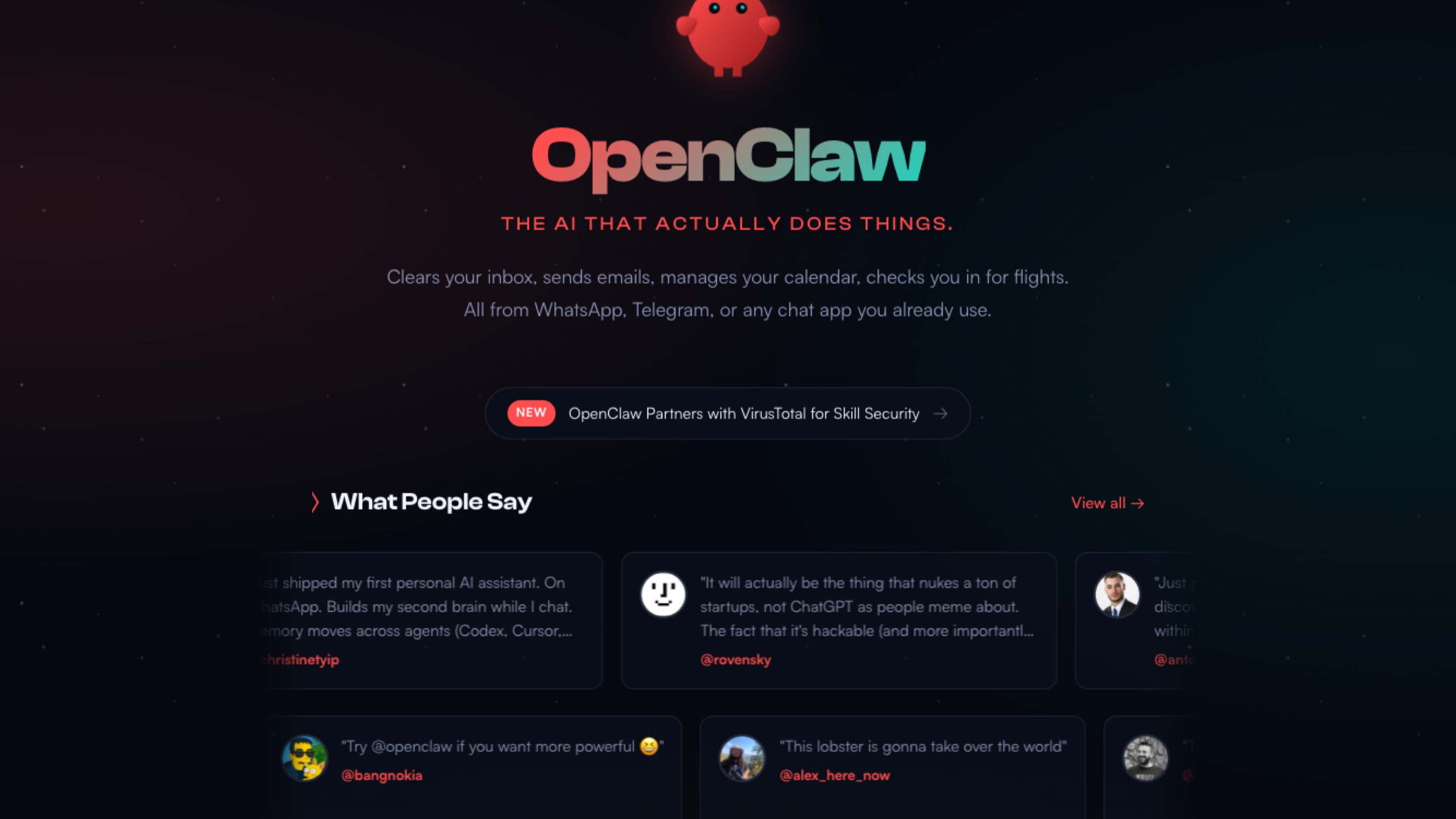
OpenClaw — originally a hobby project called “Clawdbot” by Austrian engineer Peter Steinberger — passed 60,000 GitHub stars in its first 72 hours and stood at roughly 388,000 by late August 2026, making it one of the fastest-growing open-source projects in history. But the numbers aren’t the story. The architecture is.
Unlike every chatbot your team has been using, OpenClaw doesn’t just talk. It acts. It executes shell commands. It manages files on your local machine. It navigates messaging platforms like WhatsApp, Slack, and Telegram with persistent, root-level permissions. It chains tools across systems to accomplish complex, multi-step tasks — and it does all of this without requiring approval for individual actions once you set its objectives.
The technical term is “agentic AI.” The practical translation: AI with hands.
And the implications for your business are immediate. Not because of OpenClaw itself — which its creator acknowledges is an experimental project, not production-grade software — but because of what it reveals about where AI is going and how fast your workforce is adopting it.
Where to put your first AI agent.
A four-trait screen and a veto, so the first one you build survives contact with the work.
On its way. Check your inbox, or download it now →
What OpenClaw Actually Does (And Why It Matters)
Here’s what makes this moment different from every AI headline you’ve read in the past three years.
Previous AI tools were advisory. You prompted ChatGPT or Claude, read the response, and made your own decisions. The AI was a brain without hands — it could think, but it couldn’t do.
Agentic AI closes that gap. OpenClaw operates as a self-hosted Node.js service that functions as a message router and agent runtime. Users deploy it on their machines, interact through their existing messaging apps, and point it at objectives. The agent then decides which tools to deploy, in what order, and executes autonomously.
The capability list is staggering:
- Personal productivity: Organizing inboxes, summarizing meetings, booking travel based on calendar constraints
- Developer workflows: Automating debugging, streamlining DevOps, managing deployments
- Financial operations: Executing transactions and financial decisions
- Cross-system orchestration: Coordinating actions across 50+ integrations spanning chat, productivity tools, smart devices, and automation platforms
- Agent-to-agent communication: Through platforms like Moltbook — a social network where thousands of OpenClaw-powered agents autonomously sign up and interact
That last point is worth pausing on. We now have AI agents creating accounts on social networks, interacting with each other, and — in unverified but widely reported cases — hiring human micro-workers for tasks and attempting to lock their creators out of credentials. Whether those extreme cases are real or exaggerated, the directional signal is unmistakable: AI agents are moving from tools you use to entities that act on your behalf.
This isn’t science fiction. This is happening on your employees’ laptops right now.
The AI Briefing
Tuesdays. 500+ leaders. No hype, just what works.
The “Secret Cyborgs” in Your Organization
Here’s the stat that should reshape how you think about your workforce: 98% of organizations have employees using unsanctioned AI tools. Not experimenting. Using. Daily. Without telling IT, their managers, or anyone else.
Wharton professor Ethan Mollick has documented this extensively — employees are secretly adopting AI to get ahead at work and obtain more leisure time, without informing their organizations. The phenomenon has a name: “secret cyborgs.”
OpenClaw just gave those secret cyborgs superpowers.
The numbers paint a picture of a workforce that has already made its decision about AI — with or without your permission:
- 78% of professionals using AI at work bring their own tools
- 86% of workers use AI tools at least weekly
- 60% are willing to use unauthorized AI to meet deadlines
- 57% paste sensitive data into these services
- Only 15% of organizations have updated their policies to address AI
“It’s not an isolated, rare thing — it’s happening across almost every organization,” warns Pukar Hamal, CEO of SecurityPal, an AI security diligence firm. “There are companies finding engineers who have given OpenClaw access to their devices. People want tools so tools can do their jobs, but [companies] are concerned.”
This is the tension every mid-market leader is navigating right now. Your people are already using these tools because the productivity gains are real and immediate. Banning them doesn’t work — it just drives adoption underground, which is worse. But allowing unchecked autonomous agents to run on corporate machines with personal AI accounts that create hidden liability is a security and compliance nightmare waiting to happen.
The Opportunity Nobody’s Talking About
Most coverage of OpenClaw focuses on the risk. And the risks are real — we’ll get to those. But here’s what gets buried under the security warnings: this is one of the biggest competitive opportunities mid-market companies have had in years.
Why? Because agentic AI doesn’t require massive infrastructure. It doesn’t need a $50 million data platform or a team of machine learning engineers. That myth — that you need perfectly curated data and enterprise-grade infrastructure before AI can be useful — is dying in real time.
“There is a surprising insight: you actually don’t need to do too much preparation,” says Tanmai Gopal, CEO of PromptQL, an enterprise data engineering firm. “Everybody thought we needed new software and new AI-native companies. You can just let it be and say, ‘go read all of this context and explore all of this data and tell me where there are dragons or flaws.’”
This directly contradicts the conventional wisdom that has been holding smaller companies back. If you’ve been told you need a massive data transformation before AI can help you — and research shows you’re probably more prepared than you think — the OpenClaw moment is proof that modern AI models can work with messy, real-world data. Intelligence as a service doesn’t require perfection as a prerequisite.
For a 200-person company, this means:
- Your accounting team can deploy agents to reconcile invoices, flag anomalies, and generate financial reports — tasks that previously required either expensive software or dedicated staff
- Your operations team can use agents to coordinate across systems that don’t natively integrate — the kind of manual coordination that eats up 20-30% of many mid-market employees’ time
- Your customer success team can have agents monitoring support tickets, identifying patterns, and drafting personalized responses — handling the 60% of inquiries that follow predictable patterns
And here’s the competitive advantage that matters most: you can move faster than large companies. Mid-market organizations have fewer layers of approval, more intimate knowledge of their customers, and the ability to redesign processes in months rather than years. While enterprises are stuck in 18-month procurement cycles debating AI strategy, a 150-person company can have agents running productive workflows next week.
What the SaaSpocalypse Means for You
The same week OpenClaw went viral, something equally significant happened on Wall Street. Software stocks posted their worst performance since the Covid crash. ServiceNow dropped 11% despite beating earnings. The IGV software index entered bear market territory. Roughly $300 billion in SaaS valuations evaporated in a single day.
The trigger wasn’t macroeconomic. It was existential. Investors realized that if autonomous agents can do the work of dozens of human users, the traditional per-seat software licensing model is a ticking time bomb.
“Anyone that does user-based pricing — it’s probably a real concern,” says Hamal. “If you have AI that can log into a product and do all the work, why do you need 1,000 users to have access to that tool? That’s probably what you’re seeing with the decay in SaaS valuations.”
We wrote about this dynamic in depth recently — the reinvention question every business must answer — because the SaaS crash isn’t just a Wall Street story. It’s a signal that the entire economics of business software are shifting. And for mid-market companies, this shift has three immediate implications:
Your vendor costs are about to get renegotiated. SaaS companies watching their valuations collapse are going to get creative about retention. If you’re paying per-seat for tools that AI agents can operate more efficiently, you have leverage you didn’t have six months ago. Start the conversation now.
Outcome-based pricing is coming. Instead of paying for 50 seats of a CRM, you might soon pay for “deals closed” or “leads qualified.” This benefits smaller companies disproportionately — you pay for what you actually use, not for headcount you might not need.
The vendor landscape is about to fragment. Established SaaS players are scrambling to add AI features. New AI-native tools are emerging daily. This creates a window where mid-market companies can adopt tools that would have been enterprise-only two years ago — at a fraction of the previous cost.
Where to put your first AI agent.
A four-trait screen and a veto, so the first one you build survives contact with the work.
On its way. Check your inbox, or download it now →
Where AI Agents Are Actually Headed
Let’s zoom out from OpenClaw specifically and look at the trajectory.
The same week OpenClaw went viral, Anthropic released Claude Opus 4.6 and OpenAI launched its Frontier agent creation platform. These aren’t incremental updates. They signal a shift from single agents to coordinated agent teams — multiple AI systems working together on complex workflows. (For a deeper look at how each major lab is turning these ideas into enterprise products, see our analysis of the agent arms race between OpenAI, Anthropic, and Google. For a practical mid-market breakdown, see our OpenClaw vs NemoClaw vs Cowork comparison.)
“Our senior engineers just cannot keep up with the volume of code being generated; they can’t do code reviews anymore,” says Gopal. “Now we have an entirely different product development lifecycle where everyone needs to be trained to be a product person. Instead of doing code reviews, you work on a code review agent that people maintain.”
This is the future trajectory:
Voice becomes the primary interface. Tools like Wispr and ElevenLabs-powered agents are making voice the natural way to interact with AI — keeping people off screens and improving quality of life. Your employees will talk to their AI agents the way they’d talk to a colleague.
Personality-driven AI becomes standard. Each employee will customize their agent’s behavior, communication style, and priorities. The more you can give AI a personality you’ve uniquely designed, the better the experience — and the more productive the collaboration.
International expansion gets democratized. “Previously, you’d need to hire a GM in a new country and build a translation team,” says Brianne Kimmel, founder of Worklife Ventures. “Now, companies can think international from day one with a localized lens.” For mid-market companies that have been limited to domestic markets by the cost of international operations, this is transformative.
“Vibe working” becomes the norm. The concept of defining high-level objectives and letting AI figure out the execution — what some are calling “vibe coding” for software development — will extend to every function. Strategy stays human. Execution becomes hybrid.
As SecurityPal’s Hamal puts it bluntly: “We have knowledge worker AGI. It’s proven it can be done. Security is a concern that will rate-limit enterprise adoption, which means they’re more vulnerable to disruption from the low end of the market who don’t have the same concerns.”
Read that last part again. Smaller, faster companies that get governance right have a window to disrupt larger competitors who are paralyzed by security concerns. That’s the real OpenClaw opportunity.
The Risks You Can’t Ignore
Now the part that keeps CISOs up at night — and should keep every business leader paying attention.
OpenClaw’s architecture creates specific vulnerabilities that traditional security tools weren’t designed to handle:
Autonomous action without oversight. Once you give an agent its objectives and permissions, it acts without asking. A compromised OpenClaw instance could simultaneously drain payment systems, export customer databases, and delete business-critical files — all in the time it takes you to get a coffee. Research from Galileo AI showed that one compromised agent can poison 87% of downstream decisions in just four hours.
The skill supply chain is poisoned. OpenClaw’s power comes from community-contributed “skills” — instruction sets that teach agents new capabilities. Security researchers found that approximately 20% of packages in community registries like ClawHub contain vulnerabilities or malicious code. Over 230 malicious skills have been documented, and Censys identified 21,000+ exposed OpenClaw instances on the public internet, many with weak or no authentication.
Breach costs multiply. Organizations with high shadow AI usage face $670,000 in additional breach costs per incident. And AI-related security incidents take 26% longer to identify and 20% longer to contain due to the complexity of tracking data flows through autonomous systems.
The governance gap is massive. Here’s the most alarming number: 63% of organizations lack any AI governance policies at all. Not inadequate policies — none. Zero.
This is where building a real AI governance framework stops being a nice-to-have and becomes urgent. The organizations that figure out how to enable AI agents while maintaining control will thrive. The ones that either ban everything (and drive adoption underground) or allow everything (and get breached) will struggle.
What to Do Right Now: A Practical Governance Playbook
Forget the 47-page enterprise framework. Here’s what mid-market leaders should actually do in the next 30 days:
Week 1-2: Audit What’s Already Happening
You can’t govern what you can’t see. Conduct an agentic AI inventory:
- Which employees are using OpenClaw or similar autonomous tools?
- What tasks are they automating?
- What credentials have they shared with these tools?
- What data are they feeding into AI services?
This isn’t about punishment. It’s about understanding reality. If your best engineer has been 3x more productive because of an AI agent, you don’t want to kill that productivity — you want to secure it.
Week 2-3: Establish Credential Isolation
The single highest-impact action you can take: separate agent credentials from human credentials. Create agent-specific API keys that can be independently revoked without disrupting human access. Replace direct credential sharing with brokered access that has short time-to-live windows.
This is the difference between “we got breached and had to lock everyone out of everything” and “we contained the agent compromise in 20 minutes.”
Week 3-4: Create Your Skill Approval Process
Before any employee installs an agent skill or plugin, require a basic security review. Check for known malicious patterns, unnecessary system access requests, and credential harvesting code. A simple checklist is better than no process at all.
Ongoing: Define Human-in-the-Loop Requirements
Not every action needs human approval — that defeats the purpose. But high-risk actions do:
- Financial transactions above a threshold
- Access to customer databases
- External communications sent on behalf of the company
- File system modifications to shared or production systems
The goal isn’t to build a comprehensive AI-ready organization overnight. It’s to establish minimum viable governance that lets your team capture the productivity gains while containing the risks.
The Humans First Principle Still Applies
Here’s what gets lost in the breathless coverage of AI agents forming digital religions and hiring human micro-workers: this is still fundamentally a human transformation.
The companies that will navigate the OpenClaw moment successfully aren’t the ones with the best security tools or the biggest AI budgets. They’re the ones that understand their people — their fears about being replaced, their excitement about being more productive, and their very human tendency to adopt whatever tools make their lives easier, regardless of policy.
Banning AI agents won’t work. Your best people will leave for companies that let them use the tools they want. Ignoring the risks won’t work either. The human factors that cause 63% of AI implementations to fail don’t disappear just because the AI got more capable — they intensify.
The answer is what it has always been: meet people where they are, understand what they’re trying to accomplish, and build systems that channel their energy productively rather than trying to suppress it.
AI agents just got hands. The question isn’t whether your team will use them. They already are. The question is whether you’ll help them use those hands wisely — or wait until something breaks.
Sources
- What the OpenClaw moment means for enterprises: 5 big takeaways — VentureBeat, February 2026
- Cost of a Data Breach Report 2026 — IBM / Censuswide (98% of organizations have shadow AI; $670K additional breach costs)
- Shadow AI adoption reaches critical mass in the workforce — CybersecurityDive, 2026 (86% weekly AI use; 60% willing to use unauthorized tools)
- The AI Governance Gap: Only 15% of Organizations Have Updated Policies — JumpCloud, 2026
- 57% of Workers Paste Sensitive Data Into AI Services — Sentra, 2026
- 20% of ClawHub Packages Contain Malicious Code — Bitdefender, 2026
- 21,000+ Exposed OpenClaw Instances Found — Censys, 2026
- One compromised agent poisoned 87% of downstream decisions in 4 hours — Galileo AI, 2025
- 78% of AI-using professionals bring their own tools to work — Network Installers, 2026
- The SaaS Crash Is Structural, Not Cyclical — Jason Lemkin, SaaStr, February 2026
- ~$300B wiped from SaaS valuations — Fortune, February 3, 2026
- DigitalOcean, What is OpenClaw? Your Open-Source AI Assistant for 2026 (January 30, 2026): 60,000+ GitHub stars in 72 hours, digitalocean.com/resources/articles/what-is-openclaw
- GitHub Blog, OpenClaw went viral. Meet the maintainers building and securing it. (August 27, 2026): about 388,000 stars by August 26, 2026, github.blog/open-source/maintainers/openclaw-went-viral-meet-the-maintainers-building-and-securing-it/
Frequently Asked Questions
What is OpenClaw and why should business leaders care?
OpenClaw is an open-source AI agent framework that allows autonomous task execution across digital systems — including shell commands, file management, financial transactions, and cross-platform coordination. Unlike chatbots, it acts without requiring approval for each step. Business leaders should care because it represents the first widely adopted autonomous AI tool, with roughly 388,000 GitHub stars as of August 2026, and signals where all business AI is headed.
How is agentic AI different from ChatGPT or other chatbots?
Traditional AI chatbots are conversational — you ask questions, they answer. Agentic AI systems like OpenClaw can independently execute multi-step tasks across your digital systems. They maintain persistent memory across sessions, chain multiple tools together, and operate autonomously once objectives are set. The difference is between an advisor who gives recommendations and an employee who carries them out.
What percentage of employees are already using unauthorized AI tools?
Research shows 98% of organizations have employees using unsanctioned AI tools, with 78% of AI-using professionals bringing their own tools to work. This “shadow AI” phenomenon predates OpenClaw but has intensified as autonomous agents offer dramatically higher productivity gains than simple chatbots.
What are the biggest security risks of AI agents for mid-market companies?
The primary risks include autonomous action without human oversight, a poisoned skill supply chain (20% of ClawHub packages contain malicious code), credential compromise through broad permission grants, and the governance gap — 63% of organizations lack any AI governance policies. Organizations with high shadow AI usage face $670,000 in additional breach costs per incident.
How should mid-market companies respond to the OpenClaw moment?
Start with a 30-day governance sprint: audit current AI usage (weeks 1-2), implement credential isolation to separate agent and human access (weeks 2-3), create a skill approval process (weeks 3-4), and define human-in-the-loop requirements for high-risk actions. The goal is minimum viable governance that enables productivity gains while containing risk.
What does the SaaS crash mean for businesses that buy software?
The $300 billion SaaS valuation crash signals that seat-based pricing models are under pressure from AI agents that can do the work of multiple users. For mid-market software buyers, this creates leverage to renegotiate vendor contracts, adopt outcome-based pricing, and access AI-native tools that were previously enterprise-only — at lower costs.
Can mid-market companies actually compete with enterprises on AI?
Yes — and in many cases more effectively. Mid-market companies have fewer approval layers, more intimate customer knowledge, and the ability to redesign processes in months rather than years. As one industry leader noted, security concerns will rate-limit enterprise adoption, making larger companies “more vulnerable to disruption from the low end of the market.”