

Why does company context matter more than AI tools?
When every company has access to the same AI models, the differentiator isn’t the technology — it’s the context you feed it. According to Harvard Business Review’s February 2026 research, two nearly identical B2B companies using the same AI tools produced dramatically different results; the variable was context.
Organizations that build structured knowledge bases — capturing institutional intelligence, decisions, processes, and hard-won experience — create a compounding advantage that makes every AI interaction more valuable over time. Meanwhile, Gartner reports that 30% of generative AI initiatives are abandoned post-proof-of-concept specifically because organizations failed to structure their knowledge for AI.

Questions as you read? Ask, or take the context files with you.
Where should we send it?
Sent ✓ Download it now →
The Asset Nobody’s Building
The most valuable asset your company will build in the next five years won’t be a product, a platform, or a patent. It will be a knowledge base.
Not a dusty SharePoint library or an internal wiki that nobody updates. A living, structured repository of your company’s institutional intelligence — the decisions you’ve made and why, the processes that actually work, the customer insights you’ve earned over years, the hard-won experience that makes your organization uniquely yours.
This is a bold claim. It’s also one that’s rapidly being proven by the organizations that understood it earliest.
In February 2026, Harvard Business Review published research examining two nearly identical B2B companies — similar size, similar industry, similar budgets, access to the same AI models. One produced transformative results. The other got mediocre, generic output that barely justified the investment. The variable wasn’t the technology. It wasn’t the budget. It wasn’t even the talent.
It was context.
The company that won had built a structured knowledge base that gave AI the context to understand their specific business — their customers, their processes, their competitive positioning, their institutional memory. The other company handed AI the same generic prompts everyone else was using and got the same generic answers everyone else was getting.
This distinction is about to separate the companies that thrive with AI from the ones that spend millions and have nothing to show for it. And right now, almost nobody is building the asset that makes the difference.
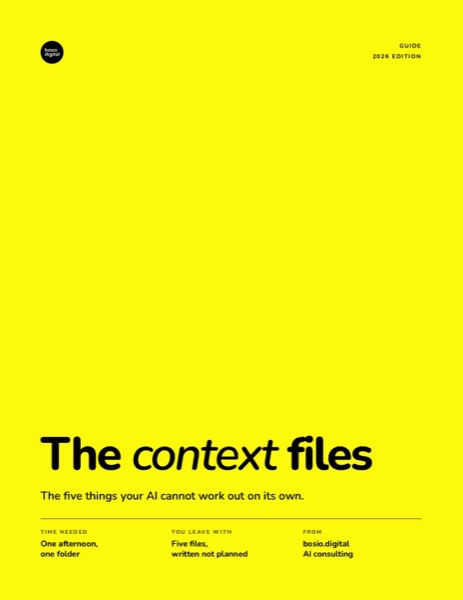
The five context files.
Fill-in templates for what your AI should know, and the page that says where each one loads.
On its way. Check your inbox, or download it now →
Why AI Gives You Generic Output
Here is the uncomfortable truth that most AI vendors will never tell you: the AI tools you’re paying for are fundamentally the same AI tools your competitors are paying for. GPT-4, Claude, Gemini — these models are available to everyone. The underlying technology is rapidly commoditizing. Prices are falling. Access is universal.
So why does your competitor seem to be getting better results?
Think of it this way. Hiring a world-class management consultant and dropping them into your company on Day One without a briefing — no background on your industry, your customers, your competitive dynamics, your organizational quirks — produces exactly what you’d expect: polished, intelligent, thoroughly generic advice. The kind of output that sounds impressive in a slide deck and accomplishes nothing in execution.
That’s what most companies are doing with AI right now. They’re deploying powerful models with zero context and wondering why the output feels hollow. Teams spend fifteen minutes crafting a prompt, get a five-paragraph response that could have come from any business textbook, and conclude that AI isn’t ready for their industry. But the AI was ready. It just didn’t know anything about them.
The data confirms this at scale. According to Gartner, 30% of generative AI initiatives are being abandoned post-proof-of-concept — not because the technology failed, but because fragmented organizational knowledge made it impossible to move from impressive demo to meaningful business result. Meanwhile, research from MIT Sloan Management Review found that 95% of enterprise AI pilots fail to deliver measurable P&L impact.
Ninety-five percent. Not because AI doesn’t work — but because organizations feed it inputs that are as generic as the outputs they complain about.
This is the pattern we see repeatedly when working with mid-market companies. Leaders invest in AI tools, roll them out with enthusiasm, and within weeks, adoption stalls. Teams try the tools a few times, get responses that feel like they could apply to any company in any industry, and quietly go back to doing things the old way. The tools get blamed. The vendor gets blamed. Nobody stops to ask the real question: what did we actually give the AI to work with?
Gartner reports that 57% of organizations lack AI-ready data infrastructure — and the word “infrastructure” here doesn’t mean servers or cloud spend. It means organized, accessible knowledge that AI can actually use.
The problem isn’t the AI. The problem is that the AI has nothing meaningful to work with. It’s a brilliant consultant sitting in an empty room.
The AI Briefing
Tuesdays. 500+ leaders. No hype, just what works.
What Context Actually Means
When we talk about context, we’re not talking about a technical integration project. We’re not talking about data lakes, API connectors, or IT infrastructure. We’re talking about the accumulated intelligence that makes your company yours — translated into a format that AI can understand and use.
Context falls into four categories, and each one amplifies AI’s ability to generate output that’s actually useful.
Strategic context is the foundation. This is your company’s positioning, competitive advantages, target customer profiles, pricing philosophy, growth strategy, and — critically — the reasoning behind those decisions. Most companies have strategy documents. Almost none have captured the why behind the strategy in a way that AI can access. When AI understands not just that you target mid-market healthcare companies but why you chose that segment and what specific problems you solve for them, every piece of content it generates, every analysis it produces, every recommendation it offers becomes dramatically more relevant.
Operational context is where institutional knowledge lives. These are the processes that actually work — not the ones documented in your employee handbook three years ago, but the real workflows your best people have refined through experience. How your sales team actually qualifies leads. How your operations team handles the vendor relationship that’s always tricky. How your customer success team spots an account at risk before the data does. This is the kind of knowledge that typically lives in the heads of your most experienced people and walks out the door when they leave. A structured knowledge base captures it, preserves it, and makes it available to AI — and to every employee who needs it.
Customer context is what makes personalization real instead of performative. This includes buying patterns, communication preferences, pain points, success stories, objections you’ve heard a thousand times and the responses that actually work. Research shows that companies getting AI personalization right see 40% more revenue compared to those taking generic approaches. That gap doesn’t come from better AI models. It comes from better customer context.
Cultural context is what most organizations overlook entirely, and it may be the most important category of all. Your company’s decision-making style, communication norms, risk tolerance, values in practice (not just on the wall), the way your teams actually collaborate — this is what makes AI output feel like it came from inside your organization rather than from a random consultant who’s never walked your halls. AI that understands your culture writes emails that sound like your best people, creates proposals that reflect your actual approach, and generates recommendations that your teams will actually implement because the suggestions fit how the organization actually works.
None of this requires a technical background to understand or a technology team to begin building. The executive who starts documenting strategic decisions and their reasoning this week — capturing operational processes from their best people, organizing customer insights in a structured way — is building the asset that will compound in value for years. And for leaders who worry they need perfect data before AI can help, the reality is that most organizations are more prepared than they think, which is the point of our piece on the AI data readiness myth. Structuring what you already know is far more valuable than waiting for data perfection.
The Compounding Effect
Here is where the context advantage becomes a context moat.
Every piece of knowledge you add to your company’s AI context doesn’t just make today’s output better. It makes tomorrow’s better, too. And next week’s. And next quarter’s. Because context compounds.
Consider what happens when a company builds a structured knowledge base and puts it to work. In month one, AI generates decent sales proposals because it understands your positioning and pricing. By month three, it’s generating proposals that reflect not just your positioning but which approaches have closed deals and which haven’t — because the outcomes of those first proposals have been captured back into the knowledge base. By month six, the AI understands which messaging resonates with which customer segments, which objections arise at which stages, and which competitive positioning wins in which scenarios. It’s drawing on hundreds of interactions worth of refined intelligence.
According to McKinsey’s research on AI high performers, organizations that pursue transformative AI use cases — the kind that reshape how business gets done — are more than 3x as likely to see outsized returns. What separates them isn’t more advanced technology. It’s more advanced context. They’ve built the feedback loops that turn every AI interaction into a data point that refines the next one.
This is the data flywheel that first movers are building right now, and it’s the reason the window for competitive advantage won’t stay open forever.
The knowledge base isn’t static. Every AI interaction generates new insights — what works, what doesn’t, what customers respond to, how decisions played out. A well-structured knowledge base captures this feedback and refines itself over time. The proposal that closed a difficult deal? That context gets added. The marketing message that underperformed? That learning gets captured too. The customer objection that revealed a gap in your positioning? It becomes part of the intelligence that prevents the same gap from appearing again.
This self-improving cycle is what transforms a knowledge base from a reference document into a learning system. The more you use it, the smarter it gets. The smarter it gets, the more valuable every subsequent AI interaction becomes. And this compounding effect creates an advantage that’s extraordinarily difficult for competitors to replicate — because they can’t fast-forward through the months of accumulated learning that your system has absorbed. You can copy a competitor’s AI tools overnight. You cannot copy the institutional intelligence and refined context they’ve spent a year building.
This is the same dynamic that leaders who have been through reinvention in the AI age understand intuitively. The transformation isn’t about the tools — it’s about the accumulated intelligence behind the tools.
Organizations that start building this context now will have six months of compounding when their competitors begin. In AI terms, that’s a generation. As Josh Bersin’s research indicates, AI-native knowledge systems represent a potentially $1 trillion opportunity across the $400 billion corporate learning market alone — precisely because structured knowledge that improves through use is exponentially more valuable than static documentation. Meanwhile, 74% of companies report they’re not meeting current skills demands, which means the organizations that build knowledge systems capable of self-learning will outpace those still relying on traditional training and documentation.
The compounding effect extends beyond content and proposals. In the next article in this series, we’ll explore how AI agents — autonomous systems that can execute multi-step workflows — take this foundation and amplify it dramatically. But that orchestration layer is only as powerful as the context it builds on. Without context, agents are fast but aimless. With it, they become an extension of your organization’s intelligence.
The five context files.
Fill-in templates for what your AI should know, and the page that says where each one loads.
On its way. Check your inbox, or download it now →
Why This Is a Leadership Problem
Building a company knowledge base sounds like it should be an IT project or an operations initiative. It is neither. It is a leadership responsibility, and specifically, it belongs on the CEO’s desk.
Here’s why: your company’s institutional intelligence — the collective knowledge of how your organization makes decisions, serves customers, and creates value — is a strategic asset. It’s the CEO’s job to build, protect, and deploy strategic assets. You wouldn’t delegate your competitive positioning to IT. You wouldn’t let operations define your company’s strategic direction. The knowledge base that feeds your AI is no different.
McKinsey’s latest State of AI research makes this point quantitatively. AI high performers are more than 3x as likely to pursue transformative use cases — ones that don’t just automate existing tasks but reshape how the business operates. What separates these organizations isn’t a better technology stack. It’s executive leadership that treats AI context as a strategic priority rather than a technical implementation detail.
This is fundamentally about what you feed the machine. And what you feed it reflects what you value, what you know, and how you think about your business. Those are leadership questions, not technology questions.
Consider the decisions involved. What strategic knowledge should AI have access to? Which customer insights are relevant and which are noise? How should institutional knowledge be structured so it’s genuinely useful rather than just collected? What tone should AI-generated communications take? What decisions should AI be able to inform and which should it stay away from? These are judgment calls that require deep understanding of the business — the kind of understanding that exists in the executive team, not the IT department.
We’ve worked with organizations where the human factors behind AI failure trace directly back to a leadership vacuum around knowledge strategy. Nobody owned the question of what the company’s AI should know. Nobody decided what institutional knowledge mattered. Without that leadership, teams built fragmented, contradictory knowledge sources that made AI output worse, not better.
The organizations getting this right have executives who treat their knowledge base the way they treat their P&L — as a living document that requires regular attention, honest assessment, and strategic curation. Gartner’s research found that organizations with mature knowledge management are 5x more likely to have highly engaged employees. Knowledge strategy doesn’t just make AI better; it makes the entire organization more effective.
If you’re a CEO or senior leader reading this, the question isn’t whether your company needs a knowledge base. The question is whether you’re going to lead the effort or let it happen by default — scattered across departments, inconsistent in quality, and missing the strategic context that makes AI actually transformative. Leadership here doesn’t mean doing the work yourself. It means setting the vision, allocating the resources, and ensuring that the company’s most valuable institutional knowledge gets captured before it walks out the door in the heads of your most experienced people.
What a Company Knowledge Base Looks Like in Practice
This isn’t about building a technology platform. At its core, a company knowledge base is a structured collection of your organization’s intelligence, organized so both humans and AI can access it effectively. You can start building one this week without buying a single tool.
Start with what your best people know. Every organization has people who seem to make better decisions, close more deals, resolve issues faster. What they know — the judgment, the patterns, the shortcuts, the warnings — is the highest-value context your company possesses. Capture it. Structure it. Make it accessible.
The knowledge base organizes around the four context categories:
Strategic layer. Company positioning, ideal customer profiles (with the reasoning behind them), competitive differentiation, pricing philosophy, growth priorities. Think of this as the briefing you’d give a brilliant new executive on their first day — everything they’d need to understand your business at a strategic level.
Operational layer. Process documentation that reflects how work actually gets done, not how it’s supposed to get done. Templates for common deliverables. Decision frameworks for recurring situations. Vendor relationships and their nuances. The informal rules that experienced employees know but new hires spend months discovering.
Customer layer. Aggregated insights about buying patterns, common objections and effective responses, success stories with specific details, communication preferences by segment. This is what allows AI to generate customer-facing content that feels personal and accurate rather than generic.
Cultural layer. Communication style guides, decision-making norms, values in practice, examples of great internal communication, the way your leaders frame difficult conversations, the tone your brand takes with customers. This is what most organizations never document, and it’s what makes the difference between AI output that feels foreign and AI output that feels like it came from inside the building. When this layer is strong, employees trust the AI’s output because it sounds like them — because, in a real sense, it is them.
The practical reality is simpler than it sounds. One mid-market executive we work with started by recording a series of 30-minute conversations with each department head, structured around the question: “What does someone need to know to make good decisions in your area?” Those transcripts, cleaned up and organized, became the foundation of a knowledge base that transformed their AI from a generic tool into something that understood their business.
For organizations already exploring AI readiness, the knowledge base provides the foundation that makes every other AI initiative more effective. It’s the prerequisite that turns scattered tools into a coherent system.
Research confirms that the operational impact is significant and measurable. AI-powered knowledge bases have been shown to reduce support handle time by 25-35% and improve self-service success rates from 40% to over 70%. Separately, studies show that employees spend approximately 19% of their workweek — nearly a full day — simply searching for information. A structured knowledge base recovers that time while simultaneously improving the quality of AI-assisted work across the organization.
The key is to start. Perfection is the enemy of progress here. A 60% complete knowledge base that’s actively being used and refined is infinitely more valuable than a theoretically perfect one that never gets built. And as MIT Sloan’s February 2026 research describes, the “LLM-ification” of organizational data — making your internal knowledge accessible to AI systems — is becoming a foundational capability for every organization.
The Window Is Open
Let’s return to where we started. The most valuable asset your company will build in the next five years is a knowledge base that turns generic AI into your AI — trained on your strategy, your operations, your customers, your culture.
The window to build this advantage is open right now, and the data is clear about what happens to organizations on each side of the divide.
Deloitte’s 2026 “State of AI in Enterprise” survey found that 62% of organizations remain stuck in pilot stages, with only 7% having fully scaled their AI initiatives. Just 34% are using AI to create new products or reinvent their business models. The vast majority are spinning their wheels — not because AI doesn’t work, but because they haven’t built the context foundation that makes it work for them specifically.
McKinsey estimates that generative AI could boost productivity by 30-45% across knowledge work, representing a potential $4.4 trillion in annual value. But that value doesn’t accrue to organizations that deploy generic AI generically. It accrues to those that have built the context layer — the institutional intelligence, the accumulated knowledge, the self-refining feedback loops — that turns AI from an expensive experiment into a competitive advantage.
The challenge, as HBR’s February 2026 research points out, is that AI doesn’t simply reduce work — it intensifies it. The organizations that thrive won’t be those that simply deploy more AI tools. They’ll be those that give AI the deep context needed to handle that intensified workload in ways that are genuinely useful. Context is the difference between AI that adds to the noise and AI that cuts through it.
For mid-market companies — the 100 to 1,000-person organizations that form the backbone of the economy — this represents a rare moment of leverage. You don’t need massive budgets or armies of data scientists. You need leadership that understands the asset, a structured approach to building it, and the discipline to start now rather than waiting for it to feel urgent. Every company that has moved from promising AI use cases to transformative AI results has one thing in common: they built the context first.
The question isn’t whether context will become the differentiator. The research has already settled that. The question is whether you’ll be the company that built the knowledge base — or the one that’s still feeding AI generic inputs and wondering why it gets generic outputs.
Context is the base layer — the institutional intelligence that makes every AI tool, every workflow, every interaction more valuable. But knowing what to build is different from knowing how to build it in a way that sticks. The next piece in this series goes inside the mechanism: what it actually means for AI to know your business, why the session reset is a design choice and not a product limitation, and how a running log changes what’s possible when your AI picks up exactly where things left off.
But context without implementation is just strategy. The advantage lives in the doing.
Build the context first. Everything else follows.
In five years, the companies that dominate their markets won’t be the ones that had the best AI tools. They’ll be the ones that had the best context. The ones that started building the knowledge base while their competitors were still debating whether AI was worth the investment. The ones that understood that in a world where technology is the same for everyone, what you know — and how well you’ve structured it — becomes the ultimate competitive advantage.
The window is open. The advantage is compounding. The question is whether you start building today.
Sources
- When Every Company Can Use the Same AI Models, Context Becomes a Competitive Advantage — Harvard Business Review, February 2026
- Five Trends in AI and Data Science for 2026 — MIT Sloan Management Review (95% of enterprise AI pilots fail stat)
- Looking Ahead: AI and Work in 2026 — MIT Sloan (LLM-ification of organizational data)
- AI Doesn’t Reduce Work, It Intensifies It — Harvard Business Review, February 2026
- The State of AI — McKinsey & Company (AI high performers 3x more likely to pursue transformative use cases; $4.4 trillion annual value; 30-45% productivity boost)
- State of AI in the Enterprise, 2026 — Deloitte (62% in pilot stages, 7% fully scaled, 34% reinventing business models)
- New Research: How AI Transforms $400 Billion of Corporate Learning — Josh Bersin (AI-native knowledge systems, $1 trillion opportunity, 74% not meeting skills demands)
- Gartner Research — 30% GenAI initiatives abandoned; 57% lack AI-ready data infrastructure; 5x employee engagement with mature knowledge management
Frequently Asked Questions
What is a company knowledge base for AI?
A company knowledge base for AI is a structured repository of your organization’s institutional intelligence — strategic decisions, operational processes, customer insights, and cultural norms — organized so that AI tools can access and use this context to generate output specific to your business. Unlike traditional documentation, it’s designed to be continuously updated and refined through use.
How does context make AI more effective?
Context transforms AI from a generic tool into a business-specific one. Without context, AI produces output that could apply to any company in your industry. With structured context about your strategy, customers, operations, and culture, AI generates proposals, analyses, and recommendations that reflect how your organization actually works. Research shows companies with strong AI personalization see 40% more revenue than those taking generic approaches.
How long does it take to build a useful knowledge base?
Most organizations can build a functional knowledge base in 30 to 60 days — starting with executive conversations, process documentation, and customer insights. The goal isn’t perfection; a 60% complete knowledge base that’s actively used and refined delivers more value than a theoretical perfect one. The compounding effect means it becomes significantly more useful every month.
Is building a knowledge base an IT project?
No. While IT may support the technical infrastructure, building a knowledge base is fundamentally a leadership responsibility. The decisions about what knowledge matters, how it should be structured, and what strategic context to include require executive judgment. McKinsey’s research shows AI high performers are more than 3x as likely to have senior leadership directly involved in AI strategy.
What's the difference between a knowledge base and a data warehouse?
A data warehouse stores transactional data — sales figures, inventory levels, financial records. A knowledge base stores institutional intelligence — the reasoning behind decisions, the processes that work, the lessons learned, the customer insights that don’t fit neatly into a database field. Both are valuable, but the knowledge base is what gives AI the judgment layer that turns raw data into useful recommendations.
Can small and mid-market companies build effective AI knowledge bases?
Absolutely. Mid-market companies (100 to 1,000 employees) actually have structural advantages: less bureaucracy, more intimate customer knowledge, and faster decision-making cycles. You don’t need enterprise-grade platforms to start. Structured documents, recorded conversations with key team members, and organized customer insights can form a powerful foundation. The key is starting, not perfecting.
What is the compounding effect of a knowledge base?
Every AI interaction that uses your knowledge base generates new data about what works and what doesn’t. A well-structured system captures this feedback — successful proposals, effective messaging, winning strategies, lessons from failures — and uses it to improve future output. Over time, this creates a self-improving cycle where the knowledge base becomes exponentially more valuable, generating an advantage that competitors cannot quickly replicate.