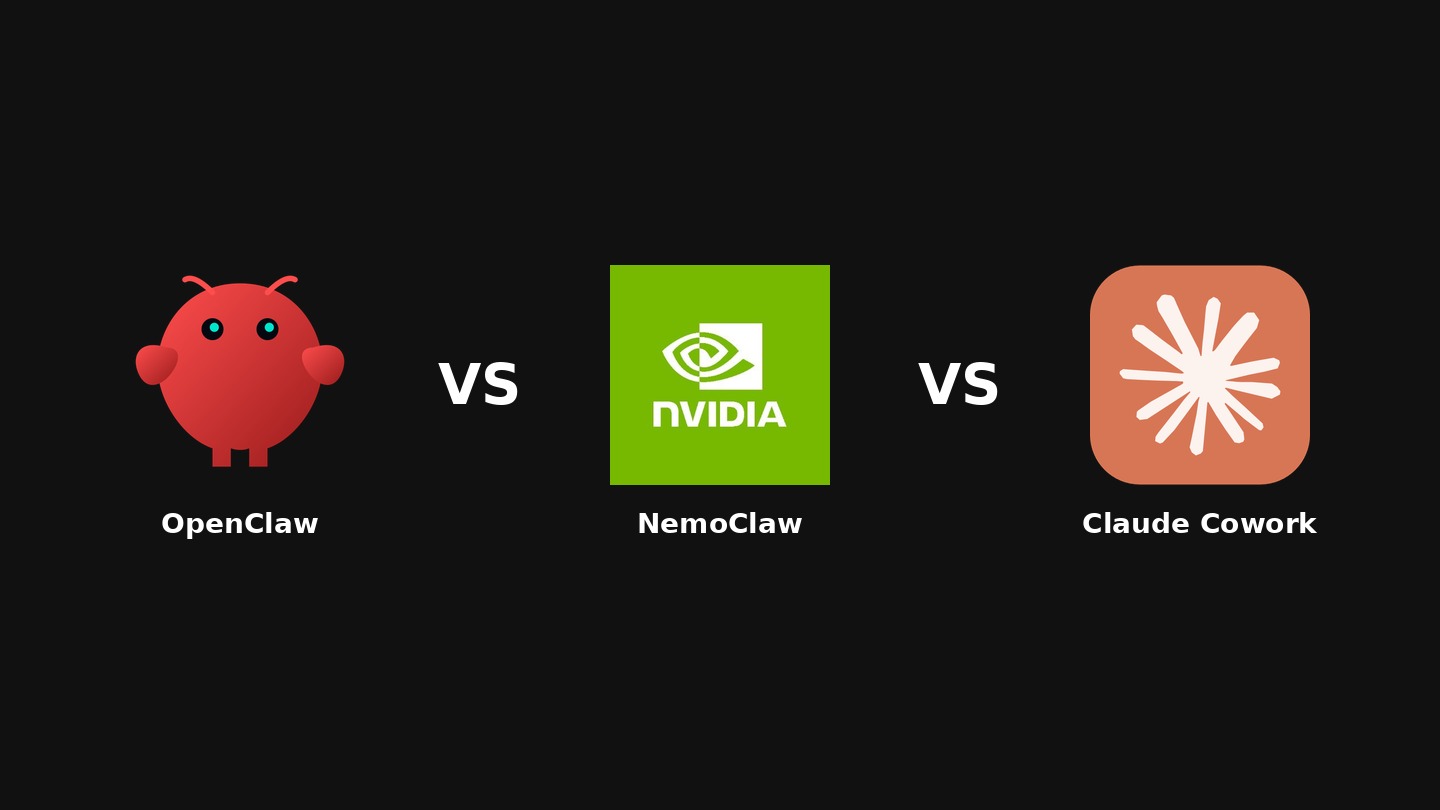
Which agentic AI platform — OpenClaw, NemoClaw, or Claude Cowork — is the right choice for mid-market companies right now?
For most mid-market companies in Q1 2026, Claude Cowork with Dispatch is the only agentic AI option that is both available and deployable without dedicated security infrastructure.
NemoClaw launched at GTC 2026 in alpha — NVIDIA itself warns it is “not ready for production.” OpenClaw has 135,000+ instances exposed to the public internet and four active CVEs in 2026, making it inappropriate for organizations without a dedicated security team.

Questions as you read? Ask, or take the first-agent screen with you.
Where should we send it?
Sent ✓ Download it now →
Three Announcements. Five Days. One Decision Your Company Needs to Make.
Five days in March 2026 compressed what would normally be a year of enterprise AI planning into a single, unavoidable choice.
On March 16, NVIDIA’s Jensen Huang took the stage at GTC 2026 and announced NemoClaw — an enterprise security layer designed to make OpenClaw safe enough for production environments. The enterprise AI community erupted. If NVIDIA was putting its name behind OpenClaw’s security, the thinking went, every company needed to get moving.
On March 17, Anthropic quietly released Claude Cowork Dispatch — remote control for the Cowork desktop agent via your phone, with local execution and no API key configuration required. It shipped without a press conference.
On March 20, Claude Code Channels arrived: Telegram and Discord integration for developers running Claude Code, turning async agent work into a two-way conversation from anywhere.
Three platforms. Five days. A landscape that looked one way on March 15 looked fundamentally different on March 21.
Here is what no one is writing clearly enough: these three options are not equally ready for deployment. They are not solving the same problem. And for small and mid-market companies — organizations between 50 and 500 employees, generating between $5M and $200M in revenue, operating with lean IT teams and real compliance obligations — choosing the wrong one in the next 90 days could mean months of remediation work, security exposure you cannot afford, or worse: buying into a platform so early that you spend Q2 cleaning up a proof of concept instead of scaling results.
We have compared all three. Here is the honest version.
The security data on these platforms should reshape how organizations evaluate their agentic AI options — and it is the starting point for the comparison every executive team needs to have before committing to any of them.
Where to put your first AI agent.
A four-trait screen and a veto, so the first one you build survives contact with the work.
On its way. Check your inbox, or download it now →
The Mid-Market Problem No One Is Naming
Before the comparison, a framing question that will make the recommendation obvious: what does a company in this segment actually have available to deploy and manage an agentic AI platform?
The answer, for most organizations in this segment, is instructive. According to the World Economic Forum’s January 2026 analysis, mid-market companies increasingly outpace enterprise in AI adoption speed — not because they have more resources, but because they have structural advantages: faster decision cycles, less legacy infrastructure, and leadership that can actually implement what they decide. The median company’s IT team in this range, however, is not staffed to manage a self-hosted AI agent with persistent credentials, YAML policy files, and a dependency on open-source security tools that haven’t been battle-tested in production.
That gap between adoption ambition and operational reality is exactly where the comparison between OpenClaw, NemoClaw, and Cowork gets important. Because the right question is not “which platform is most technically impressive?” The right question is: which platform can your organization actually deploy, secure, and scale with the team you have today?
That question changes the answer entirely.
Which platform can your organization actually deploy, secure, and scale with the team you have today?
According to Gartner, worldwide AI spending will reach $2.5 trillion in 2026 — but spending patterns in this segment tell a different story than enterprise. While 65% of enterprises increased AI budgets by a median 22% year-over-year, these organizations are making more selective bets: fewer platforms, higher usage expectations, lower tolerance for multi-quarter implementation cycles. They need something that works next Monday, not next fiscal year.
With that frame established, here is what each platform actually delivers.
The AI Briefing
Tuesdays. 500+ leaders. No hype, just what works.
OpenClaw: The People’s Agent With an Enterprise Problem
OpenClaw’s growth story is genuinely remarkable. As we covered when Jensen Huang declared every company needs an OpenClaw strategy at GTC 2026, the project went from zero to 250,000 GitHub stars in 60 days — the fastest-growing open-source project in history by that measure. The developer community has built thousands of skills, integrations, and workflows on top of it. The momentum is real.
The security picture is also real, and it is not compatible with responsible deployment without significant investment in infrastructure most companies in this segment do not have.
The lethal trifecta. Security researcher Simon Willison identified what he calls the “lethal trifecta” of AI agent risk: access to private data, exposure to untrusted content, and the ability to communicate externally. OpenClaw exhibits all three by design. Palo Alto Networks extended this framework at the start of 2026 by adding a critical fourth element: persistent memory. OpenClaw stores context across sessions in SOUL.md and MEMORY.md files. This means malicious payloads can be fragmented across time — injected into memory on one day, activated when conditions align on another. Traditional endpoint security tools are not designed to detect this kind of attack vector.
The exposure numbers. SecurityScorecard published internet-wide scanning data in February 2026 showing 135,000+ OpenClaw instances exposed to the public internet. OpenClaw binds to 0.0.0.0:18789 by default in older versions, meaning it listens on all network interfaces — including public ones — unless explicitly reconfigured. Many deployments never reconfigured it.
The supply chain risk. Snyk’s ToxicSkills audit found that 36% of all ClawHub skills — the community-built extensions that make OpenClaw powerful — contain detectable prompt injection. This means more than one in three skills available in the community marketplace could be used to manipulate the agent’s behavior in ways the user never intended. For a company deploying OpenClaw for customer data analysis, accounts payable, or HR workflows, the exposure is not theoretical.
The credential exposure. OpenClaw stores API keys, OAuth tokens, and authentication credentials in plaintext Markdown and JSON files in local directories. These files are documented targets for commodity infostealers — AMOS, RedLine, Lumma, Vidar are all known to harvest them. When Snyk, Palo Alto, and Microsoft Security are all publishing warnings about the same platform in the same quarter, the pattern is clear.
To be direct about what this means for organizations in this segment: OpenClaw is not inherently unsuitable for enterprise deployment. It is unsuitable for enterprise deployment without a dedicated security team, a hardened infrastructure layer, active monitoring, and a vendor management process for community skills. If your IT function is two people who also manage your network and your laptops, OpenClaw is not your platform.
The four active CVEs filed against OpenClaw in 2026 — CVE-2026-32056, CVE-2026-32042, CVE-2026-32011, and CVE-2026-32000 — are not the result of OpenClaw being uniquely bad software. They are the result of a project moving fast, at scale, without a bug bounty program or a dedicated security team. That is appropriate for a grassroots developer tool. It is not appropriate for a platform processing your company’s operational data.
NemoClaw: The Right Architecture, Announced Too Early
NVIDIA’s NemoClaw announcement at GTC 2026 generated enormous coverage, and the architecture deserves that coverage. What NVIDIA has designed — an enterprise security layer that installs onto OpenClaw in a single command, adding OpenShell sandboxing, a privacy router, and YAML-defined policy enforcement — is genuinely the right answer to the security problems outlined above. The launch partner list (Adobe, Salesforce, SAP, ServiceNow, Siemens, CrowdStrike, Atlassian, Palantir) signals that the largest software companies in the world are building toward this architecture.
The problem is the timeline.
NemoClaw launched at GTC as an early-access alpha. NVIDIA explicitly described it as “alpha-stage” and warned developers to “expect rough edges.” Alpha software does not start enterprise procurement clocks. It does not appear in vendor security questionnaires. It does not pass InfoSec reviews.
Analysts tracking the project are consistent on timing: plan your evaluation for Q3 2026. For broader enterprise deployment, the math points toward 2027. The hardware NemoClaw is designed to run on — NVIDIA’s DGX Station and DGX Spark — is beginning to ship in spring 2026, but hardware availability and production-ready software are different milestones.
There is also a positioning question that matters specifically for this segment. NemoClaw’s launch partner list is instructive: Adobe, SAP, Salesforce, ServiceNow. These are not vendors serving the 50–500 employee segment. They are the software backbone of global enterprises with dedicated AI teams, multi-year implementation cycles, and IT organizations that can absorb the complexity of on-premises NVIDIA hardware with YAML policy governance. That is the customer NemoClaw is being built for first. Deployments for companies in this range will come — but not in 2026.
NemoClaw’s architecture addresses OpenClaw’s core security weaknesses with genuine sophistication: sandboxed execution via OpenShell, a privacy router that intercepts outbound data, and YAML policy files that define exactly what the agent can access. For organizations with the infrastructure and technical staff to configure and maintain it, this is the right long-term direction. But “the right long-term direction” is not a deployable solution for a company trying to build agentic AI capabilities before Q3.
For leaders in this segment who want to track NemoClaw — and you should — the right posture is: watch the GitHub repo, assign someone to follow the Q3 2026 release notes, and plan a structured pilot evaluation in Q4. Do not let GTC excitement compress that timeline into a Q2 proof of concept that produces nothing except technical debt.
Where to put your first AI agent.
A four-trait screen and a veto, so the first one you build survives contact with the work.
On its way. Check your inbox, or download it now →
Claude Cowork: The Architecture That Makes the Recommendation Obvious
To understand why Cowork is the recommendation for small and mid-market companies, you need to understand what it actually is — because the surface description (“AI assistant on your desktop”) undersells the architecture by an order of magnitude.
Cowork is not a chatbot with connectors bolted on. It is a full agentic execution environment running inside a virtual machine on your local computer. That single architectural decision — local VM isolation — is what separates Cowork from OpenClaw at a fundamental level and makes it deployable without a security team.
How the execution model works. When you assign Cowork a task, it does not generate a response and wait for your next prompt. It enters an autonomous execution loop: analyze the request, decompose it into subtasks, execute each step inside the sandboxed VM, observe the results, self-correct if something fails, and continue until the work is done. This is the same agentic loop that powers Claude Code — observe, plan, act, reflect — now applied to knowledge work instead of software engineering.
For complex tasks, Cowork spawns sub-agents — independent Claude instances that each get their own context window and work on different parts of the task simultaneously. A request like “analyze last quarter’s pipeline data, draft a board summary, and build the supporting slides” becomes three parallel workstreams, not a sequential conversation.
The security architecture OpenClaw doesn’t have. Cowork’s VM is not a software sandbox — it is a hardware-isolated virtual machine using Apple’s Virtualization Framework. Your files exist inside the VM only if you explicitly authorize a folder. Directories you don’t share — your SSH keys, credentials, personal documents — don’t exist in the agent’s environment. They are not restricted; they are invisible. Compare this to OpenClaw, where the agent operates in your actual filesystem with access to everything, storing credentials in plaintext Markdown files that commodity infostealers are designed to harvest.
Network access routes through the host operating system, meaning your existing firewall rules and network policies apply. Data processed by the agent stays on your device. Conversation history stores locally, exempt from cloud retention policies. For organizations navigating SOC 2, HIPAA, or data residency requirements, this is not a feature — it is the prerequisite.
What it actually produces. Cowork does not just answer questions — it creates deliverables. Excel spreadsheets with working VLOOKUP formulas, conditional formatting, and multiple tabs. PowerPoint presentations. Formatted reports from scattered notes. Batch file operations across hundreds of documents. Statistical analysis with visualizations. These outputs land directly in your file system, not in a chat window you have to copy from.
Connectors and plugins. Cowork’s connector library — Google Calendar, Drive, Gmail, DocuSign, Slack, HubSpot, and 20+ others — covers the operational surface area of most companies in this segment. But the real extensibility comes from plugins: packaged bundles of skills, connectors, and sub-agents designed for specific roles or workflows. And for organizations that have already built a persistent AI context layer, Cowork becomes significantly more powerful — the agent operates with the full institutional knowledge of how the business runs, not just access to its tools.
Scheduled tasks. You can save any workflow as a scheduled task that runs automatically on a cadence you define — daily pipeline reports, weekly meeting prep, Monday morning email triage. This is where Cowork starts functioning less like an assistant you prompt and more like an operational system that runs your recurring workflows without human triggering.
Dispatch and Channels: The Remote Access Layer
Cowork’s Dispatch feature, released March 17, 2026, adds mobile access to this architecture. You assign a task from the Claude mobile app — “summarize last week’s client emails and flag anything that needs a response today,” “pull the pipeline numbers from HubSpot and draft a status update” — and Claude executes it on your desktop using the full Cowork environment. The setup requires a QR code and two apps. No API keys. No YAML configuration.
Claude Code Channels — the Telegram and Discord integration released March 20 — extends this for technical staff already running Claude Code. Assign tasks via Telegram message, receive status updates through the same channel. Requires Claude Code v2.1.80+ and administrator enablement on Team and Enterprise plans.
The Honest Limitations
Complex multi-step tasks hit a 50% success ceiling. For simple, clearly defined tasks, Claude executes reliably. For workflows involving multiple systems, conditional logic, or ambiguous instructions, performance degrades. The research-preview status reflects this — capable beta, not a finished product.
Your computer must stay awake. Cowork runs on macOS and Windows (x64) and requires the Claude Desktop app to be open and the computer active. Background execution while the computer sleeps is not yet supported. Scheduled tasks share this constraint.
Cowork activity is not yet captured in audit logs, the Compliance API, or data exports — a gap that matters for regulated industries. And conversation memory persists only within projects, not across them.
Available on Pro ($20/month), Team ($20–$100/seat/month depending on seat type), and Enterprise ($20/seat plus usage at API rates) plans. Team plans include Cowork and Claude Code for teams of 5–150, with centralized billing, SSO, and admin controls — the pricing structure most relevant for team-based deployment.
For companies in this segment, Cowork represents an honest trade-off: a managed, VM-isolated agentic platform with meaningfully less extensibility than what OpenClaw could theoretically deliver, but zero security exposure, no IT infrastructure requirements, and a deployment timeline measured in hours rather than quarters. The architecture is the argument.
The Five Criteria Mid-Market Actually Uses to Make This Decision
Abstract comparisons are not useful when you have a board meeting in three weeks and a CEO who read the GTC coverage and is now asking why you don’t have an OpenClaw strategy. Here are the five questions your organization needs to answer — and how each platform scores.
1. Can we deploy it without a security team?
OpenClaw: No. The documented vulnerabilities — plaintext credentials, network exposure, supply chain risk — require active security management. NemoClaw: Cannot evaluate yet. Alpha. Cowork + Dispatch: Yes. Local execution, no API key exposure, no community skills supply chain to audit.
2. Does it work with the tools we already use?
OpenClaw: Extensible via community skills — but with the supply chain risks documented above, every skill requires security vetting before deployment. NemoClaw: Designed for the enterprise software stack (SAP, Salesforce, ServiceNow) — but those connectors are still being built by launch partners. Cowork + Dispatch: 20+ production-ready connectors covering the operational stack companies in this range actually use — Google Workspace, HubSpot, Slack, DocuSign. Available now.
3. What does it cost for a team of 10–50 knowledge workers?
OpenClaw: Free software, but API token costs scale with usage. Add security infrastructure, IT management time, and potential remediation costs and the total cost of ownership is not zero. NemoClaw: Hardware (DGX Station) plus enterprise software licensing — not a realistic price point for companies in this range. Cowork + Dispatch: $20–$100 per seat per month on Team plans (Standard or Premium), including Cowork, Claude Code, SSO, and admin controls. Enterprise plans start at $20/seat with usage-based billing.
4. What is the compliance exposure?
OpenClaw: Material. Plaintext credentials, internet-exposed instances, and persistent memory that can carry injected payloads across sessions are not compatible with SOC 2, HIPAA, or basic data residency requirements without significant remediation. NemoClaw: Designed for compliance — but alpha software cannot be audited against compliance frameworks. Cowork + Dispatch: Local execution architecture means data processed by the agent stays on the device. Anthropic’s enterprise compliance posture (SOC 2 Type II, GDPR, HIPAA BAA availability) provides the baseline.
5. Can we build on it, or are we buying a finished product?
OpenClaw: Highly extensible. If you have technical staff to manage the security surface area, the ceiling is high. NemoClaw: Designed for extensibility at enterprise scale — the right answer for 2027 with proper infrastructure. Cowork + Dispatch: Plugins and connectors extend the base functionality. Less extensible than OpenClaw but the plugin ecosystem is growing. The right answer for organizations that need results in 90 days.
The Recommendation
Here is the direct version, by organization type.
If you are a small or mid-market company with 50–500 employees and a lean IT team: Deploy Cowork + Dispatch now. Identify three to five high-value workflow tasks — pipeline reporting, document preparation, email triage, meeting prep, CRM updates — and run a structured 30-day pilot. Track hours saved per week. Document what breaks and what the 50% complex-task ceiling actually means for your specific workflows. Build the internal evidence base now, so that when NemoClaw reaches production maturity in 2027, you are making a migration decision with data rather than making a deployment decision from scratch.
If you are a company in this range with a technical team and a tolerance for research-preview software: Consider Claude Code Channels alongside Cowork. For developers or operations leads already in the Claude Code workflow, Channels adds async agent management that meaningfully expands what is possible without adding security risk.
If someone in your organization is pushing for OpenClaw: Ask one question: who owns the security posture? If the answer is “we’ll figure it out” or “the open-source community handles that,” the answer to OpenClaw is no for now. Return to this conversation in Q3 when the security tooling matures and you have had time to staff appropriately.
If you are waiting for NemoClaw: Q4 2026 is the earliest reasonable evaluation window. Assign someone to monitor the GitHub repo. Do not let GTC excitement start a procurement process for alpha software.
The advantage for companies in this segment — identified by the World Economic Forum as a defining trend of 2026 — does not come from choosing the most technically impressive platform. It comes from choosing the platform that can generate real operational results in the next 90 days, with the team and infrastructure you actually have. For most organizations in this segment right now, that means Cowork. That is not a permanent answer. It is the right answer for this quarter.
Build Your Agentic AI Foundation This Quarter
The organizations that will benefit most from NemoClaw’s eventual production release are not the ones watching the GTC keynote replay in March 2026. They are the ones that have spent Q1 and Q2 building internal fluency with agentic AI — understanding which workflows benefit, which tasks need human oversight, which connectors matter most for their specific operational context.
Cowork + Dispatch is not the ceiling. It is the foundation.
Here is a practical 90-day path.
Weeks 1–2: Identify your high-value workflows. Document the 10–15 hours per week of knowledge work that is repetitive, rule-based, and data-dependent. Pipeline reporting. Status updates. Meeting prep. Document drafting. Email triage. These are the workflows where agentic AI creates immediate ROI and where the cost of a failed attempt is low enough to learn from.
Weeks 3–6: Deploy Cowork and run structured pilots. Connect the tools your team actually uses — start with Google Workspace and your CRM. Assign specific tasks to Claude. Measure completion quality, not just speed. Build a shared understanding of what the platform does well and where human review remains essential.
Weeks 7–10: Establish your governance layer. Even with Cowork’s managed security posture, organizations need internal clarity on what the agent can access, what data should never be processed by AI tools, and who reviews outputs before they reach clients or external stakeholders. Document this now, while the deployment is small. The governance framework you build on a 5-person pilot will scale to a 50-person deployment. This is where understanding the broader competitive AI landscape helps — the governance decisions you make today determine how easily you migrate platforms as the market matures.
Weeks 11–12: Evaluate, extend, and plan for Q3. By week 12, you will have operational data on time savings, workflow quality, and team adoption. Use it to make your Q3 decision: expand Cowork deployment, begin evaluating Claude Code Channels for technical staff, or — if the NemoClaw timeline has accelerated — add a structured evaluation workstream for Q4.
The companies that will have a meaningful agentic AI capability in 2027 are not the ones that waited for the perfect platform. They are the ones that started building in 2026, learned from real deployment, and made incremental bets rather than waiting for a single transformative implementation.
Your IT team doesn’t have six months to evaluate three platforms. That is exactly why we wrote this comparison. The decision is not complicated once the research is clear — and now it is.
Sources
- SecurityScorecard STRIKE Team: 135,000+ Exposed OpenClaw Instances — SecurityScorecard, February 2026
- Why OpenClaw May Signal the Next AI Security Crisis — Palo Alto Networks, 2026
- Running OpenClaw Safely: Identity, Isolation, and Runtime Risk — Microsoft Security Blog, February 2026
- OpenClaw Security 101: Vulnerabilities and Hardening — Adversa AI, 2026
- The OpenClaw Security Crisis — Conscia, 2026
- NVIDIA’s Open-Source NemoClaw Takes Direct Aim at Microsoft Copilot — Smart Chunks, March 2026
- NemoClaw vs OpenClaw: Security, Privacy and Performance 2026 — AI.cc, 2026
- Claude Dispatch: Control Cowork From Your Phone — FindSkill.ai, March 2026
- Claude Dispatch: The Constraints, the Security Model, and What Comes Next — DEV Community, March 2026
- Claude Cowork Dispatch: Anthropic’s Answer to OpenClaw — Latent Space, March 2026
- It’s Time for AI’s Mid-Market Business Moment — World Economic Forum, January 2026
- 2026: The Year Mid-Market Outpaces Enterprise in AI Adoption — QBSS, 2026
- Gartner Says Worldwide AI Spending Will Total $2.5 Trillion in 2026 — Gartner, January 2026
Frequently Asked Questions
Is OpenClaw safe for business use in 2026?
OpenClaw is safe for development and personal use in controlled environments. For business deployment involving customer data, financial information, or any data subject to compliance requirements, OpenClaw requires significant security infrastructure — dedicated security staff, network isolation, careful skill vetting, and active monitoring — that most organizations in this segment do not have in place. SecurityScorecard identified over 135,000 OpenClaw instances exposed to the public internet in early 2026, and Snyk’s ToxicSkills audit found that 36% of community skills contain detectable prompt injection.
When will NemoClaw be ready for mid-market deployment?
NemoClaw launched in alpha at GTC 2026 in March with NVIDIA’s own caveat to “expect rough edges.” Analysts tracking the project recommend planning evaluations for Q3 2026 and treating Q4 2026 as the earliest realistic enterprise pilot window. For organizations without a dedicated NVIDIA hardware deployment (DGX Station or DGX Spark), the production timeline extends further. Organizations in this segment should monitor the GitHub repository and plan a structured evaluation workstream for Q4, not Q2.
What does Claude Cowork Dispatch actually do?
Dispatch allows you to assign tasks to Claude Cowork on your desktop from your phone via the Claude mobile app. Claude executes the task using your desktop’s connected tools — files, email, calendar, CRM — and returns the result to your mobile thread. Execution happens locally on your device; data does not route through external servers for processing. Dispatch launched as a research preview in March 2026 and is available on Pro ($20/month) and Max ($100/month) plans.
How much does deploying an agentic AI platform cost for a mid-market team?
Claude Team plans cost $20–$100 per seat per month (Standard at $20, Premium at $100, billed annually) for teams of 5–150, including Cowork, Claude Code, SSO, and centralized admin controls. Enterprise plans start at $20/seat with usage-based billing at API rates, adding audit logs, SCIM, compliance API, and HIPAA-ready options. OpenClaw’s software is free, but API token costs, security infrastructure, IT management overhead, and potential remediation expenses create a total cost of ownership that is not zero. NemoClaw requires NVIDIA hardware (DGX Station, DGX Spark) plus enterprise software licensing, placing it outside typical budget parameters for 2026.
Can agentic AI platforms access and leak sensitive company data?
The risk varies significantly by platform architecture. OpenClaw stores credentials in plaintext local files and has documented exposure to infostealers; without proper network isolation and security management, sensitive data is at risk. NemoClaw’s privacy router is designed to intercept and filter outbound data — but as alpha software, this has not been independently audited. Cowork’s local execution model means data processed by the agent stays on the device and does not route through external processing servers, making it architecturally safer for sensitive workflows — though internal governance policies about what tasks to assign the agent remain the organization’s responsibility.
What is Claude Code Channels and who is it for?
Claude Code Channels is a Telegram and Discord integration for Claude Code, released March 20, 2026, that creates a two-way communication bridge between a developer and a running Claude Code agent. You send a task via Telegram message; Claude executes it and reports back through the same channel. It requires Claude Code v2.1.80+ and administrator enablement on Team and Enterprise plans. It is designed for technical users already working with Claude Code — developers, technical operations leads, or founders comfortable in the terminal — not for general knowledge worker deployment.
What should mid-market companies actually do this quarter?
The practical 90-day path: identify 10–15 hours per week of repetitive, rule-based knowledge work (pipeline reporting, document prep, meeting prep, email triage), deploy Cowork with its existing connectors for those specific workflows, build internal governance clarity about what the agent can and cannot access, measure real time savings, and use that data to make a Q3 decision about scale. Track NemoClaw’s GitHub progress in parallel and plan a structured evaluation for Q4. Do not implement OpenClaw without a security team. Do not start a NemoClaw procurement process while it remains in alpha.