
How do I know if a boutique AI consulting firm is actually boutique?
The old test — senior people deliver the work — no longer separates anyone. In 2026, as the consulting pyramid collapses industry-wide, the real question is ownership transfer: do you leave the engagement with a system your team can run, or a relationship you can’t end? The five tests in this guide surface that distinction before you sign.

Questions as you read? Ask, or take the twelve questions with you.
Where should we send it?
Sent ✓ Download it now →
Every consulting firm in the AI space now calls itself “boutique.” The Big 4 have spun up boutique-styled practice areas. Mid-tier firms have pruned their pitch decks to sound smaller. Solo operators have built two-page websites and adopted the label. The word, in the year it should mean the most, has come unmoored from anything specific.
Three years ago, the boutique value proposition was straightforward: you got the senior people. They sold the work, they did the work, and they signed the work off. At a Big 4 firm, you got the senior partner for the pitch and the kickoff, then a rotating cast of consultants two to four years out of business school for the rest of it. That gap was the boutique advantage, and it was real.
It is not the boutique advantage anymore. McKinsey, BCG, and Bain have frozen starting consultant salaries for the third year running and trimmed graduate intakes hard. PwC’s global chair Mohamed Kande has said publicly that the industry needs “a different set of people” — fewer juniors writing decks, more senior practitioners doing work that used to take a team of six. The pyramid is collapsing. Senior-led delivery is no longer a boutique edge; it is rapidly becoming the industry’s only viable model.
Which means the question every mid-market buyer should be asking has shifted. The old question was: will the senior partner actually do my work? The new question is: at the end of this engagement, do I own anything? This article is about the second question. The five tests below are designed to find the gap between firms that build for ownership transfer and firms that build for ongoing dependency — because by 2026, that is the gap that matters.
The Pyramid Is Collapsing — and It Breaks the Boutique Advantage You Think You’re Buying
Deloitte’s 2026 data is even sharper: 84% of companies have not redesigned work around AI, even after deploying it.
To understand what “boutique” should mean in 2026, you have to understand what is happening to consulting itself.
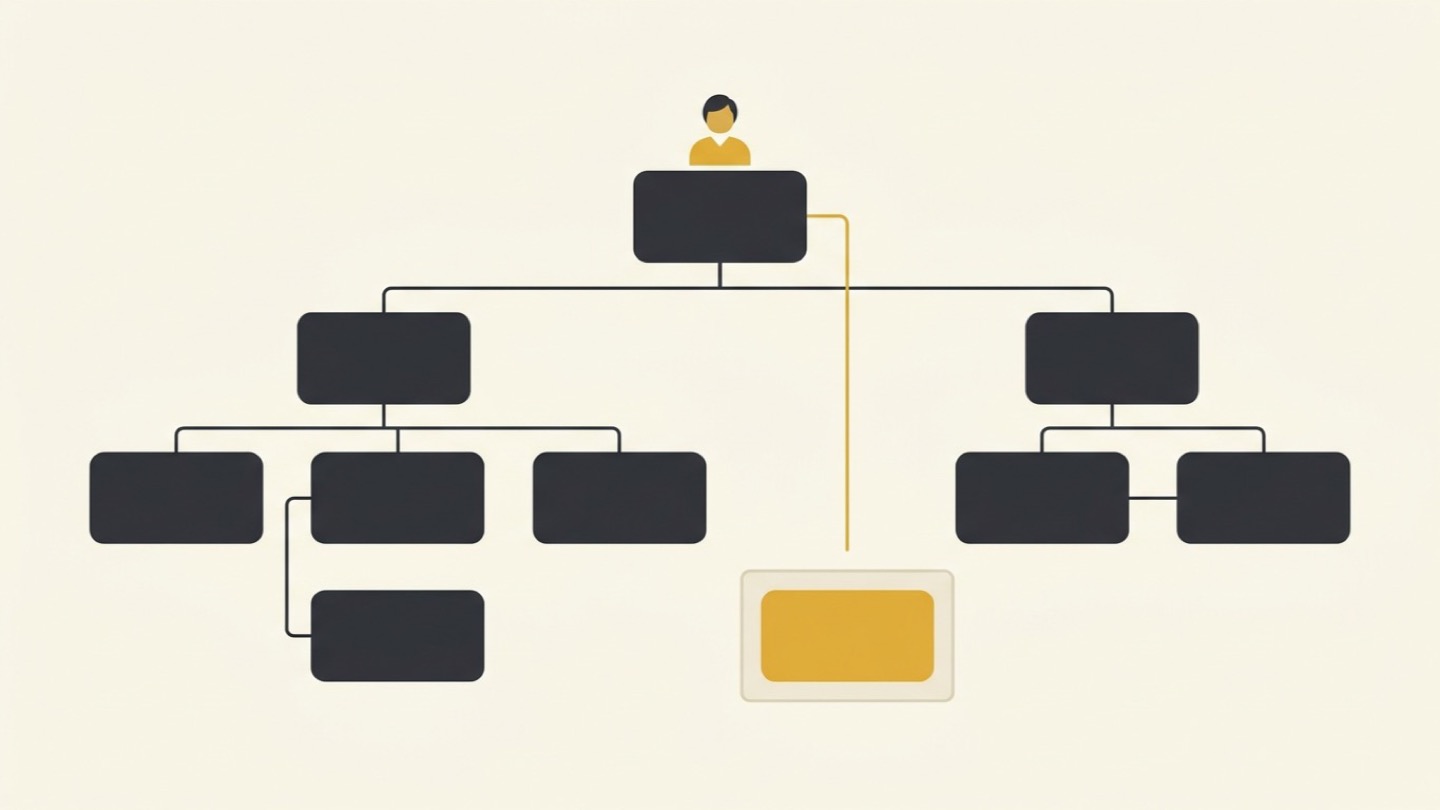
For roughly five decades, the consulting industry ran on a pyramid: a small number of senior partners at the top who sold and oversaw the work, supported by a wide base of junior analysts who actually executed it. The leverage ratio — partners to associates — was where the margin lived. Big 4 firms perfected this. So did McKinsey, BCG, and Bain.
That model is unraveling. The Irish Times reported in December 2025 that McKinsey, BCG, and Bain have frozen entry-level consultant salaries for the third year in a row and significantly cut graduate intake. The Harvard Business Review formalized the shift in September 2025 with an analysis arguing that AI is changing the structure of consulting firms, not just their tooling. The structural change is the collapse of the pyramid into something shorter and flatter — fewer juniors, more senior practitioners doing AI-assisted work that once required a team. PwC’s global chair Mohamed Kande has been openly direct about it: the firm needs “a different set of people.”
This matters for anyone evaluating a boutique AI consulting firm because the old shorthand for “boutique” no longer separates one option from the other. Five years ago, “the senior people will deliver the work” was an actual differentiator — at a Big 4 firm, that was not happening. In 2026, the Big 4 are also senior-shifting, partly by choice and partly because the juniors aren’t being hired. The market is converging on senior-led delivery from both ends.
So when a firm tells you “you’ll have senior people on your engagement,” that statement no longer distinguishes anyone. It is the floor, not the ceiling. The question that does distinguish them is what those senior people are building for you, and what happens to that work after they leave.
Twelve questions to ask before you sign.
Twelve questions, the red flag behind each answer, and a grid to score two firms side by side.
On its way. Check your inbox, or download it now →
What Boutique Actually Means Now: Ownership Transfer vs. Dependency Creation
If senior-led delivery is no longer the differentiator, what is?
The most useful frame we’ve found — built from watching dozens of mid-market AI engagements succeed or stall — is this: every consulting firm is, on a long enough timeline, either building toward your independence or building toward your dependence. The mode is rarely stated. It is almost always embedded in how the firm structures the engagement.
A dependency-creation firm builds artifacts that only they can interpret. Their deliverables are slide decks rather than systems. Their “transformation” is a body of advice held in their consultants’ heads. When the engagement ends, the artifacts sit in a shared drive. When your team tries to operationalize them, they discover that the firm’s understanding of your context is the missing layer — and the only way to get that layer back is to hire the firm again. This is not malice. It is a business model.
An ownership-transfer firm structures the engagement differently. The methodology is taught, not held. The systems they build live in your stack, not theirs. The context they generate — the maps of your business, the AI architecture, the decision criteria — accumulates in artifacts your team can read, edit, and extend. When the engagement ends, they leave you with capability, not a contact relationship. They will tell you, sometimes uncomfortably, when you no longer need them.
This is the structural shift that 2026 demands. Deloitte’s 2026 State of AI in the Enterprise report — surveying more than 3,000 executives across 24 countries — found that only 25% of companies have moved more than 40% of their AI pilots into production. Eighty-four percent have not redesigned the work itself around AI capabilities. The bottleneck is not enthusiasm; it is the gap between pilot and ownership. Companies are paying for the discovery and the demo. They are not yet owning the system.
This is also the lens through which to read the BCG finding that only 5% of organizations are generating substantial value from AI, while 60% are generating no material value at all. The gap between the 5% and the 60% is not a question of who hired better consultants. It is a question of who owns the system at the end. The dependency model produces pilots. The ownership model produces operating capability. The same is true at the implementation layer: a boutique engagement that does not transfer ownership is not boutique consulting — it is a small-team retainer with a different name.
This is, structurally, what a mid-market AI consulting engagement looks like when it is designed for ownership transfer: every phase produces an artifact your team will own and operate. The engagement is structured to end. That sounds like a contradiction. It is the point.
The AI Briefing
Tuesdays. 500+ leaders. No hype, just what works.
Twelve questions to ask before you sign.
Twelve questions, the red flag behind each answer, and a grid to score two firms side by side.
On its way. Check your inbox, or download it now →
The Five Tests for a Real Boutique AI Consulting Firm
The five tests below are the ones we’d ask if we were on the buyer’s side of the table. They are designed to surface the dependency-vs-ownership question without ever asking it directly — because a firm that hears the question coming will rehearse the answer. The tests work by asking about the structure of the engagement, where the structure reveals the model.
Test 1: The Staffing Model Test — Are the People Who Sold the Work the People Who Will Do the Work?
The first test still matters, but for a different reason than it used to. It is no longer a Big 4 problem; it is an industry problem. As the pyramid collapses, firms of every size are reorganizing their senior bench. Some are doing it cleanly. Others are camouflaging the same old structure with new language.
Ask directly: “Who specifically is going to be in the room during discovery, during implementation, and during the handoff?” The answer should be three names — usually two, sometimes one, in a true boutique. The answer you want to hear includes specifics: name, role, what they’ll personally be responsible for, and whether you can speak with them before you sign.
What good looks like: the senior person who is in the sales call says, “I’m in every working session. Here is the second person who will be in the room. Here is the moment, if any, when a third person comes in — and here is what they’ll specifically own.” Then they offer a working call before contracting.
What to watch for: “We have a senior advisory team that stays involved.” “You’ll have access to our partner network.” “Our team scales up depending on the engagement.” All three formulations are designed to preserve flexibility for the firm at the cost of clarity for you. The flexibility almost always resolves toward more junior delivery once the contract is signed. We’ve written a longer breakdown of the questions to ask an AI consulting firm before you sign anything — the staffing model question is one of the eight.
Test 2: The Methodology Test — Is There a Real Framework, or a Generic AI Playbook?
The second test sounds like an academic question but it is the most diagnostic of the five. A real boutique AI consulting firm has a repeatable methodology — a framework that explains how they think about AI transformation specifically, and how they sequence the work. It is named, it is documented, and it can be explained in fifteen minutes.
A firm that does not have one is, almost by definition, improvising on your dollar. They will execute well or poorly depending on the talent of the individual partner on the engagement, not depending on the firm’s accumulated learning. You are paying for one person’s instinct, not for a system that has been refined across multiple clients.
What good looks like: the firm can walk you through their framework on a single page. They can tell you what each phase produces, why the phases are in that order, and where in the framework most clients struggle. They can also tell you what their framework explicitly does not cover — the absence of which is also a sign of intellectual honesty.
What to watch for: methodology that is just a generic AI implementation playbook with the firm’s logo on top of it. The tell is interchangeability: if their slide on “our methodology” could appear in a competitor’s deck with a different logo and you couldn’t tell the difference, it is not a methodology. It is a stock template. Generic AI implementation playbooks are everywhere now, and they are particularly dangerous because they create the appearance of structure without the substance of one.
Test 3: The Ownership Transfer Test — Do You Own the System at the End, or Rent the Firm?
This is the test that matters most in 2026, and it is the one almost no buyer asks.
The question is structural: at the end of the engagement, what specifically do you own? Not “what insights did you gain” — what artifacts, what systems, what running capabilities are sitting in your stack, owned by your people, that will continue to deliver value if the consulting firm walks out the door tomorrow?
This question matters because the dominant failure mode of AI consulting in 2026 is not bad strategy. It is good strategy that never operationalizes. RAND’s research finds that more than 80% of AI projects fail. The reasons cluster heavily around the post-engagement gap — the firm leaves, the system that was built isn’t fully owned, the internal team can’t operate it, and the project quietly stops being used. The same dynamic shows up at McKinsey’s State of AI 2025 data: enterprise AI deployments are stuck at “1% at maturity” — a phrase that translates, in plainer language, to “almost no companies own what they bought.”
What good looks like: the firm shows you, before signing, the exact artifacts you will own at the end of each phase. A documented architecture. A configured AI system running on your accounts, not theirs. Context files in your repository. Trained internal owners. Decision criteria you can apply yourself. A genuine offboarding plan that ends the engagement when ownership is transferred — not when the retainer ends.
What to watch for: deliverables that are primarily documents-about-the-work rather than the work itself. Slide decks summarizing what was done. “Playbooks” written about your situation that nobody on your team actually contributed to. A continued reliance on the firm’s tooling, the firm’s accounts, or the firm’s specific consultants as the operating layer. If, six months after the engagement ends, you can’t run the system without re-engaging the firm, you didn’t own it. You were renting it.
Test 4: The Change Management Integration Test — Is the Human Side Built In, or Sold Separately?
The fourth test surfaces a quiet but consistent split in the market. Many AI consulting firms are technically excellent and organizationally blind. They build systems that work and nobody uses. The change management workstream, if it exists, is bolted onto the end of the engagement as an “adoption sprint” — usually too short, usually too late, usually a thin substitute for the deep human work that determines whether the system gets traction.
This is not a small failure mode. McKinsey’s research finds that only about 1% of companies have reached AI maturity — and the diagnostic, repeatedly, is human, not technical. Deloitte’s 2026 data is even sharper: 84% of companies have not redesigned work around AI, even after deploying it. The technology landed. The organization didn’t move.
A firm that treats change management as a separate workstream — particularly one priced as a separate add-on — is signaling, structurally, that they do not believe it is integral. A firm that treats it as Phase 1 is signaling the opposite.
What good looks like: the firm cannot describe their technical phases without referencing the human readiness work that runs in parallel. AI champion or AI Enabler identification is a named role in the engagement, not a suggestion. There is a specific methodology for addressing the four fears that consistently drive resistance — unreliability, job displacement, loss of control, cognitive atrophy. Change management is not a workstream; it is the substrate.
What to watch for: the phrase “we’ll add a change management workstream if you’d like.” The “if you’d like” is doing all the work in that sentence — it’s an option, not a foundation. Also watch for change management framed as “training and communication.” Training is a fragment of change management, not the whole. If the firm cannot describe how they identify and develop AI champions inside your organization — or, worse, if they do not have a name for the role — they are not running an integrated practice.
Test 5: The Honesty Test — Will They Tell You What They Can’t Do?
The fifth test is the simplest to administer and the hardest to fake. Ask the firm: “What would you specifically not recommend for us right now, and why?”
A firm that wants to help you will have an answer. The answer will be specific to what they have learned about your situation. It will sound something like: “Given what you’ve described about your data infrastructure, starting with autonomous agents is going to create reliability problems before you’ve built trust. We’d start with an augmentation layer instead, even though that’s a smaller initial engagement.” That is a firm thinking about your outcome, not their revenue.
A firm in pure sales mode cannot answer this question well. They will pivot back to capabilities. They will say “it really depends on your needs.” They will reframe every option as viable because they are paid to sell every option. The absence of a specific recommendation against something — particularly when you’ve asked for it directly — is itself the answer.
The recent Deloitte refund to the Australian government over a report containing AI-generated hallucinations is the public version of what happens when this test fails. A firm with a strong honesty culture would have caught the issue internally, or refused the engagement in that form. A firm optimized to ship the deliverable does not have that discipline.
What good looks like: they tell you not to do something, with a specific reason. They name a competitor or a different category of provider who is a better fit for part of the work. They tell you that one of your stated goals is unrealistic for the timeline. They tell you their methodology has limits and name what they are.
What to watch for: bland positivity. Total flexibility. Reframing every constraint as an opportunity. The firm equivalent of “yes, and.” It feels good in the sales process. It is the single strongest predictor of post-engagement disappointment.
When You Should NOT Hire a Boutique AI Consulting Firm
This is not a case for boutique across the board. There are real, specific situations where a boutique firm is the wrong tool, and an honest evaluation guide has to name them.
You should not hire a boutique AI consulting firm for a multi-country deployment with heavy regulatory exposure — pharmaceuticals, banking, defense, multi-jurisdiction healthcare — where the engagement requires a global compliance bench, in-country legal coverage, and audit-ready documentation at enterprise scale. The bench is the deliverable in that kind of work. A small firm cannot deliver that footprint, no matter how senior the team.
You should not hire a boutique if the work genuinely requires hundreds of consultants in parallel — large-scale data infrastructure migrations, multi-ERP consolidations, global rollout programs. A boutique cannot scale into that volume, and attempting it will produce a worse outcome than working with a firm that is built for it.
You should not hire a boutique if your procurement model is built around large-vendor counterparties — preferred vendor lists, master service agreements, insurance and bonding requirements sized for firms ten times larger. The administrative friction can become higher than the value of the engagement.
And you should not hire a boutique if the work is straightforwardly a tool deployment in a stable environment. If the answer is “deploy Copilot to 800 seats and run the standard adoption playbook,” a Microsoft partner is the better fit. Boutique AI consulting firms exist for the harder problem of strategic AI transformation, where the answer is not pre-packaged.
For everything else — mid-market companies, complex but bounded transformations, situations where senior judgment matters more than scale — boutique is structurally the better fit. But “everything else” is not “everything.” Be honest about which problem you have.
What Ownership Looks Like in Practice
The ownership-transfer model is easier to describe in the abstract than to recognize in a proposal. A useful frame: a real ownership-transfer engagement is structured in phases, and each phase produces an artifact you will own and operate.
The first phase is diagnostic — a structured assessment of your business under AI pressure that produces a written mandate and a prioritized opportunity map your team owns. If the firm keeps the diagnostic as a proprietary tool you can’t read or extend without them, that is a dependency signal.
The second phase is architectural — designing the AI operating model that will sit underneath your business. This produces architecture documents, decision criteria, and the first versions of the context files and configurations that will run the system. These should live in your stack, not the firm’s. If the architecture references “our internal system” or “our proprietary platform” as load-bearing components, you are signing up for a relationship, not buying a capability.
The third phase is implementation — building the system itself, with your people involved at every step. The system runs on your accounts, configured with your context, owned by your team. The firm is teaching as much as they are building.
The fourth phase is intentional handoff — training internal owners and structuring the off-ramp. The engagement ends when ownership is transferred, not when the budget runs out. This is the phase most consulting models silently skip — and the phase that defines whether the work was a boutique AI consulting engagement or an expensive proof-of-concept.
This four-phase structure — and how the artifacts in each phase compound — is the operating logic of a mid-market AI consulting engagement done well. The structure exists to make ownership transfer the default, not the exception.
The Cost Question
A predictable next question is what a boutique AI consulting engagement actually costs in 2026, and how that compares to the alternatives.
The honest answer is that boutique pricing varies more than enterprise pricing, because the work itself varies more. A focused diagnostic and roadmap engagement at a senior-led boutique typically runs in the $25,000 to $75,000 range. A full architecture-and-implementation engagement — the kind that produces a working AI operating layer with ownership transferred to the internal team — typically runs $150,000 to $400,000, depending on scope. The same scope at a Big 4 firm typically starts at $500,000 and frequently lands north of $1 million, largely because of the headcount the engagement is structured to carry.
The full pricing picture is covered in our AI consulting cost guide, and the structural alternatives to Big 4 engagements in our guide to AI consulting beyond the Big 4. The cost question and the evaluation question are different questions — both are worth answering before signing.
Sources
- Top consultancies freeze starting salaries as AI threatens pyramid model — Irish Times, December 2025 (McKinsey, BCG, Bain salary freeze and graduate intake cuts)
- AI Is Changing the Structure of Consulting Firms — Harvard Business Review, September 2025 (pyramid model collapse, PwC’s Mohamed Kande on “a different set of people”)
- Deloitte 2026 State of AI in the Enterprise — Deloitte, 2026 (25% of companies moved 40%+ of pilots to production; 84% have not redesigned work around AI; N=3,235 executives, 24 countries)
- Are You Generating Value From AI? The Widening Gap — BCG, 2025 (5% of organizations generate substantial value from AI; 60% generate no material value)
- The State of AI in 2025 — McKinsey QuantumBlack (enterprise AI maturity data)
- Superagency in the Workplace — McKinsey, 2025 (1% of companies at AI maturity)
- The Root Causes of Failure for Artificial Intelligence Projects — RAND Corporation (more than 80% of AI projects fail)
- Deloitte refunds Australian government over AI-hallucinated report — Fortune, October 2025 (AU$290,000 refund following report containing AI-generated fabrications)
Frequently Asked Questions
What is a boutique AI consulting firm?
A boutique AI consulting firm is a small, specialized advisory firm — typically two to thirty people — that focuses specifically on AI strategy and implementation rather than general management consulting. The defining characteristic, historically, was senior-led delivery: the people who sell the work are the people who do it. In 2026, with the pyramid model collapsing across the industry, the more useful definition is structural — a boutique firm is one whose engagement model is built around ownership transfer rather than ongoing dependency, and whose accountability lives with the same one or two senior practitioners from start to finish.
How is a boutique AI consulting firm different from a Big 4 firm?
The structural differences are scale, delivery model, and engagement design. Big 4 firms operate on a leverage model — a small number of partners overseeing large teams of associates who do most of the execution. Boutique firms typically run with senior practitioners delivering the work directly. Big 4 engagements are often scoped as multi-month, multi-million-dollar transformations with significant change overhead. Boutique engagements are typically smaller, faster, and more concentrated. A more detailed comparison sits in our guide to AI consulting beyond the Big 4, which covers when each model is the right fit.
How much does a boutique AI consulting firm cost?
Boutique AI consulting engagements typically range from $25,000 for focused diagnostic work to $400,000 or more for full architecture and implementation programs that transfer ownership of a working AI operating layer to the internal team. The same scope of work at a Big 4 firm typically starts at $500,000 and frequently lands above $1 million. The cost difference is not primarily about quality — it is about the headcount the engagement is structured to carry. Our AI consulting cost guide covers the pricing structure in detail.
How do I know if a boutique firm is genuinely senior-led?
Ask for the names of the specific people who will be in the room during discovery, implementation, and handoff — and ask to speak with at least one of them before signing. A genuinely senior-led firm will name two or three specific practitioners, say what each is responsible for, and offer a working call before contracting. A firm that resists this request, or that talks about “senior oversight” or “partner involvement at key milestones” without naming specific people, is signaling that the senior bench will not be the delivery bench.
When should I NOT hire a boutique AI consulting firm?
You should not hire a boutique AI consulting firm for multi-country deployments with heavy regulatory exposure (pharmaceuticals, banking, defense), for engagements that require hundreds of consultants working in parallel across business units, or when your procurement model is structured around large-vendor counterparties with insurance and bonding requirements that exceed what a small firm can provide. You should also not hire a boutique for straightforward tool deployments in stable environments — that work is better suited to a vendor’s implementation partners. Boutique AI consulting firms are built for strategic AI transformation, not for scale-driven execution.
How long does a boutique AI consulting engagement take?
Typical boutique AI consulting engagements run between six weeks for focused diagnostic work and six to nine months for full architecture and implementation programs. The compression relative to Big 4 timelines comes from two structural factors: fewer handoffs between the people doing the work, and a deliberate focus on transferring ownership to internal teams quickly rather than extending the engagement. A senior-led boutique should be able to give you a phase-by-phase timeline with specific deliverables before contracting.
What's the difference between boutique AI consulting and AI implementation services?
AI implementation services typically deploy a specific tool — a Copilot rollout, a chatbot, an automation platform — in a relatively bounded scope, often as the partner of a specific vendor. Boutique AI consulting is broader and earlier in the value chain: it answers strategic questions about where AI fits in the business, what the operating model should look like, and how the organization needs to change to operate it well. The two are complementary. A boutique AI consulting engagement often produces the strategy and architecture that implementation services then execute against — and the boutique firm typically owns the AI Enabler development and change management that determines whether the implementation gets used.
How do I evaluate a boutique firm's track record?
Ask for two specific references: one from a mid-market client of roughly your size in the last 18 months, and one from an engagement that didn’t go as planned. The first reference tells you whether the firm has the depth of experience to navigate your situation. The second reference tells you something more diagnostic — how the firm behaved when the work got hard. A firm that can talk honestly about a difficult engagement, what they learned, and what they would do differently is a firm with a real practice. A firm that has never had a difficult engagement is either very small, very new, or not telling you the truth.
What makes the best boutique AI consulting firm?
The best boutique AI consulting firms share five traits: the senior people who sell the work stay in the room and do it (continuity of senior attention, not a hand-off after the pitch), they run a real, repeatable methodology rather than improvising each engagement, they transfer ownership so you’re left with a capability rather than a dependency, they build in change management because adoption is where most AI work actually fails, and they’ll tell you what not to do — including when AI isn’t the answer. “Best” is less about size or brand than about which firm’s structure matches the work you actually need done.