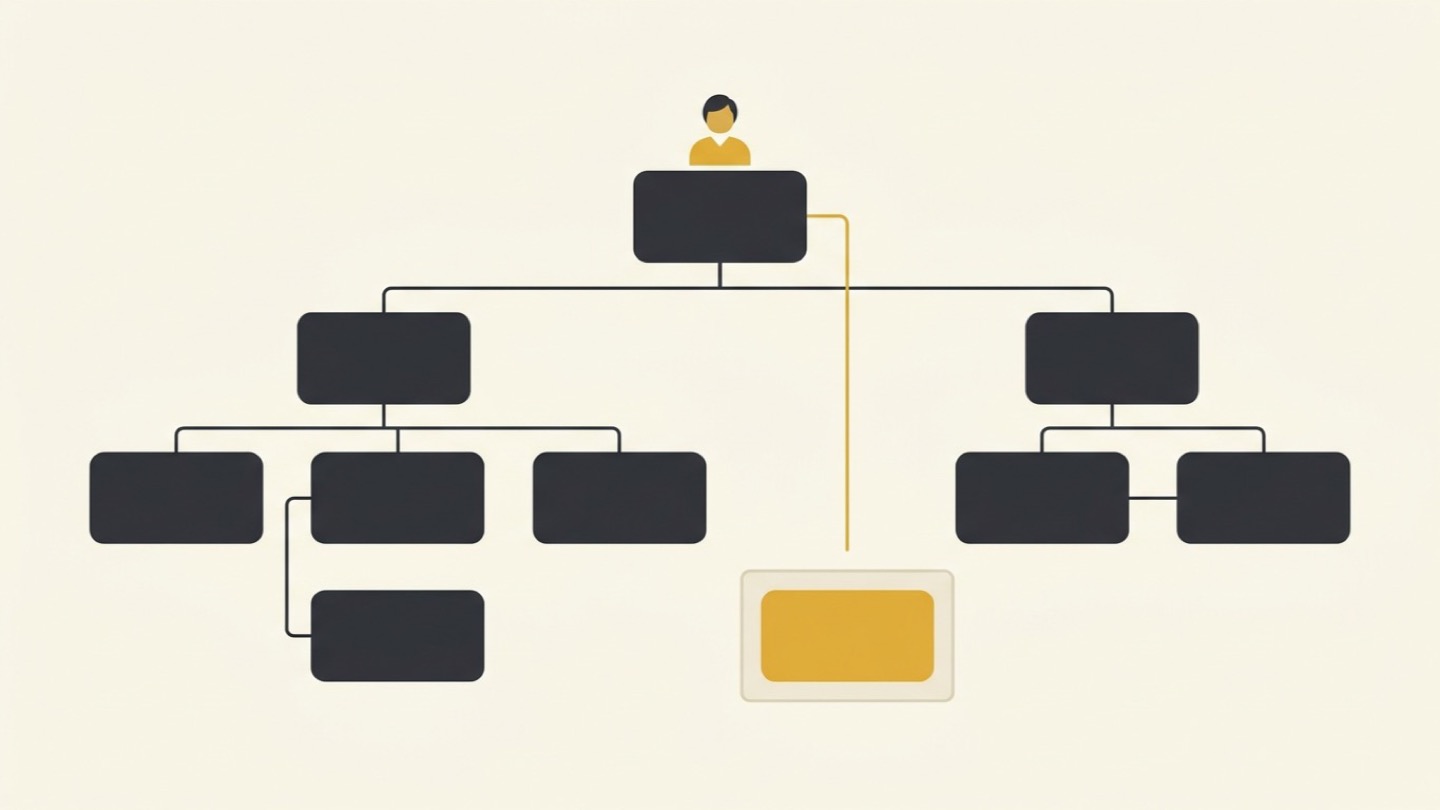

Does my company need an AI consultant, or can we handle AI transformation internally?
If your company has 50 to 500 employees and your AI initiatives have not moved beyond pilot stage after three or more months, you almost certainly need outside expertise.
MIT’s GenAI Divide report found that 95% of enterprise AI pilots fail to deliver measurable ROI — not because the technology fails, but because internal teams lack the cross-functional experience to navigate strategy, data, change management, governance, and execution simultaneously. The companies that scale AI successfully bring in consultants who have pattern recognition from doing this across dozens of organizations.
Source: MIT GenAI Divide 2025; Deloitte State of AI 2026; Pertama Partners AI Failure Statistics 2026.

Questions as you read? Ask, or take the twelve questions with you.
Where should we send it?
Sent ✓ Download it now →
The Conversation Most Leaders Are Avoiding
The question is whether you can afford the time it will take and the mistakes you will make along the way.
You have tried to figure out AI internally. It is not working the way you expected.
Maybe you bought a platform. Maybe you ran a pilot. Maybe you assigned it to your most technical person and told them to “explore what’s possible.” The tools are there. The budget is approved. And six months later, you are in exactly the same place — except now you have a subscription you are not fully using and a team that is quietly skeptical about the whole thing.
This is not a technology problem. This is a pattern we see in nearly every company between 50 and 500 employees that tries to navigate AI transformation without outside expertise. And the pattern has a name in the research: pilot purgatory.
MIT’s GenAI Divide report found that 95% of enterprise AI pilots fail to deliver measurable ROI. Not because the technology underperformed — because no one inside the organization had the experience to turn a successful experiment into an operational system. Deloitte’s 2026 State of AI survey confirms the gap: while 88% of organizations now use AI in at least one function, only one-third have begun to scale it.
The distance between “we use AI” and “AI is changing how we operate” is where most companies get stuck. And it is exactly the distance a consultant is designed to close.
Here are the five reasons that gap exists — and why your team, no matter how talented, is not equipped to close it alone.
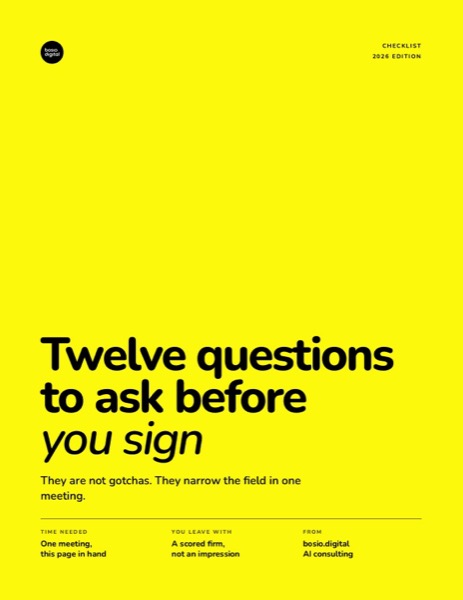
Twelve questions to ask before you sign.
Twelve questions, the red flag behind each answer, and a grid to score two firms side by side.
On its way. Check your inbox, or download it now →
Your Strategy Problem Is Not What You Think It Is
The first thing most companies get wrong is not the AI implementation. It is the AI strategy — or more precisely, the absence of one that connects technology decisions to business outcomes.
You have probably already made technology choices. You have selected a platform, or your team has started using ChatGPT, or someone in operations built a workflow with Claude. The tools are not the issue. The issue is that no one has answered the question that precedes every technology decision: what specific business problem are we solving, for whom, and how will we measure whether it worked?
This is not an obvious failure. It looks like progress. People are using AI. Demos are impressive. But Gartner’s research shows that 63% of organizations either lack or are unsure whether they have the right data management practices for AI — and that uncertainty extends to strategy. Through 2026, Gartner predicts organizations will abandon 60% of AI projects that are unsupported by AI-ready data and clear strategic alignment.
A consultant who has done this across dozens of companies sees the misalignment immediately. Not because they are smarter than your team — because they have pattern recognition your team cannot have. They have watched 30 companies make the same three strategic mistakes and they know what the fourth month looks like when you make them. Your team is seeing this for the first time. A good consultant is seeing it for the thirtieth.
And the most consequential strategic decision a consultant introduces is one most companies do not know exists: building a persistent AI context layer — the architecture that turns your company’s scattered knowledge, processes, and institutional memory into something AI can actually use. Without it, every AI interaction starts from zero. Every prompt requires re-explaining who your customers are, how your processes work, what your team has already decided. With it, AI compounds — each interaction builds on the last, and the system gets more valuable the longer you use it. This is the difference between companies that use AI as a tool and companies that use AI as a compounding operational advantage. Your team does not know this architecture needs to be built. A consultant who has implemented it knows it is the single highest-leverage investment in the entire engagement.
When you have someone who has navigated the full landscape of AI consulting approaches, the strategy conversation shifts from “what tools should we buy” to “what outcomes are we building toward and what is the fastest path to get there.”
The AI Briefing
Tuesdays. 500+ leaders. No hype, just what works.
The Data Problem You Cannot See From Inside
Every company believes their data situation is either fine or a disaster. Both assessments are usually wrong.
The companies that think their data is ready discover — once someone with implementation experience actually audits it — that their CRM has 40% duplicate records, their financial data lives in three systems that do not talk to each other, and the “clean dataset” their team built for the pilot was manually curated in a way that cannot scale. The data looked ready because no one had tried to use it at production scale.
The companies that think their data is a disaster discover something different: they actually have enough usable data to start, but they have been measuring readiness against an enterprise standard that does not apply to a 200-person company. They have been waiting for perfect when good enough would have gotten them to production six months ago.
Deloitte’s 2026 survey found that only 20% of organizations rate themselves as talent-ready for AI — the lowest readiness score across all five dimensions they measured, below strategy, governance, technical infrastructure, and data management. The people gap is the widest gap. And the data problem is, more often than not, a people problem in disguise: you do not lack data. You lack someone who knows what “good enough” looks like for your specific use case.
An experienced consultant does not just audit your data. They reframe the question entirely. Instead of “is our data ready for AI?” they ask “what data do we need for the three use cases that will generate ROI in 90 days, and how close are we?” That reframe — from abstract readiness to specific, use-case-driven assessment — is worth more than any data cleaning project you could run internally.
The Human Side Will Break Before the Technology Does
This is the one that catches every organization off guard. And it is the reason more AI transformations fail than any technical limitation.
Anthropic’s study of 81,000 people across 159 countries — the largest qualitative AI study ever conducted — revealed something that should reshape how every company approaches implementation: people’s primary concern about AI is not job loss. It is loss of autonomy and agency. The fear of becoming dependent on something they do not fully understand. The fear of their own judgment atrophying. The fear that the skills they spent years building will stop mattering.
These are not irrational fears. And they do not respond to a town hall presentation about “exciting new AI tools.”
Your team will resist in ways that look like something else entirely. It will look like skepticism about the technology. It will look like complaints about the interface. It will look like people finding reasons why their specific workflow “doesn’t work with AI.” What it actually is — every time — is a human response to a perceived threat that no one has acknowledged or addressed.
McKinsey’s data shows that 32% of organizations expect workforce reductions from AI while simultaneously trying to get those same workers enthusiastic about adoption. The contradiction is obvious from the outside. From the inside, leadership often cannot see it — because they are too close to the strategic rationale to recognize how it lands with the people who have to live with it.
This is where a consultant earns their fee several times over. Not by running change management workshops — by designing the implementation sequence so the human resistance never reaches critical mass in the first place. The right consultant knows that you deploy to your most enthusiastic team first, not your most important workflow. That you measure time saved before you measure headcount impact. That the internal narrative matters as much as the technical architecture. Your team knows the technology. A consultant who has been through this dozens of times knows the humans.
Twelve questions to ask before you sign.
Twelve questions, the red flag behind each answer, and a grid to score two firms side by side.
On its way. Check your inbox, or download it now →
Governance Is Not Optional and You Do Not Have It
Here is the uncomfortable truth about AI governance in most companies with 50 to 500 employees: it does not exist. There is no policy document. There is no review process. There is no clarity on what data the AI can access, what decisions it can inform, or who is accountable when something goes wrong.
And right now — today — your employees are using AI tools on company data without any of those guardrails in place.
Deloitte found that governance readiness lags every other dimension of AI maturity, with only 30% of organizations reporting adequate AI governance frameworks. For agentic AI specifically — the autonomous systems that are rapidly becoming the next deployment wave — only 21% of companies have a mature governance model. Gartner’s prediction makes the stakes explicit: through 2026, atrophy of critical-thinking skills due to AI use will push 50% of global organizations to require AI-free skills assessments.
Your company needs governance not because a regulator is coming — although in regulated industries, they are — but because ungoverned AI creates liability, inconsistency, and organizational risk that compounds silently until it becomes a crisis. The employee who feeds client data into a public AI tool. The sales team using AI-generated proposals that contain fabricated statistics. The HR department automating screening with a model that has undisclosed biases. These are not hypothetical scenarios. They are happening in companies exactly your size, right now.
Building governance from scratch requires expertise your team does not have — not because they are not capable, but because effective AI governance requires having seen how it breaks. A consultant who has built governance frameworks across multiple organizations knows which policies actually get followed, which ones become shelf-ware, and how to design the lightest-possible framework that still protects the company. Your governance framework should take weeks to build, not months. But only if the person building it has done it before.
The Speed Advantage You Are Losing Every Quarter You Wait
The final reason you need a consultant is the simplest and the most urgent: the window for building AI capability at a manageable pace is closing.
Right now, your competitors are in the same position you are — experimenting, uncertain, making incremental progress. The playing field is roughly level. That will not be true in 12 months. McKinsey reports that 23% of organizations are already scaling agentic AI systems with another 39% actively experimenting. The companies that move from pilot to production in the next two quarters will have a structural advantage that compounds: better data, trained teams, proven workflows, organizational muscle memory for AI-assisted operations.
The companies that are still “exploring” in Q4 2026 will face a different problem entirely. They will not just be behind on technology — they will be behind on the organizational learning that makes technology useful. And organizational learning cannot be purchased, fast-tracked, or compressed. It has to be earned through real deployment, real mistakes, and real iteration.
A consultant compresses the timeline from exploration to production. Not by doing the work for you — by helping your team skip the mistakes that cost other companies six months each. The average abandoned AI project costs $4.2 million according to Pertama Partners’ 2026 analysis, and mid-market companies abandon an average of 1.1 AI initiatives before finding the right approach. A consultant who has seen those failures does not eliminate the risk. They reduce it by an order of magnitude — and they get your team to the “learning from real deployment” stage months earlier than you would get there alone.
Every quarter you spend figuring this out internally is a quarter your competitors might be spending with someone who already knows the answers.
What the Right Consultant Actually Does
If the five gaps above sound familiar, here is what addressing them looks like in practice — not in theory, but in the first 90 days of a well-structured engagement.
Weeks 1–2: The honest assessment. A good consultant does not start by selling you a solution. They start by understanding what you actually have — your data reality, your team’s readiness, your existing tools, your governance gaps, and the three to five use cases where AI will generate measurable ROI fastest. This is where pattern recognition matters most. Your team sees your organization. A consultant sees your organization in the context of the 30 similar ones they have worked with.
Weeks 3–6: The focused build. Not a company-wide AI transformation. Not a 47-slide roadmap. A focused deployment against two or three high-value workflows — the ones where success is measurable, failure is low-risk, and the team involved is ready to learn. Simultaneously: a lightweight governance framework that covers the immediate risks without creating bureaucratic overhead that slows adoption.
Weeks 7–12: The handoff that matters. The difference between a good consultant and a dependency-creating one is what happens here. By week 12, your team should be running the AI workflows independently, measuring results against defined KPIs, and making decisions about what to scale next based on real operational data — not consultant recommendations. The goal is not a permanent advisory relationship. The goal is an organization that does not need one.
This is the sequence that turns “we use AI” into “AI is changing how we operate.” It is not complicated. But it requires someone who has run it before — because the sequencing, the pacing, and the human dynamics are where every DIY attempt breaks down.
What that engagement should produce for a mid-market company, phase by phase, and what you own when it ends, is laid out in our guide to AI consulting for mid-market companies.
The Decision You Are Actually Making
The question is not whether you can figure out AI internally. You probably can — eventually. The question is whether you can afford the time it will take and the mistakes you will make along the way.
The 95% pilot failure rate is not a commentary on the intelligence of the teams running those pilots. It is a commentary on the complexity of a challenge that spans technology, data, people, governance, and strategy simultaneously. Your team is almost certainly excellent at one or two of those dimensions. No internal team is equipped for all five — not because they lack talent, but because the experience required to navigate all five dimensions only comes from having done it across multiple organizations.
The companies that will have a meaningful AI capability in 2027 are not the ones that figured it out alone. They are the ones that were honest about what they did not know, brought in expertise to close the gaps, and used the time they saved to build real organizational capability while their competitors were still running pilots.
You have already identified that AI matters for your business. That was the easy part. The harder part — the part that separates the companies that transform from the ones that stall — is admitting that doing this well requires help.
When you are ready to have that conversation, start by understanding what kind of consulting partner actually fits a company your size. Then ask the eight questions that separate the firms that deliver from the ones that don’t.
Your competitors are making this decision right now. The only question is whether you make it first.
Sources
- MIT NANDA — The GenAI Divide: State of AI in Business 2025 (preliminary findings; research period January to June 2025; 300+ public AI initiatives reviewed, 52 organizations interviewed, 153 senior leaders surveyed)
- Deloitte — State of AI in the Enterprise 2026 (3,235 business and IT leaders across 24 countries)
- McKinsey — The State of AI in 2025 (global survey; 88% organizational AI adoption, 23% scaling agentic AI)
- Gartner — AI Readiness and Data Management 2025–2026 (63% lack data management practices; 60% abandonment prediction)
- Anthropic — What 81,000 People Want from AI (80,508 participants across 159 countries, December 2025)
- Pertama Partners — AI Project Failure Statistics 2026 ($4.2M average sunk cost per abandoned project)
Frequently Asked Questions
How do I know if my company actually needs an AI consultant?
If you have been using AI tools for more than three months without measurable business impact — time saved, revenue generated, costs reduced — you likely need outside expertise. Other indicators: your AI pilot has not moved to production, your team disagrees on what AI should be used for, you have no AI governance policy, or your data readiness is unknown. Companies between 50 and 500 employees are particularly vulnerable because they face enterprise-level complexity with lean IT resources.
What does an AI consultant actually do that my team cannot?
The primary value is pattern recognition from working across multiple organizations. Your team is seeing AI implementation challenges for the first time. An experienced consultant has seen the same failure patterns dozens of times and knows how to avoid them. Specifically, consultants compress timelines by helping you skip common mistakes, identify the highest-ROI use cases faster, design governance frameworks that actually work, and manage the human-side change dynamics that cause most AI projects to stall. McKinsey data shows only one-third of companies successfully scale AI — the consultant’s job is to put you in that third.
How much does AI consulting cost for a mid-market company?
AI consulting rates typically range from $150 to $400 per hour, with project-based engagements for companies with 50 to 500 employees generally running $25,000 to $150,000 depending on scope. However, the relevant comparison is not the consulting cost — it is the cost of failure without one. Pertama Partners’ 2026 analysis found the average abandoned AI project costs $4.2 million in sunk investment. A 90-day engagement that prevents even one failed initiative pays for itself many times over. For a complete breakdown by engagement model, company size, and scope, see our AI consulting pricing guide for mid-market companies.
Can we just hire an AI expert instead of using a consultant?
You can — and eventually you should build internal capability. But hiring takes three to six months, the AI talent market is extremely competitive, and a single hire cannot cover all five dimensions of AI transformation: strategy, data, people, governance, and execution. The most effective approach for companies in this segment is to engage a consultant for the initial 90-day sprint to build the foundation and prove ROI, then hire internally to maintain and scale what has been built. The consultant establishes the patterns. Your hire sustains them.
What if we have already tried a consultant and it did not work?
Most failed consulting engagements share one of three problems: the firm specialized in technology without addressing the human side, the engagement produced a strategy document instead of operational results, or the team you met during the sales process was not the team that did the work. These are exactly the failure modes our eight-question evaluation framework is designed to prevent. The right consultant delivers measurable outcomes in 90 days, builds your team’s capability rather than creating dependency, and defines success across all three dimensions — technical performance, business impact, and user adoption.
How long does it take to see results from AI consulting?
A well-structured engagement should produce measurable results within 90 days. Weeks one through two focus on assessment and use-case identification. Weeks three through six focus on deploying against two to three high-value workflows. Weeks seven through twelve focus on measuring results and transitioning ownership to your team. If a consultant proposes a six-month discovery phase before any implementation begins, that is a signal to look elsewhere. The companies that succeed with AI move quickly from strategy to deployment — the learning happens in production, not in planning documents.
What should mid-market companies prioritize first when working with an AI consultant?
Start with the use cases that have the highest ratio of potential impact to implementation complexity. For most companies with 50 to 500 employees, this means operational workflows like pipeline reporting, document preparation, email triage, meeting preparation, and CRM data management. These workflows are repetitive, rule-based, and data-dependent — which means AI handles them reliably, time savings are immediately measurable, and the risk of a failed attempt is low enough to learn from. Do not start with customer-facing AI or decision-making automation. Start where the wins are obvious and the stakes are manageable.